Friday, June 26, 2026

Is Life Always Messy?

-


Shabbat Table Talk from the desk of Rabbi Alexander Seinfeld
June 26-7, 2026 • 12 Tamuz 5786 • Chuk-Balak (Num 19-25)

AI-chef2Thank you to all those who showed appreciation for last week's joke-evolution post.

This week I received one of the biggest compliments of my life.

A 20-something who has started reading the Art of Amazement said to me,

"I can't believe you created this without AI!"

As most people have learned by now, there are two sure-fire ways to spot an AI creation

a) It made mistakes.
b) It's too perfect.

Think about the irony of what I just said.

Of course, (a) refers to mistakes that a human wouldn't make, like giving a person six fingers.

How dumb do you have to be to do that???

Sometimes the AI makes such obvious mistakes that I wonder if it's programmed to do that intentionally, in order to appear more human...??

Like when I prompted, "Give me a list of comments in the Talmud that could be called 'scientific'" and it simply invented them - entire quotations in Aramaic with tractate and page numbers.

But how about this:

In 2024, identical twin brothers Moshe and Yosef Mizrachi welcomed baby daughters into the world. On the exact same day. What are the odds?

​Flash forward exactly two years later (last week): God does a copy-paste.

Moshe and Yosef are back at Shaare Zedek Hospital with their wives who both gave birth on the very same day yet again.

​This time around: both babies are boys.

​Two identical twin brothers. Two different years. Four births. All falling on the exact same calendar days.

First twin girls, then twin boys.

Life isn't supposed to be so neat and perfect, is it? 

Or is life somehow better when it's a bit messy?

What do you think?


Shabbat Shalom

Friday, June 19, 2026

How Many Leaders Does It Take (to Change a Light Bulb)?

-


Shabbat Table Talk from the desk of Rabbi Alexander Seinfeld
June 19-20, 2026 • 5 Tamuz 5786 • Korach (Num 16-18)

millionPMsThere are many versions of this joke; it may be mere political folklore:

1. The Ben-Gurion & Eisenhower Version

Eisenhower lamented how difficult it was to be the president of 170 million people. David Ben-Gurion fired back: "You think that's hard? Try being the prime minister of two million prime ministers." 

2. The Golda Meir & Richard Nixon Version

During Golda Meir’s first state visit to Washington in September, 1969, seeking critical military aid, Nixon suggested she didn't appreciate the difficulty getting things done in America: "Madam Prime Minister, you have to understand, it's difficult to get things done here, America is not like Israel; I'm the president of 150 million Americans."

Meir countered, "Mr. President, I assure you I do understand, and if you think that your job is difficult, consider: I am the prime minister of three million prime ministers!"

3. The Charles de Gaulle Version

The joke is so perfect for capturing a national psyche that it actually collided with another famous quote. French President Charles de Gaulle famously grumbled in front of Golda Meir, "How can you govern a country which has 246 varieties of cheese?" Meir responds: "Can you imagine how difficult it is to lead a country that has three million prime ministers?"

4. The Shimon Peres Version

When Shimon Peres served as Prime Minister, he frequently retold this joke on the international diplomatic circuit, but he updated the numbers to reflect Israel's late-20th and early-21st-century population booms. He would often tell American or European dignitaries: "You are the leader of millions of citizens. I am the prime minister of seven million prime ministers."

5. The Benjamin Netanyahu Defense-Minister Version

In more recent decades, the joke evolved to reflect how specialized and deeply invested the Israeli public is regarding military and security strategy. Bibi and other modern Israeli politicians have occasionally shifted the punchline slightly to fit cabinet roles, joking: "It is not hard to be the Defense Minister of a country. What is hard is that I am the Defense Minister of nine million Defense Ministers, all of whom know exactly how the military should be run better than I do."

6. The Restaurant Kitchen Version

"Running a Michelin-starred kitchen isn't about cooking. It's about trying to convince a room full of twenty-something culinary school graduates—all of whom think they are the next Gordon Ramsay—to stop reinventing the menu for five minutes and just chop the onions."

7. The Software Engineering Version

In tech, there is a famous axiom known as Sayre’s Law ("In any dispute, the intensity of feeling is inversely proportional to the value of the stakes at issue"), which engineers turned into a classic industry joke: 

"If you ask a team of 50 senior software engineers to build a nuclear power plant backend, they will approve it in ten minutes without looking. If you ask them what color to paint the bicycle shed in the employee parking lot, you will get 50 different blueprint designs and a three-week corporate civil war."


This joke is funny because it reveals a truth. Question for your table: What is that truth? And if it's true, is it inevitable? (Is there a version of this joke that works for your place of work or family or social setting?)


Shabbat Shalom


This message may also be read at Times of Israel.
Appreciated this Table Talk? Like ittweet it, email it...  


Friday, June 12, 2026

Who's In Recovery?

-


Shabbat Table Talk from the desk of Rabbi Alexander Seinfeld
June 12-13, 2026 • 28 Sivan 5786 • Shelach (Num 13-15)

MezuzadoveHow did you do with last week's no-complaining challenge?

Speaking of changing habits, yesterday I had the pleasure of speaking at a Jewish men's recovery house.

People in addiction recovery are the most amazing people. They are turning their lives around in a profound way. They have decided that they want to travel on a different path that is less harmful to themselves and their relationships.

It's incredibly hard but they are doing it, and learning to take it one day at a time.

So why a "recovery house"? And what might make it "Jewish"? And why do you suppose they call it being "in recovery"????

I'll leave those questions for your dinner table discussion. I hope it will be fruitful.


Shabbat Shalom

PS - For a Torah perspective on addiction, click the above image.

Thursday, June 04, 2026

Is Complaining Ever Justified?

-


Shabbat Table Talk from the desk of Rabbi Alexander Seinfeld
June 5-6, 2026 • 21 Sivan 5786 • Behalotecha (Num 13-15)

complaintboxI know someone who wanted to kick the habit of complaining. What did he do?

Every day, he updated a line in his email signature: 

"___ days of no complaining."

That's called accountability.

And it suggests a couple questions for your Shabbat table:

1. Would that system work for you?

2. Would that system work for changing other habits? How about eating habits?

3. What's wrong with complaining anyhow?

Regarding the latter question, it seems to me that most complaining is un-constructive (at best):

"It's boiling outside!"
"It's freezing outside!"
"This company has the worst customer service!"


And so on. 

And those are benign examples. It can be worse:

"You're always late."
"You're so messy."
"You're a neat-freak."


It seems to me that complaining is like finger cracking—it's a habit that relieves some tension for the person doing the complaining but annoys everyone else.

(It also seems to me that there is a difference between a complaint and a request. Asking for something to be different is not the same as merely complaining about it—even if the complaint is intended to provoke change. What do you think?)

So this is a question for all complainers out there (which may be any one of us at any given time): What's more important, is releasing your tension by complaining worth it even if it brings everyone else down? Is there any other way a person could cultivate to release that tension?

Expert hack: If you feel an urge to complain, go ahead and let it out, but then add something positive. For instance: "The store was packed today... but I found everything on my list!"

Shabbat Shalom


Thursday, May 28, 2026

Who Invented the "Jewish Soul"?

-


Shabbat Table Talk from the desk of Rabbi Alexander Seinfeld
May 28-29, 2026 • 13-14 Sivan 5786 • Naso (Num 4-7.

Who Invented the "Jewish Soul"?

Not-in-heavenLast week's topic — Once Upon a Time a Jew? (a true story of a lapsed convert) — struck a chord with many people, but not all for the same reason.

For some, the issue of membership in the Tribe is one of sincerity—if you're a sincere convert, how could you possibly revert to your previous idolatry?

For others, the issue is one of kindness—it's the community's responsibility to welcome and nurture the stranger.

For others the main issue is neither legal nor social, it's spiritual—about gaining a "Jewish soul."

Yet as one person wrote,

I've always wondered about the Jewish Soul, if it exists, when it comes online for converts, or if it's always been there. The people I've seen rail against the idea so clearly have one, whereas the people who push the idea, I'm not so sure about. and what does that mean for those of us, that no one can figure out their halachic status? that one day we have a jewish soul, the next we don't, depending on paperwork? at a certain point, it's absurd.

Her sense of absurdity comes (I believe) from the fact that you won't find any mention of a "Jewish Soul" in the Written Torah, only in the Oral Tradition.

Perhaps that fact points us to what's ultimately at stake but also to a resolution to the feeling of absurdity.

What's at stake is the fundamental nature of Torah. Is Torah—including its application to real-world questions—in Heaven or on Earth?

If the Talmud famously insists that the Torah is lo b'shamayim hee (it is not in Heaven), then perhaps the soul operates by the same rule. Is holiness something dropped perfectly from heaven, governed by rigid, celestial paperwork? Or is it realized here on Earth, through the deeply human process of wrestling with identity, law, and community?

If the tradition tells us that the Torah is not in heaven, is it possible that the soul isn't either? Is it perhaps found—and forged—right here in the struggle?

What do you think?


Shabbat Shalom

This message may also be read at Times of Israel.
Appreciated this Table Talk? Like ittweet it, email it...  

Thursday, May 21, 2026

Once Upon a Time a Jew?

-


Shabbat Table Talk from the desk of Rabbi Alexander Seinfeld
May 21-23, 2026 • 6-7 Sivan 5786 • Tomorrow: Shavuot (Exod 19-20); Shabbat: Naso (Num 4-7in Israel; Shavuot II (Deut 14-16 everywhere else.

jewishhead

Shavuot—beginning tonight—is our annual occasion to revisit the meaning of "Torah" and our relationship to it.

In Ramban's teaching, it's truly the 8th day of Passover when our freedom  journey reaches it's climax. 

As Rav Hirsch says throughout his Commentary, moral freedom requires Torah. So when we contemplate and embrace the Torah on Shavuot, we are contemplating and embracing moral freedom.  

But what happens if someone has a change of heart?

For instance, what if a Gentile embraces the Torah but then later changes her mind?

Everyone knows that Judaism doesn't seek converts but welcomes them. 

But is that a one-way journey or a revolving door?

This topic was broached this week by an individual who had indeed experienced such a change of heart. In her own words:

A year or so after my conversion and after marrying my now husband, I've been so disgustingly disappointed in my community. They started rumors about me not being 'really Jewish' or not Jewish enough since I eat kosher at my family's homes, etc. I'm so hurt by the whole thing I've gone totally OTD. I relinquished all association with Judaism, my husband too. I haven't gone back since hearing this. I write this since it's a different and rare experience after converting orthodox, since nobody really talks about leaving, ever. I don't want to bring anyone down, just sharing my experiences.​

She then went on to describe how her ongoing search for meaning has led her to embrace Christianity.

Leading back to our first question:

Is she still Jewish? Was she ever Jewish? What do you think?


Wishing you and yours a 

Chag Shavuot Sameach (tonight and tomorrow) and a

Shabbat Shalom


Friday, May 15, 2026

Alt-Right, Musk-Left?

Shabbat Table Talk from the desk of Rabbi Alexander Seinfeld
May 15-16-9, 2026 • 29 Iyar 5786 • BeMidbar (Num 1-4).

muskaltman1This public squabble between billionaires lends itself to so many Table Talk-worthy discussion questions.

One, as you know, happens to be Jewish, while the other is a classic Jew-hater.

(Forgive me for not using the term anti-Semite; doing so honors and perpetuates its origins as a way to high-brow Jew-hatred.)

I'm happy to see that the Paper of Record has finally come clean on its Jew-hatred. It has been an open secret for decades, but until now they've managed hide it in a mere anti-Israel slant, seducing many thoughtful people who would otherwise have cancelled their subscriptions long ago. Now anyone with a moral compass must respond in the only language that the Times will understand. Moreover, why would you want to give a dime to such an organization? 

The fact is that these very public events give us an opportunity for self-reflection and the following question for your table: 

The Jew-haters seem to think that Jews matter (for the wrong reasons); what do you think? Do we matter for the right reasons?


Wishing you and yours a 

Shabbat Shalom,

Chodesh tov (Sunday), and

Chag Shavuot Sameach (Thursday night/Friday)


Friday, May 08, 2026

Labor of Love?


Shabbat Table Talk from the desk of Rabbi Alexander Seinfeld
May 8-9, 2026 • 22 Iyar 5786 • BeHar-Bechuk. (Lev 25–27).

NewBodycover-front-3drevThis morning I watched a neighbor gingerly walking—with a walker and two helpers—from her house to a minibus that takes seniors to an activity center.

She has been our neighbor for 25 years. Her decline has been steady downward slope. And from what I can tell, mostly due to inactivity.

It is a fact, first recorded in Pirkei Avot, that left alone, your muscles will naturally start to disappear after age 30, accelerating each decade. 

With muscle training—as little as five minutes a week for each muscle group!—you can slow, stop, or even reverse the decline.

On that note, you may have noticed that it has been awhile since I updated you on the Torah Health and Wellness program/project.

First of all, on the theme of getting stronger, if you click on the above link, our "I Wanna Dance At My Grandchildren's Weddings" daily workout schedule. 

No, walking/swimming/elliptical/cycling is NOT enough. 

(BTW, the website has many updates on both the homepage and deep inside—if you are interested in the latest inspiration and information on being healthy, you may want to look around.)

Now, if you are a creative person you can probably relate to the following.

Even before the book was published in June, 2023, I was already working on a 2nd edition. 

At first it was tiny tweaks, fixing typos and so on. But slowly the 2nd Edition took on a life of its own... The improvements are on nearly every page. 

I do believe that we will have it available by Rosh Hashanah. But because the matter (for some people) is urgent, I decided to move the e-Book forward faster. I know that most people prefer a hard copy but those of you who read e-books may want to check it out—and I'd love to hear your feedback. The format allows me to make edits pretty quickly. The above link takes you to the e-Book (Kindle) page on Amazon (not yet ready for Apple's iBooks).

Please note—I uploaded the new file this morning, so it may take an hour or two before the site updates. If the image on the website looks like the above (with the REVISED AND EXPANDED bar), then you know it's the 2nd Edition.

Wishing you and yours a 

Shabbat Shalom

(v'Healthy)


Friday, May 01, 2026

How Do You React?

Shabbat Table Talk from the desk of Rabbi Alexander Seinfeld

May 1-2, 2026 • 15 Iyar 5786 • Emor (Lev 21–24).


spilledwineLast week's theme (

"Trouble With a Capital 'T'") was about an inward struggle.

This week, outward.

Scenario #1:

You have company at your dinner table. It's Shabbat, there's a white tablecloth (did you know that's a mitzvah?) and the nicer dishes and so on.

One of your guests is a bit clumsy and spills his wine—that's red wine.

Question for your table: how do you react?

Scenario #2 - your sitting at the dining room table with a book open—not a cheap paperback, but an expensive hardcover book, let's value it at least a $100. Someone (maybe your spouse or other member of your family) brings you a cup of juice or tea or other colorful beverage, and while setting it down, it sloshes onto your book.

How do you react?

These exact scenarios occurred in the lives of two famous rabbis, and their reactions should be instructive to all of us.

In the first scenario, the rabbi was Rav Yisoel Salanter zl and his immediate reaction was to spill some of his own wine and remark, "This table sure is wobbly!"

In the second scenario, the rabbi was Rav Moshe Feinstein zl. The expensive book was the Talmud and the liquid was ink and the spiller was his wife... his immediate reaction was, "That's actually a very pretty color!"

If you think about it, when someone makes a mistake, they already feel bad enough about it, why should you rub it in?

Our job is not to hit them over the head, it's to say, "You are 100% loved despite your mistake and what you have done did not diminish that even a bit!"

Easier said than done, no?


Shabbat Shalom

Thursday, April 23, 2026

Oh, We Got Trouble... With a Capital "T"...

-


Shabbat Table Talk from the desk of Rabbi Alexander Seinfeld
April 24-25, 2026 • 8 Iyar 5786 • Achrei-Kedoshim (Lev 16–20).

Emoji poolHere's a question for your table:

Can you complete the following sentence in a way that anyone could say it truthfully:

"Someone I know is trying to __________, but it's a struggle."


Everyone is struggling with something, right? So I guess in that broad sense, we can be sympathetic and supportive.

But are everyone's personal struggles so particular to them that there is no comparison? Or are there any struggles that are more universal than others? 

It seems to me that one could put it this way:

"Someone I know is trying to change a long-standing habit, but it's a struggle."

One of the core teachings of Jewish wisdom is the universality of the struggle.... Knowing that you and I broadly share the same struggle is a great motivator. In that sense, it's a level playing field.

Whether the habit is food-related, or vaping, or time management, or patterns of speech (like a perpetual complainer), there is a universal human challenge of reclaiming autonomy from a habit.

Try shifting your thinking from, "I'm doing something wrong" to ""I'm caught in a universal trap, and here is the roadmap to get out."

Everyone is indeed struggling with something—usually, it’s the gap between who they are and who they know they could be.


Shabbat Shalom

This message may also be read online at Blogspot and Times of Israel.
Appreciated this Table Talk? Like ittweet it, email it...  


Friday, April 17, 2026

How To Make the Best Bourbon?

-
 
 
Shabbat Table Talk from the desk of Rabbi Alexander Seinfeld
April 17-1181, 2026 • 1 Iyar 5786 • Tazria-Metzora (Lev 12-15).

NewRiffOutside of the boutique world of whisky connoisseurship, it takes a minor miracle for a bottle of bourbon to make the mainstream media.
 
Forbes readers saw the headline, “World’s Best Bourbon Costs Only $40.”
 
For a business audience, as for a bourbon drinker, that’s mildly interesting news.
 
But for a Jewish reader looking behind the headlines, there’s a far greater story.
 
Whisky is chametz (leavened) and therefore must be sold or destroyed prior to Pesach. After Pesach, any chametz that was not sold becomes permanently non-kosher. While New Riff whiskies are all Pesach-compliant, that was not always the case.
 
New Riff President Mollie Lewis explained that her family-owned business’s transition to Pesach observance began decades ago when her father Ken operated a retail boutique, the Party Source.
 
“Some of our best customers and close friends are Orthodox Jews. Starting in the early 2000s, Ken would sell all of the chametz to someone for the period of Passover, then buy it back, and he continued that tradition into New Riff.... We have a rabbi who officiates. It’s a wonderful thing—it’s our nod to our history, it’s our nod to our consumers, and we just believe it’s the right thing to do.”
 
Lewis made that comment on a December, 2020 podcast interview with Rabbi Drew Kaplan.
 
But several details in her comments caught the attention of astute listeners who questioned the halachic validity of the sale, including describing it as “very informal.”
 
Since halachah requires the sale of chametz to be made with a formal, legally-binding contract, Lewis’s comment suggested that the necessary legal and religious rigor may have been absent.
 
Rabbi Kaplan describes what happened:
 
“While on the show, one question we discussed regarded their selling of their whisky for Passover, as it is chametz, which ostensibly sounded satisfactory. However, thanks to the thoughtful listenership of the show, I received questions as to what the actual situation was concerning their selling of their chametz and discovered that, while they were used to having sold their chametz, owing to the beginning of the COVID-19 pandemic only a few weeks prior to Passover, they had a lot going on and it did not end up happening in 2020.”
 
As a result of the interview (and the listener inquiries), New Riff Kosher formally engaged Cincinnati Kosher to certify their products beginning in 2021.
 
Now, a whisky matures in the barrel for at least four years. Therefore, the first kosher New Riff reached the market in 2025. And that’s the year it started winning major awards, including two double gold medals at the John Barleycorn Awards and their Balboa Rye being ranked fourth in the world by Whisky Advocate.
 
But the biggest honor came at the World Whisky Awards—held on February 8, 2026, where their very first strictly kosher whiskey was named World’s Best Bourbon.
 
Judges described the New Riff Bourbon as “lemon zest and butterscotch on the nose,” leading to “a bright palate with cinnamon, caramel, fresh fig, vanilla cookie, sweet pastry, dried leather, pumpernickel rye, corned beef and brine.” One finishes the experience with the taste of “caramel, lemon peel, crumb cookie and coffee.”
 
As compelling as that whisky surely is to the palate, New Riff has also achieved spiritual greatness: the Lewis family’s heightened attention to kashrus has been followed by grants and other support for the Cincinnati Jewish community.
 
If whisky is your favorite l’chaim, and Kentucky Bourbon is your favorite whisky, then a world-class vintage selling for $40 a bottle is surely something to toast. And knowing that the Lewis family has raised the spiritual bar for their company surely gives greater simcha to every glass.


Shabbat Shalom ... and l'Chaim!

This message may also be read on Times of Israel.
Appreciated this Table Talk? Like ittweet it, email it...  


Friday, April 10, 2026

How To Get Post-Matzah Traction?

-
 
 
Shabbat Table Talk from the desk of Rabbi Alexander Seinfeld
April 10-11, 2026 • 24 Nissan 5786 • Shemini (Lev 9–11).

AvosTreasuryFirst question for your table: How did you break your "fast" last night?

If you recall from two weeks ago, I suggested we all start pursuing "RI" instead of "AI". 

Go ahead and use AI, but don't pursue it. What we should all be pursuing is RI.

And where would you guess is the first go-to source of RI?


It's our great book called Pirkei Avot. Here's a nugget:

If I'm not for myself, who will be for me?

And if I'm only for myself, what am I? 

Heard that one before?

How about this one: 

The world stands on three things: Torah (wisdom), Avodah (spirituality), and Chesed (acts of kindness). 

Most people excel at one of these at least, some excel at two of them. 


Second question for your table: Should one try to 
excel at all three?

For the full RI-value, we recommend a good translation with commentary. Our top 3 picks for adults, youth, and children are here.


Shabbat Shalom ... enjoy your challah!


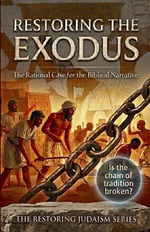
PS - In case you missed the announcement before Pesach, check out our new book: Restoring the Exodus: The Rational Case for the Biblical Narrative. 


Friday, March 27, 2026

Enough With AI, How About Some RI?

-


Shabbat Table Talk from the desk of Rabbi Alexander Seinfeld
March 27-28, 2026 • 10 Nissan 5786 • Tzav (Lev 6-8).

RI-LOGO2RI? (If you're reading this at the dinner table, try asking if anyone can guess what that stands for...) 

RI refers, of course, to "Rabbi Intelligence."

In classical Jewish thought, there are two kinds of rabbi, A-Rabbi and B=Rabbi.

An A-Rabbi is an Authority figure. Think Moses—tall, long beard, super firm handshake. This is a guy you're going to listen to (if you know what's good for you). 

Now, although Moses has passed on to the next world, he appointed a successor, and his successor a successor, and so on, and we have rabbis today who can trace their authority all the way back up that chain.

B-Rabbi is a Buddy. It could be your neighbor. It could be your friend. It could be... YOU. Rabbi B may not be in the chain of authority, but there's another chain that everyone can connect to—the chain of learning.

The original author of the Haggadah was certainly a B-Rabbi and most likely an A-Rabbi as well. With his (likely but not necessarily it was a he) erudition, he crafted a learned text for fellow B-Rabbis to use at their Seder.

Herein lies the problem for modern Jews. How many of us are B-Rabbis who can appreciate the depth and breadth of this masterpiece called the Haggadah?

So we have thousands of commentaries—cheat sheets, if you will—to raise the bar and turn a lay person into a B-Rabbi at the Seder.

But there's one small catch: in order to succeed in the B-Rabbi business, you'll need to... (ahem)...study

There, I said it. I said it and I know I'll get flack for it.

Because who wants to study a 2,000-year-old text just so that I can have a Seder? If we understood the Haggadah better, wouldn't that risk making our Seder more meaningful and then take longer? Isn't the point to get through it as fast as possible?

If this conundrum speaks to you, then you probably are the target audience for the Art of Amazement Haggada and you definitely need the 2026 JSLI Passover Kit - a ZIP file of over 15 great Seder resources (PDF of full haggadah, bingo cards, charades, etc. etc.). To get the Kit, you can click here.

Question for your table: What's the perfect length for a Pesach Seder?


Shabbat Shalom and

Chag Sameach


PS - this year's Kit includes our "Healthy & Holy Passover" excerpt from Body & Soul, which you can also find via TorahHealth.org.

PPS - 
Don't forget to get a copy of the new book - Restoring the Exodus: The Rational Case for the Biblical Narrative — we recommend gifting the pocket-size paperback version to every adult at the Seder


Friday, March 13, 2026

A Tactless Attack Tactic?

-


Shabbat Table Talk from the desk of Rabbi Alexander Seinfeld
March 13-14, 2026 • 25 Adar 5786 • Vayakeil-Pekudei (Exod 35-40).

Cover-best1bKeep reading for a big announcement! (the image at the left is a hint)

To prepare you for it, here's a question for your table: What's worse - when they attack us physically or spiritually?

For many people, one of the highlights of the Passover Seder (in two weeks and change!) is the song, V'he sheh amda.... 

V'hee she'amda lavoteinu velanu
Shelo echad bilvad amad aleinu lechaloteinu
Eh'la she'b'chol dor va'dor
Omdiim aleinu lechaloteinu
Vehakadosh baruch hu matzileinu miyadam


And this is what kept our ancestors and what keeps us surviving. For, not only one arose and tried to destroy us, rather in every generation they try to destroy us, and God saves us from their hands.

(Here's a group of yeshiva guys singing this week it in a bomb shelter while awaiting their Rabbi to begin the class).

If you don't know the song, start learning it today and by the time Pesach arrives you'll sing it like a pro.

So when they're attacking us in Israel, we understand that because we're "occupiers" or "land stealers." Even in New York we could maybe imagine it's a sociological issue, you know such population density. 

But why are they attacking us in Lyons, Bondi Beach, Jackson, and now Detroit?

The truth is that their hatred is mostly religious, sometimes cloaked in tactful politesse.

Just look at the recent ruling of the European Court of Human Rights: the old Wittenberg Cathedral (home of Martin Luther himself, a major amplifier of this hatred) may continue to display on the outside wall one of the most hideous, disgusting, offensive, painful Jew-hating images ever created - the "Jew Pig."

What was the Court's reason? Because the congregation had installed a plaque nearby declaring that this sculpture is historical but doesn't reflect their modern sensibilities.

Oh really?  

BTW - there are about 30 churches in Europe that choose to continue to be adorned with a "Jew Pig."

(Hat-tip to Michael Duelman, who fought this legal battle for nearly a decade.)


One of the biggest attacks on us has been the 150-year-old battle against our national holiday - Passover.

The central ritual of Passover is to tell the story of the Exodus. But if the Exodus never happened, then apparently our entire religion is a mythology.

Personally, I have no problem believing in and telling a story that my parents and grandparents told me.

But these attacks — some by Jewish clergy — have confused people. Is Judaism ultimately a fairy tale? Does the Torah belong on the same shelf as Aesop's Fables — some nice moral lessons, but with no greater verisimilitude than any other mythology?

To respond to these attacks, I'm pleased to announce a new book - Restoring the Exodus: The Rational Case for the Biblical Narrative

Hardcover
Kindle version
iBooks version

You don't need to wait long for the paperback (pocket-size)... it should be available on Sunday. Just in time to order a stack for your Seder.


Shabbat Shalom


PS - You can now get our free Passover download at TorahHealth.org.


Friday, March 06, 2026

You'll Never Believe These Numbers...

-


Shabbat Table Talk from the desk of Rabbi Alexander Seinfeld
March 6, 2026 • 18 Adar 5786 • Ki Teitsei (Exod 30-34).

NumbersSo much has happened since last week's Clothes Encounters of the Jewish Kind message, it's hard to wrap your head around it.

(In case you don't follow my podcasts, here's one on the theme of the war and Purim: 
What Can YOU + I Learn From ʞǝlɐɯ∀?)

The language of numbers is a useful tool for helping think about big things.

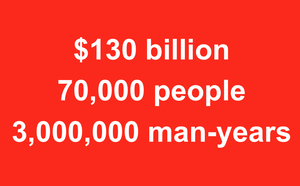
Try asking this at your table: How much money would you guess that the nation of Iran has invested over forty years in the singular effort to destroy Israel? How many people would you guess have been involved - full time - in this "Project" ???

I put these two questions into an AI-bot to crunch the numbers. Here are some results:

CategoryEstimated Direct Cost (1982–2026)
Proxy & Regional Militias$45 billion – $55 billion
Missile & Drone Programs$25 billion – $35 billion
Nuclear Infrastructure (Direct)$30 billion – $45 billion
TOTAL DIRECT SPENDING$100 billion – $135 billion

For comparison, that "investment" represents the sum of three years' wages for every Iranian family. It could have fed every Iranian for six years.

How many people have been working on this "Project'?

CategoryAvg. Full-Time PersonnelTotal Man-Years (Estimated)
Quds Force / IRGC Leadership8,000352,000
Hezbollah (Core Regulars)12,000528,000
Hamas / PIJ (Militant Wings)15,000660,000
Strategic Weapons (R&D/Mfg)25,0001,100,000
Regional "Axis" Militias10,000440,000
TOTAL~70,000~3,080,000

The effort spent on the Project is roughly equivalent to running the entire Iranian healthcare system for nearly a decade, or providing a full year of education for every child in the country for several cycles. The human capital diverted into clandestine warfare has created a reality where there is one full-time "proxy/agent" for every two nurses in the country.

Here's another comparison chart:

CategoryCost Per FamilyWhat it could have bought instead
Proxy Funding~$1,800High-speed internet and a modern laptop for every student.
Nuclear Program~$1,400A state-of-the-art regional hospital in every major district.
Missile/Drone Dev~$1,587A 10-year supply of drought-resistant irrigation for every farm.

The economy has reverted to "pillow" wealth - Iranian households hold around 250 tons of gold coins and jewelry - more than the official gold reserves held by the Central Bank. Rumors of nationalization of private gold has triggered chaos in the streets. This week there has been a surge bartering gold directly for essentials like medicine, satellite internet terminals, and fuel. The gold sections of the major Bazaars in Tehran, Isfahan, and Shiraz have effectively shut down. Merchants are refusing to open their shops, fearing that the "Interim Council" will send security forces to seize their inventory.

So their 40-year national
 "Project" has now reached its final irony: the state is asking the people to hand over their gold to pay for the very drones and missiles that triggered the Israeli/American strikes now destroying the country’s infrastructure.

According to traditional Jewish sources, when a country - like Nazi Germany or Shia-Iran - becomes singularly focused on killing Jews, it is by definition "Amalek."

Seeing that being dismantled before our eyes is joyous. The job isn't yet complete, but there is every reason to be happy and grateful to have lived to see this moment in history.

The Jewish People have made many mistakes in the past 3,300 years, not least of which was (in this week's Torah Portion) building the Golden Calf. We are far from perfect. Our greatness comes out when we (a) admit and fix our mistakes and (b) unite under the banner of "love your neighbor."

May we continue to hear and share good news.


Shabbat Shalom


PS - You can now get our free Passover download at TorahHealth.org.

Appreciated this Table Talk? Like ittweet it, email it...