Showing posts with label meaning. Show all posts

Friday, January 07, 2022

Dying to Regret?

The purpose of this blog is a no-regrets Shabbat table....please print and share...

Happy Birthday shoutout to Donna in Tacoma!

5 Regrets bookHave you ever heard of Bronnie Ware?

Me neither, before this week.

(I was not even aware that "Bronnie" existed as a given name, perhaps because I've never been Down Under. Today, however, I am Bronnie aware.)

Bronnie's story dovetails with last week's light-hearted comparison of Queen Elizabeth and Pharaoh.

(By the way, I was surprised that no one pointed out another parallel - Queen Elizabeth and Pharaoh have the distinction of being the longest-reining monarch in their country's history.)


Today's dovetail is about people who are fortunate to live long lives but sadly approach the end of their years with regrets.

Bronnie Ware is an Australian nurse who turned her patients' dying regrets into a virulently-popular blog who then turned the blog into a best-selling book (who then turned the book into a new career).

Before we spill the beans, try asking this at the dinner table:

What would you guess are the top 5 regrets of average people on their death bed?

Here is Bronnie's list (along with her comments):


1. I wish I'd had the courage to live a life true to myself, not the life others expected of me.

"This was the most common regret of all. When people realise that their life is almost over and look back clearly on it, it is easy to see how many dreams have gone unfulfilled. Most people had not honoured even a half of their dreams and had to die knowing that it was due to choices they had made, or not made. Health brings a freedom very few realise, until they no longer have it."

2. I wish I hadn't worked so hard.

"This came from every male patient that I nursed. They missed their children's youth and their partner's companionship. Women also spoke of this regret, but as most were from an older generation, many of the female patients had not been breadwinners. All of the men I nursed deeply regretted spending so much of their lives on the treadmill of a work existence."

3. I wish I'd had the courage to express my feelings.

"Many people suppressed their feelings in order to keep peace with others. As a result, they settled for a mediocre existence and never became who they were truly capable of becoming. Many developed illnesses relating to the bitterness and resentment they carried as a result."

4. I wish I had stayed in touch with my friends.

"Often they would not truly realise the full benefits of old friends until their dying weeks and it was not always possible to track them down. Many had become so caught up in their own lives that they had let golden friendships slip by over the years. There were many deep regrets about not giving friendships the time and effort that they deserved. Everyone misses their friends when they are dying."

5. I wish that I had let myself be happier.

"This is a surprisingly common one. Many did not realise until the end that happiness is a choice. They had stayed stuck in old patterns and habits. The so-called 'comfort' of familiarity overflowed into their emotions, as well as their physical lives. Fear of change had them pretending to others, and to their selves, that they were content, when deep within, they longed to laugh properly and have silliness in their life again."


Final question for your table: her data set comes from people who all were confined to nursing homes at the end of their lives. Would you expect that a broader sample would yield different top regrets?

Shabbat Shalom


PS -  There are 10 ways to hear this week's highly-acclaimed 10-minute Body & Soul podcast, "A Drop of Golden Sun" :

iTunes/iPhone … YidPod … Spotify … Google Podcasts … Pocketcasts … Stitcher … Podbean … Amazon Podcasts … RSS … or just on the web.

Appreciated this Table Talk? Like it, tweet it, forward it....


Friday, October 16, 2020

Why on Earth Are You Here-o?


The purpose of this blog is to make the Shabbat Table epic. Please print and share.

Dedicated to the memory of Yermiyahu Matan (Jeremy Dossetter) - whose yahrzeit was this week (please remember him here);
Happy birthday shout-out to his dear mother Susan;
and Mazal tov to Yaakov Felson on becoming bar mitzvah. 

Announcement: To become a partner in the publication of groundbreaking new book, Body and Soul: A Torah Guide to Health, Fitness, and Longevity, Medically-Annotated, it is now possible to contribute a dedication in someone's honor or memory to be printed in the book, please send an email to dedications@jsli.org for instructions and may the merit of your contribution uplift them and the Jewish People and the world. Eight years in the making, this collaboration of Torah scholars, doctors and dietitians will, we hope, change the way we relate to our bodies and to food.

Hero-

Try starting off the conversation with this couplet:

Who's your hero?
Whose hero are you?


I wonder how many people think about such questions. Or about this week's title question....

Why in the world are we here?
Surely not to live in pain and fear....

The question is arguably the fundamental problem driving the entire Torah.

It seems to me the Torah's answer to that question is: You're here to be a hero.

Like all great heroes, you only become a hero through trial and tribulation.

Of course, the tests often come when we're least expecting them. The surprise too is part of the test.

So here is a true story that happened to my friend the other day.

He was filling up at a service station near the highway. Two women approached him and told him that they were en route to the airport, but the person driving them had ditched them while they were using the ladies' room. He had driven off with their luggage. 

For your table: Put yourself in his shoes. What would you do?

Less dramatic versions of this encounter happen every day: a panhandler at the red light; a spouse asking for help; a child whining; a parent lecturing; any of the above nagging....


I'm guessing everyone at the table can come up with many better examples.

If you find yourself resisting playing the hero, just wanting to be left alone and not get involved, it's a sure sign you're being tested.

What about a test of your patience? Is that also a test of your heroism?

What about when you make a mistake and someone calls you on it - is that also a call to heroism?

Now we can bring it full circle:

Who's your hero?
Whose hero are you?


Shabbat Shalom


Enjoyed this Table Talk? Vote with your fingers! Like ittweet it, forward it....
  

Friday, November 30, 2018

The Bearable Bareness of Being

The purpose of this blog is to enable some soul-baring at the Shabbat table. Please print and share.

A deep thank you to all those who helped make our "Giving Tuesday" appeal (here) a great success. PS - It's never too late to join the party.

In memory of Marshall Bach, Moshe Topas and others who have recently left us.

And in case you got distracted, here is a reminder of the days, hours and minutes until Channuka.


Medical loveThis morning I paid a shiva call to a family who lost their son a few days ago to an overdose.

With that brief intro, here's the first question for your table:

What mental image do you have of their son at this point?

Frankly, I didn't know their son at all, never even met his mother, only know his father casually. So everything I'm about to tell you I learned just this morning.

First, their son was brilliant. He loved biology, was very good at it, and completed a pre-med degree in under four years.

As an undergraduate, he worked with a professor on biomedical research and co-authored a paper.

He was accepted to the Technion Medical School.

Perhaps due to his brilliance, his chemical addictions did not follow a smoothe, predictable trajectory.

They involved alcoholism rooted in his teenage years, drugs readily available during his gap-year in Israel, pain medication supplied liberally after a motorcycle accident, several stays at rehab centers.

And through it all, an extremely loving and caring family.

At the shiva, his father told about the graduation ceremony from rehab.

Each participant stood and said, "My name is So-and-so, and I'm an addict."

His son stood and said, "My name is Moshe, and I'm an addict, and I'm a Jew."

His father also quoted a Talmudic passage about the famous rabbis healing each other:


R. Hiyya b. Abba fell ill and R. Yohanan went in to visit him. He said to him: Are your sufferings welcome to you? He replied: Neither they nor their reward.  He said to him: Give me your hand. He gave him his hand and he raised him.

R. Yohanan once fell ill and R. Hanina went in to visit him. He said to him: Are your sufferings welcome to you? He replied: Neither they nor their reward. He said to him: Give me your hand. He gave him his hand and he raised him. Why could not R. Yohanan raise himself? The prisoner cannot free himself from jail.


I see at leats two profound lessons there.

Let's break it down.

First of all, why does the visiting rabbi ask, "Do you want this illness?"

What kind of question is that? Why would anyone want an illness?

You'll probably get some very interesting answers from your table.


In my opinion, think the answer is clear in the patient's reply. The reason a person may want (or at least accept) an illness is due to the concept of tikkun - that ever adversity that we experience is for our own good, to help us in some way.

His question in effect is, "Is the sickness bearable in light of the putative benefits, or is it unbearable?"

It reminds me of another person who died recently, a lifetime San Francisco resident, of lung cancer. Like all lung cancer patients, his last days were of unbearable suffering.

"I want neither the illness nor its benefits!"

A second take-away, it seems to me, is the role of the patient. In many cases - especially addiction - he has to want to recover. And he has to want to every day.

Hopefully we can encourage him and help him find motivations, but the will has to be real.

A third piece of wisdom, it seems to me, comes from the fact that the healing comes by asking him to grasp his hand, and by the analogy to a prisoner.

It seems to me that too many of us want to go it alone - whether it be in recovery, weight-loss, investing, or even home repairs. DIY is praiseworthy but there is no shame - in fact there is tremendous praise - to someone who ignores his or her ego and asks others for help.

If someone helps you climb the mountain, it doesn't make you any less heroic and in fact a shared summit is sweetest.


Shabbat Shalom

and

Happy Channukah (however you spell it)


PS - If you're still scrambling for Channuka, you may want to click here.

Friday, August 31, 2018

In Search of Your Inner Great-Grandparent

The purpose of this blog is to get things ticking at the Shabbat table. Please print and share.


pocketwatchAll faucets become leaky. — Ancient Chinese proverb

OK, so it's not so ancient and not so Chinese.

Maybe it's only true chez Seinfeld.

But every leaky faucet makes me think that Chinua Achebe was right.

The dairy sink's leak had been easy enough - remove the handle, pop in a new washer, cleaned up in under 10 minutes.

But last night's struggle with the other side was meatier. I felt like I'd met my match and it's name is Moen which rhymes with moan. It was one of those DIY jobs that gets you rationalizing: Is a leaky faucet really such a big deal?

Or: Can't this wait until after Rosh Hashana?

So....(for your table), What does matter before Rosh Hashana?

This is a follow-up to
last week's question, "Why does Rosh Hashana matter anyway?"

You've had a whole week to think about it. Ready for an answer?


If statisticians are to be believed, there's a high probability that everyone reading this (or hearing it read) has or had 2 parents.

(Maybe in this day and age I should say "at least" 2 parents.)

And I'm no statistician, but I'm fairly certain that these odds extend to having 4 grandparents.

I'm even willing to bet that you have (or had) 8 great-grandparents.

OK, let's pause right there.

I've never met anyone who could pull this one off:

Raise your hand if you can name your 8 great-grandparents and tell one interesting thing about each of them.

If you happen to be the one-in-a-million who can do that, then extend it back to your 16 great-great-grandparents.

At some point most humans fade into the background. Even those lucky enough to have children eventually become someone's forgotten great-grandparent.

And don't assume that there will even be a digital record of your life.

Maybe you'll be lucky enough to die with sufficient drama for them to display one of your possessions in a museum.

(I hope you're clicking on all the links as you read - they are all quite interesting.)


Bottom line - there are two proverbial books open on Rosh Hashana.

What's the secret to being written in the Book of Life?

Come up with a reason why your life is going to matter for at least another year.

Friendly suggestion: you might want to get a copy of this year's new 40 Meditations for the High Holidays....

One day you'll be at best a distant, remote, faint memory. How are you going to create a legacy?


Shabbat Shalom
 

Enjoyed this Table Talk? Vote with your fingers! Like it, tweet it, forward it....


Friday, December 30, 2016

Are You In the Gutteral?

The goal of this blog is to add eightness to the Shabbat table talk ...  Please share.
Continuing to wish a speedy recovery to Tamar Adina bas Kayna Shulamis and to Ruth bat Sarah.
In honor of Tehila's seventh birthday.


Hanukkah-Chanukah-frequencyPhilosophically-speaking, why should it be eight days?

Isn't the standard number in the Torah seven?

(Try asking this at your table - ask them how many sevens they can think of in the Torah. For that matter, how many sevens can they think of in nature? Notes on a major scale, etc. I've come up with nineteen so far - email me if you want my full list.)


To answer the philosophical question, here's a little philosophy for you, followed by a brief word from Jerusalem.

Last week, I asked if it matters (and why) how you say "Channuka".

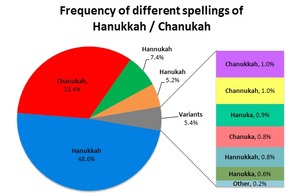
One reader, William in Brookline, sent a beautiful answer.

He notices that the difference between the two pronunciations is a single Hebrew letter - "chet" v. "hey". Numerically, the difference only 3, which could be represented by the word "av" which means father....


"Using Google Translate, הנוכה ["Hanukah"] means, "seasonally"; חנוכה [Chanukah] means,
"dedication".  We have more than a seasonal holiday here: we dedicate ourselves to אבינו שבשמים [God], so if we add the אב to the seasonal festival, we have our Dedication."


If William will permit me to riff off of him a bit.... It is interesting that Channuka is related to the word for "education" — "chinuch". Eduation isn't just dedicating a child, it's preparing the child for life.

The idea of Chanuka is to re-dedicate yourself — that is, to prepare yourself.

Maybe you thought you were prepared?

But you're not. None of us were.

We were maybe prepared on the level of seven, but not on the level of eight.


The other day I was speaking with my 12-year-old nephew in Jerusalem.

He asked me, "If there was enough oil for one day, then the miracle was only seven days. The last day it burned up, so it wasn't a miracle!"

His answer: For most of the world, it's only a miracle when oil doesn't burn. But for a Jew, it's even a miracle when it does burn. Everything in nature is miraculous.

As long as you are waiting for that miraculous success, that miraculous recovery, that divine intervention in marriage or childbirth or winning the lottery, then you are still living in the world of seven.

When you start to realize the miracle of the quotidian, you are living in the eight.

That's why it matters how you say it. Because this world matters. The here-and-now matters. Beauty matters. If you pronounce something wrong, you are marring the cosmic harmony.

So the real magic of Channuka - the real preparation - happens tomorrow night, when you light those eight candles.

Take a good gander and think about re-dedicating yourself to living in this beautiful moment.


Channukah sameach and

Shabbat Shalom


Like this email? How about putting your gelt where your gab is: Like it, tweet it, or just forward it.


PS - Thanks to those who responded to last week's "word from our sponsor"....

Do
you have a favorite Table Talk? Maybe it was last summer's story about the greatest Olympic champion or Satisfact or Fiction. Maybe the Sandy Hook one did it for you. Perhaps it was We of the Storm. One of the most popular of all time was Late for the Train (2006). Some still remember the musical Chinese Food on Xmas.

Please consider an end-of-the-year tax-deductible contribution to support this weekly Table Talk. If you had paid a buck for your favorite one, would you have said, "Money well spent"? What of the fact that it comes to your inbox for free every Friday? Does that make worthless? (or priceless?)

This blog actually costs several nickels to produce, and we rely on readers like you to keep it going. There are the costs of the 10-year-old computers and the rest of the office overhead. There is staff time.

Yet this blog is provided as a free service by JSL in order to achieve our mission of fostering a paradigm-shift in Jewish education. You have the opportunity today to enjoy being being an active partner in this mission. At any level of contribution, you will be a partner.
http://jsli.org/donate/

Friday, December 16, 2016

Wheel of Fortune.... How does it turn?

The goal of this blog is to not leave the Friday night table talk to chance.... Please share.
In memory of Moshe Simcha Moskowitz and wishing a speedy recovery to Tamar Adina bas Kayna Shulamis.


Dreidel RouletteA horrific accident this week.

A mother and her son drop older sister off at the airport, going to Israel to study. What a happy goodbye!

On the way back, in front of her is a disabled vehicle on the highway - she slows down, but the semi behind her does not slow down and rams her into the stalled vehicle.

How long it took first responders to arrive, who knows and who wants to know. Both mother and son were airlifted to separate hospitals in DC.

The mother is presently in ICU, fighting for her life.

The son - a 13-year-old in our son's school - did not make it.

The funeral was yesterday.

It looked like the entire Jewish community was there. Not only were all 600 seats filled in the huge sanctuary, so was every foot of the standing room, so was the overflow room, spilling out into the hallways and the foyer.

First question for your table: Was it because the parents are well known and loved?

But speaker after speaker told of how special this boy was. His name was Moshe Simcha - and he was always happy (simcha means happiness). He wasn't an extroverted, joking kid. He was mild-mannered, soft-spoken, but extremely friendly and even more than friendly, he was helpful.

His seventh-grade teacher said, "You know those days when you come in to school and you really need a coffee but you don't have time because you have to go copy your handout? Moshe would make sure you had a coffee on your desk and the copies made before you even had a chance to ask him for help."

His father said, "At home, he was always asking, 'What can I do to help?'"

It seems that he had perfected the
mitzvah of honoring your parents.
 
Other kids loved him, because he was super nice to everyone, of all ages.

Our son called him "really nice". (That is a very rare compliment.)

He was a fighter - he didn't let diabetes stop him from training for and completing a 120-mile bike-a-thon to raise money to help disabled kids go to camp.

He was a learner - he recently asked his father if they could spend five minutes a day learning together the laws of lashon hara. Why? "Because it's really important and I don't think I know it well enough."

His father, a beloved first-grade teacher, said, "Moshe taught us all something. He was a teacher - a rebbe - to all of us."

Even those of us who never met him.

(Even those of us who merely read about him in an email?)

His family ask:

• In his memory, that we aspire to emulate him;
• As a collective "prayer" for his mother, that we light Shabbat candles five minutes early today.

Hence I share the story with you, and ask you to
forward it to everyone you love.

Second question for your table: What's a greater tragedy - a meaningful life cut short at 13, or a long, healthy life without meaning or mission?


Shabbat Shalom


PS - After 2,500 years, there is finally a new way to play dreidel. Click on the image above.

Like this post? How about putting your gelt where your gab is: Like it, tweet it, or just forward it.

Friday, October 07, 2016

Yom Kippur - Vive la Différence

The goal of this email is to put the PUR back into Yom Kippur. Please share.

pattern-line-white-black-zigzag-30149489Here's a puzzler for your Friday night dinner table:

What's black and white and read all over, and worth 36¢?

Too hard? OK, we'll come back to that.

First, a more personal question:

Now that the hard work is behind us, and Yom Kippur is so far off, what's there to do?

The answer, according to the Rambam, is.... do more.
If you are ordinarily not particularly friendly.... try to be friendly.

If you are ordinarily friendly.... be more friendly.

If you ordinarily are not particularly careful about what you say.... be careful.

If you ordinarily are careful about what you say.... be more careful.

If you ordinarily don't give tzedakah generously.... give tzedakah generously.

And if you are ordinarily generous.... now be more generous.

Once or twice a year I remind you that this blog is a project of a non-profit organization that is doing ambitious, creative work for the betterment of the Jewish People and humanity (like this, and this, and this, not to mention this

and this and this.)
 
Our operating budget is funded mainly by people like you. If you find this email occasionally uplifting, thought-provoking, discussion provoking, educational or even amusing, please consider an $18 donation for the New Year. (
http://jsli.org/donate/)

Doing so sends the message that this blog is worth at least 36¢ a week to you.

Is it?

A final question for your table:

If a person is normally a tzaddik - is
it possible for them to become a greater tzaddik?


We have one week to practice being a greater tzaddik until the big soul-scrub next Tuesday night.

Wishing you a Shabbat Shalom and a happy Yom Kippur.


"We make a living by what we get, but we make a life by what we give." (Churchill)


Sunday, October 02, 2016

Rosh Hashana for Thinkers

The goal of this blog is a BOFA (breath of fresh air) at the Rosh Hashana table. Please share.

applesandhoneyLast Monday, with just a week left of the year 5776, we attended the funeral of my 19-year-old son's best friend.

I do not need to tell you that it was heart-wrenching.

He was a nice kid. Soft-spoken, smart. One summer a few years ago I hired him and my son to paint our fence. When they completed the job, he refused to accept payment, telling me that he didn't feel he had done a good enough job. I was satisfied, but his own sense of integrity prevented him from accepting payment.

(The official cause of death was accidental drowning.)

I share this unhappy news in the spirit of Rosh Hashana.

If you find that a bit ironic, it may be because you are thinking of Rosh Hashana like January 1: champagne, fireworks, saxophone, Scotch whiskey.


Nope.

Rosh Hashanah is that one day a year (OK, two) (OK, maybe one) to think about your life.

How fragile it is, how quickly it can end ....

How precious it is.

What it will take to make 5777 the best year ever.

My Rav used to tell us, "Yom Kippur is easy. You fast and say I'm sorry a bunch of times. Rosh Hashana is hard work. You have to think."

Tradition says that how you think on Rosh Hashana affects your entire year. The day has a certain karmic energy that causes your thoughts  to have more influence than on any other time of the year.

Rosh Hashana determines who will be healthy and who will get sick. Who will earn and who will lose. Who will live and who will die.

(The root of "hashana" is shina which means "change". Rosh Hashana = beginning of change.)

This need to think is the real reason for two days of Rosh Hashana: clarity matters, and most of us need two days to get it.

Whether you do it for one day or two, if you end Rosh Hashana before achieving greater clarity about your life, you just missed an opportunity.

Here are two questions to help those at your table hear the shofar a little differently this year:

1. If you knew that this was going to be the last year of your life, how would you live it?
2. If you had to stand in a court and justify living for another year, what would you say? What do you hope to accomplish that would justify another year of life?


(For 23 more questions for contemplation, or for my "Rosh Hashana Omens" sheet, send me an email.)

Wishing you and yours a good, sweet year of health, success and great happiness. May you be inscribed and sealed in the Book of Life.

If I have written or said anything in the past year to offend, kindly forgive me. And let's all pause around sunset tonight and forgive everyone who may have offended us.

L'shana tova!


"Men will forgive a man anything except bad prose." (Churchill)


Like this email? How about putting your gelt where your gab is: Like it, tweet it, or just forward it.

Friday, September 09, 2016

Satisfact or Fiction?

The goal of this email is to please even the maximizers at the dinner table. Please share.
Happy Birthday shout-out to Shelli in SF


Contented CatWhen I first used the word "saticficer" five years ago, at least one reader thought it was a typo.

The word is indeed a neolgism, coined in 1956 by the brilliant polymath Herbert Simon.

A satisficer is a person who chooses a product or service that is "good enough" (satisfied with what will suffice).

As opposed to a maximizer, who is always trying to get the "best".

According to Barry Schwartz (his book; his TED talk; his research), satisficers are usually far happier than maximizers.

To put it simply, maximizers take forever to make choices, then often regret their choices.

Question 1 for your table - Test yourself to see if you are a satisficer or maximizer:

Imagine having the task of sewing a patch onto a pair of jeans. The best needle to do the threading is a certain 4" needle with a 3mm eye. The problem is that this needle is hidden in a haystack along with 100 other needles of various sizes. Would you the use the first needle that can sew on the patch, or spend the time searching for that one specific needle in the haystack
?

Maybe that's too crazy an example. So let's make it more realistic: Think of a few non-food items you recently purchased. Did you go for "good enough" (satisficer) or pursue the elusive "best" (maximizer)?

(Still not sure? Try this 6-question quiz.)

Question 2 - It's a mitzvah to be happy. Therefore, it's a mitzvah (usually) to act as a satisficer. But how can a maximizer become a satisficer?

(I've seen many attempts to answer this question, such as this and this, but none are satisfying me.)

(But Gretchen Rubin's blog post - and her readers' comments - are worth a quick read.)

Question 3 - this may be the hardest one - Are there any times when even a satisficer ought to act like a maximizer?


Shabbat Shalom


PS: Some Rosh Hashana links....

1. Rosh Hashana countdown timer: http://jsli.org
2. For my Rosh Hashana prep worksheet (appropriate for any age), reply to this email and ask!
3. Our four favorite honey dishes which make great gifts: Here's the link.


PPS - Just one hidden link this week - can you find it?

Like this email? How about putting your gelt where your gab is: Like it, tweet it, or just forward it.

Friday, July 22, 2016

PG-613? (Pokemon Go, is it a Mitzvah?)

The goal of this email is to augment reality at the Friday night dinner table....

twitter v. pokemonI heard that the new Pokemon-Go game works like a pedometer and knows when you are walking, giving extra points for being on your feet.

I also heard that it rewards sportsmanship and teamwork.

Is that icing on the cake, or a silver lining on a gray cloud?


The cake is that people are obviously having a lot of fun with it.

The gray cloud is that it's a hammer in our ADD-toolbox.

(And perhaps some other pushback.)

There is a solution, based on last week's Hellen Keller piece.

This is a tool that you can use right now to enact Keller's vision (pardon the pun).

It's called NATURE.

Ironically, it works best when your smart phone runs out of juice.

If you're one of the unfortunate few to have an ultra-long battery life, it may require shutting off your phone. Or leaving it in the car.

(Hard to do, right? I know.)

It's great to be out in nature.

It makes you mentally and physically healthier.


But what do you do when you have to return home, and get back to work/school/life?

How about this: bring nature home with you.

Here's how:

Two years ago we launched the Amazing Nature for Teachers curriculum.

The site is now called teachamazingnature.com.

Last year, we trifurcated it:

1. Amazing Nature - for secular teachers
2. Nifla'ot - for Judaics teachers
3. Ma Rabu - for teaching tefila (prayer)


There are three ways you can play:

1. Register your kid's teacher or school for next year.
2. Sign up your family.
3. Subscribe yourself.

Go ahead - give it a try! I guarantee it will give you 301x more long-term gratification than Pokemon-Go, or your money back.

Now let's get to this week's first question for your table - Why is Pokemon Go so popular, even though it is PG (pardon the second pun)?


Is it the instant gratification? Is it the challenge?

Is it that it's safe (well, most of the time anyway)?

Is it the energy and synergy?

When you watch people play, it seems like are striving for something that seems intangible, like the energy of a fire.

In Jewish wisdom, fire represents the evil inclination. And the only way to cool it down is through the Torah.

Yet the Torah, too, is compared to a fire. Fight fire with fire? The Torah is also a challenge that is also nearly instantly gratifying, and is 100% safe.

Some say it's the greatest "game" ever played.

We have an ancient tradition that just as Jerusalem was destroyed with fire, it will be rebuilt with (metaphorical) fire.

It so happens that "Pokemon Go" in Hebrew has the gematria (numerical value) of 301, which is the same as eish (fire).

Hmm....Will Jerusalem be rebuilt through Pokemon?

Or through millions of people waking up from their augmented-insanity, deleting that app and making room in their heads for a bit of Jewish wisdom?


Shabbat Shalom


Like this post? How about putting your gelt where your gab is: Like it, tweet it, or just forward it.

Friday, February 12, 2016

How to Make Waves

The goal of this email is to add some gravity to the Shabbat table.
Wishing Lily in SF a happy birthday this week!
Wishing Mom (Chaya bas Yehudis) a continued recovery.


gravity waves1. Get two black holes.

Let one of them be 36 times more massive than our sun.

Let the second one be 29 times the mass of our sun.

2. Put them in a blender and mix.

3. Do the math: the resulting super black hole will be how many times more massive than our sun?

If you guessed 65, you are happily mistaken.

The correct answer: 62.

How could that be?

It turns out when you mix two black holes together, it's impossible to keep it all in the mixing bowl. There is a 5 percent splatter rate.

But every sixth grader knows that not even light can escape from a black hole! How can any energy escape?

It turns out that black hole splatters are more awesome than light. They make space itself ripple, whatever that means.

Not big ripples, but tiny, tiny ripples that are so tiny, to detect them you need a really awesome seismograph.

The one they came up with is a five-mile electric eye. Sort of like the one in elevators to keep people from being crushed by the closing doors, but about a million times more expensive.

And just to be safe, they built two of them, 1,800 miles apart.

But you only heard the headlines of this gravitational-waves story you may have missed the following detail:


To prevent false positives, LIGO has an elaborate system in place to occasionally inject ersatz signals. Only three scientists on the team know the truth in such cases, and in at least one instance their colleagues were prepared to publish the results when they finally revealed the ruse.

Consider the greatness of that system. These scientists are so interested in getting the truth....they know that their fancy machine is very, very good yet imperfect and they know that they are very smart yet imperfect, so they create a system to push themselves towards greater perfection.

That's like you trying to get in shape and having a trainer occasionally tempt you with appropriate distractions. Because whenever you conquer an urge or a distraction, it makes you stronger and greater.

What if the entire universe were set up in such a way that each of us got karmic tests at just the right time to make us stronger and greater?

For the kids at your table: Do you ever feel tested in that way?
For the adults at your table: If it turns out that the philosophical "what if" above were not true, w
ould believing it and living according to it be a net good or net harm?


Shabbat Shalom 

PS - great infographics on LIGO here.

Friday, December 25, 2015

Make Beer, Not War

The purpose of this blog is to turn Friday night dinner into Shabbat.... Please print and share.
 
Jaffa-GateTwo days ago, on Wednesday morning, Rabbi Reuven Biermacher went to Jerusalem's Old City.

At 10 am the 45-year-old immigrant from Argentina taught a group of Panamanian 16-year-olds something from the Talmud.

They were on summer vacation and their counselor came by to ask the rabbi to give them a break.


The students demurred, “No! We don’t want a break. This is the best class of the day!”

At 11 am he gave his regular Talmud class, followed by a short talk to a group of South American students.

What all three classes had in common was a beloved, wise rabbi, "full of joy and life", who cared for each of his students.

At 12:45 he left the yeshiva and headed towards Jaffa Gate, which is the main route taken by Jewish residents and tourists, and anyone else who wants to use it. The footpath outside Jaffa Gate looks like any sidewalk in any large city.

It was an unseasonably warm, sunny December day in Jerusalem.

And there, returning home to his wife and seven children, Rabbi Biermacher encountered evil.

Two young men lunged at him with knives.

Ofer Ben-Ari, 46, happened to be driving by and witnessed the attack. With only his bare hands as weapons, he ran out of his car to save the rabbi's life.

Police arrived moments later and Ben-Ari was hit by a stray bullet.


Both victims were rushed to Shaare Zedek Medical Center where they died within an hour of each other.

Biermacher's 16-year-old daughter described him as "a man of gold who never harmed anyone." One of his colleagues said in a eulogy, "He was walking example of what we all aspire to be....He was always there for everyone.... We have to take responsibility to live up to his example and make a serious change in our lives..... To look at what happened as a message to me, to think that I deserved this more than he did, and I am lucky to be here. God has chosen the best among us deliberately.... Instead of thinking, 'Am I safe or am I not safe?' we should think, "What matters is that I'm doing my job."

Ben-Ari owned a recording studio in Jerusalem and opened it free of charge to distressed youth. He also provided temporary housing for the homeless in a property he owned. He is survived by his wife and two children and here is a brief report of his funeral.

2 victimsThese two tragedies leave one speechless.

But I am not sharing them with you to make you sad, rather to foster a discussion at your dinner table. Perhaps these two questions are appropriate:

We know that everyone has to die. But is it better to die quickly and suddenly as they did (in this case as heroes), but without a chance for anyone to say goodbye? Or to suffer a period of illness first?

We all know (but don't like to think about it too much) that anyone and everyone's fortune could change in a moment. So what?


Shabbat Shalom.

PS - Funds are being established to help the two widows and nine orphans. For more info, post a comment or send an email.


Like this post? How about voting with your finger: Like it, tweet it, or just forward it.

Friday, December 11, 2015

Worth the Effort?

The goal of this blog is to minimize the effort and maximize the reward at your Shabbat table.... Please print and share.
 

flickeringOur daughter Goldy asked an interesting Channuka question the other day.

"Why is it that you're supposed to have enough oil (or wax) to burn for at least half an hour, but if they go out before that, you don't need to relight them?"

Good question.

So what was Goldy's answer?

"It's to teach us that when it comes to spirituality, it's the effort that counts. You cannot control the outcome, but you have to make the effort. That's all that matters in Shamayim."

One of the other kids at the table said, "Too bad they don't grade you in school based on your effort!"

It seems to me there is a great Table Talk in Goldy's Dvar Torah.

Think of how many things in life are measured by the outcome, not the effort.

It's hard to think of anything that is measured by the effort.

When is the reward ever according to the effort?


Happy Hannuka and Shabbat Shalom.


PS - Although Hannuka is here, it is never too late to click here.


Like this post? How about voting with your finger: Like it, tweet it, or just forward it.

Friday, December 04, 2015

My Channuka

The goal of this blog is to bring controversy and clarity to the Shabbat table.... Please print and share.

Warning - long post this week. Apologies to those with short attention spans. If you want to skip the scholarly part, scroll down to "My Channuka" or you could just read last year's or the 2011 Channuka miracle, or the George Washington story.

menorahThe Talmud's famous chapter, "Mai Channuka? - What is Channuka?" is most famous for what it leaves out.

Here is the passage in full:


What is Channuka? When the Greeks entered the Holy Sanctuary they defiled all the oil that was there. And when the dynasty of the Hasmoneans grew strong and defeated the Greeks, they searched and found only one flask of oil with the stamp of the Kohen Gadol (High Priest) that had been set aside; and there was only enough oil to burn for one day. A miracle occurred and they lit [the Menorah] from this oil for eight days. The following year the Sages established these days for praise and thanksgiving. (Shabbat 21b)

It only tells about the miracle of the oil. There is no mention of Hellenism, religious persecution, civil war.

This omission has led to many opinions out there about the history and meaning of Channuka.

Somebody wrote i
n the Wikipedia article, "According to the Talmud, unadulterated and undefiled pure olive oil with the seal of the Kohen Gadol (high priest) was needed for the menorah in the Temple, which was required to burn throughout the night every night". As you can see above, the Talmud doesn't actually say that.


According to about.com's "Judaism Expert", it had something to do with an otherwise unknown eight-day purification ritual involving oil.

According to myjewishlearning.com, "This event was observed in an eight-day celebration, which was patterned on Sukkot, the autumn festival of huts."

I would like to address the latter view, because it is so widely believed and taken by many to be fact.

It comes from a question historians have. The non-Rabbinic sources we have that mention Channuka seem to tell a different story than the Talmud.

For instance, Josephus mentions the fact that we celebrate for eight days, and that we call it the Festival of Lights, but he claims not to know why it is called that.

The apocryphal books of Maccabbees make no mention of the miracle of the oil.

Due to these omissions, and due to some other evidence, some historians have speculated that Channuka started as a belated Sukkot and the rabbis later invented the story of the miracle. One problem with this theory is that Josephus doesn't mention it. So it is no stronger an argument than his omission of the story of the oil.

Let's look at the 3 other pre-Talmudic sources that mention Channuka:


1 Maccabbees is written by an eyewitness, the best record we have of what happened. He mentions “blameless priests, such as had delight in the Law”, implying that there were guilty priests around who did not relish the Law. Yet he does not mention the idol allegedly set up in the Temple. He says, “They celebrated the dedication of the altar eight days, and they offered sacrifices with joy, and sacrifices of salvation, and of praise.” Notice no mention of the menorah nor why eight days. Yet we do see the juxtaposition of “celebrated” “dedication and “eight days”.

2 Maccabbees is an abridged version of the above by Jason of Sirene, ca. 100 BCE (not an eyewitness), who wrote in Greek. He also mentions the altar, but not the menorah. “And they kept eight days with joy, like the feast of the tabernacles, remembering that not long before they had kept the feast of the tabernacles when they were in the mountains, and in dens like wild beasts.” This is the source for some historians to read this as causative – Eight days of Hannuka because of Sukkot – but the text doesn’t actually say this!

Mishna - written by Rabbi Yehudah haNasi and colleagues ca. 200 CE. The common scholarly view is that Channuka is absent from Mishna (as a separate holiday like Purim which has its own tractate) because Rabbi Yehudah was anti–Hasmonean. This may explain also why Talmud focuses on miracle and not on the war. Except that it's not entirely absent from the Mishna, so this isn't a very strong argument.

This disparate sources yield no easy answer, and we should see that it’s impossible to say anything for sure – much of what is written in scholarship is over-confident, not solidly supported by evidence.

My Channuka

Based on all of these sources, I have a slightly different approach.

One has to understand that the Maccabeean war is halachically problematic. It was largely a civil war, Jew against Jew. Who authorized the Maccabees to wage it?

The Maccabees were, in the eyes of their Jewish enemies and the Assyrian overlords, a band of terrorists. I'm not so sure that the rabbis of the time (Pharisees) would not have felt the same, even though they surely sympathized with the cause (the religious persecution was quite brutal - Judaism was outlawed and religious Jews were heavily persecuted).

So there would have been good reason for the Pharisees and later the Mishna and Talmud to minimize it. It may be compared to Israel’s war of independence in 1948 – this is a very uncomfortable halachic position for right-wing rabbis. Do you celebrate Israel Independence Day? If you celebrate do you say Hallel? If you say Hallel do you say it with a bracha?

Yet they had to deal with the fact that there was this miracle of the oil.

What does the oil prove? That the victory in war was Heaven-sent! But if you believe that the war was forbidden to wage in the first place, how do you process that?

Answer: You certainly don’t publicize it.

Then why did they institute a festival at all?

It seems to me that the Hasmoneans did it first. They made themselves kings and created Channuka to celebrate and give Divine approbation to their victory. Maybe the rabbis at the time were passive — they didn’t want to openly support it but neither could they deny the Jews our victory.

And the holiday stuck.

Centuries later, in writing the Talmud, the rabbis have a holiday that cannot be ignored (because they believe in the miracle), so they confine the discussion to the oil and ignore the halachically-problematic war.

This hypothesis explains Josephus, the Mishna and the Talmud, and can perhaps also explain why the author of 1 Maccabees does not mention the Menorah nor give a reason for the eight days. Perhaps he himself was a Pharisee and is ignoring the miracle for a similar reason that the Talmud ignores the political events and the Mishna ignores both. He lived at the time of the political events and could not ignore them, but he could ignore the religious implications. The authors of the Mishna and Talmud were the opposite - they lived centuries later and could ignore the uncomfortable political events and focus on only on the religious part.

So what's today's take-away from all of this?

I think that we should follow the Talmud and focus on the Menorah, but it is important understand the nature of that event.

It is not true that they needed to wait for eight days. That's fiction.

It is not true that they needed special oil. That's fiction.

What is true is that they wanted to use special oil. Why? Because they were rededicating the Temple for crying out loud, after it had been turned into a pagan shrine! They wanted the rededication to be as beautiful as possible.

That, in my mind, is the main theme of Channuka. We should not be satisified merely to do the right thing in life. We should strive to do the right thing in the most beautiful way possible.

There's a term for that - hiddur mitzvah - the beautification of a mitzvah.

Hellenism (i.e., Western Culture) puts a huge premium on external beauty.

Some religions completely deny the external and put 100% premium on the internal.

Channuka is about combining the two. The internal matters most, but use the external to beautify it.

For example, let's say you decide to give a beggar a dollar. That's good, but better to give him a crisp clean dollar than an old worn out bill. And better to give with a smile than a frown. Same amount of money!

Judaism is about both faith and action. But not any ol' action. It should be beautiful.

Question for your table — what are other ways to do hiddur mitzvah?


Shabbat Shalom and Happy Channuka.


PS - Although Hannuka is almost here it's not too late to click here.


Like this email? How about voting with your finger: Like it, tweet it, or just forward it.