Shabbat Table Talk from the desk of Rabbi Alexander Seinfeld
Oct 23-24, 2026 • 13 Mar Cheshvan 5787 • Lech-l'cha (Gen 12-17)
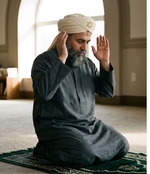 Here's a great conversation starter with almost any Jewish person: What's your Jewish journey?
(Try asking that at your table...you might be suprised at some of the answers.)
I have asked countless people that question and while every story is unique, there are some definite recurring patterns that you see.
But one such Jewish Journey story sticks out in my mind as the most unusual.
Moshe (not his real name) had arrived to Israel in the 1980s as a young man with a mainstream American Jewish background who happened to be...
... a devout Muslim.
Why Islam? His Jewish education had left him with a spiritual void, and Islam filled that void.
He then decided to visit Islam's holy sites, which brought him to Jerusalem.
Of course, when you visit Jerusalem, you go to the Western Wall (Kotel). And there, Moshe met the famous Rabbi Meir Schuster, who had the uncanny ability to find the Pintele Yid in a crowd, even when his outer clothes were Islamic. Rabbi Schuster invited him to learn about Judaism in an English-speaking yeshiva.
Now, devout Muslims say a 10-minute prayer at five daily time windows:
• Fajr (Dawn): from dawn until just before sunrise.
• Dhuhr (Noon): from high-noon until mid-afternoon.
• Asr (Afternoon): in late afternoon.
• Maghrib (Sunset): from sunset until dark.
• Isha (Night): from dark until dawn (or midnight, depending on the calculation method).
While experiencing the yeshivah, he was offered a dorm room with a more advanced student. They got along fine, with one small point of friction: the first prayer time (Fajr) is for a normal person in the middle of the night. Rolling out his prayer mat and chanting Arabic verses from the Koran at 4:00 am was disturbing his roommate on several levels.
So being a pious and wholesome fellow, he went to the Dean—i.e., the Rosh Yeshiva—to discuss the matter and ask if he should stop saying the Fajr.
Oct 23-24, 2026 • 13 Mar Cheshvan 5787 • Lech-l'cha (Gen 12-17)
Here's a great conversation starter with almost any Jewish person: What's your Jewish journey?(Try asking that at your table...you might be suprised at some of the answers.)
I have asked countless people that question and while every story is unique, there are some definite recurring patterns that you see.
But one such Jewish Journey story sticks out in my mind as the most unusual.
Moshe (not his real name) had arrived to Israel in the 1980s as a young man with a mainstream American Jewish background who happened to be...
... a devout Muslim.
Why Islam? His Jewish education had left him with a spiritual void, and Islam filled that void.
He then decided to visit Islam's holy sites, which brought him to Jerusalem.
Of course, when you visit Jerusalem, you go to the Western Wall (Kotel). And there, Moshe met the famous Rabbi Meir Schuster, who had the uncanny ability to find the Pintele Yid in a crowd, even when his outer clothes were Islamic. Rabbi Schuster invited him to learn about Judaism in an English-speaking yeshiva.
Now, devout Muslims say a 10-minute prayer at five daily time windows:
• Fajr (Dawn): from dawn until just before sunrise.
• Dhuhr (Noon): from high-noon until mid-afternoon.
• Asr (Afternoon): in late afternoon.
• Maghrib (Sunset): from sunset until dark.
• Isha (Night): from dark until dawn (or midnight, depending on the calculation method).
While experiencing the yeshivah, he was offered a dorm room with a more advanced student. They got along fine, with one small point of friction: the first prayer time (Fajr) is for a normal person in the middle of the night. Rolling out his prayer mat and chanting Arabic verses from the Koran at 4:00 am was disturbing his roommate on several levels.
So being a pious and wholesome fellow, he went to the Dean—i.e., the Rosh Yeshiva—to discuss the matter and ask if he should stop saying the Fajr.
WAIT—before you read what the Rosh Yeshiva said, try asking at your table: "What would you have said?"
The Rosh Yeshiva told him, "You're doing better than we are! Don't stop!"
He's not the only Torah scholar with a long beard that I've heard say words to that effect. Devout Muslims are true to their ancestor Ishmael, whose name literally means, "God will hear." The spiritual power of that devotion and that unity among them that it fosters should not be underestimated.
(Fun fact: one of the leading rabbis in the 2nd Century CE was R' Ishmael, who was a colleague of the famous Rabbi Akiva.)
(Fun fact: when praying at the Temple (now destroyed), Jews too would kneel and prostrate.)
Now, according to Jewish law, a Jew is allowed to pray in a mosque but not in a church. Question for your table: Does that make sense?
The Rosh Yeshiva told him, "You're doing better than we are! Don't stop!"
He's not the only Torah scholar with a long beard that I've heard say words to that effect. Devout Muslims are true to their ancestor Ishmael, whose name literally means, "God will hear." The spiritual power of that devotion and that unity among them that it fosters should not be underestimated.
(Fun fact: one of the leading rabbis in the 2nd Century CE was R' Ishmael, who was a colleague of the famous Rabbi Akiva.)
(Fun fact: when praying at the Temple (now destroyed), Jews too would kneel and prostrate.)
Now, according to Jewish law, a Jew is allowed to pray in a mosque but not in a church. Question for your table: Does that make sense?
Shabbat Shalom
This message may also be read online at Times of Israel.
Appreciated this Table Talk? Like it, tweet it, email it...

