Showing posts with label Rosh Hashana. Show all posts

Friday, September 08, 2023

A New Wave?

Table Talk from the desk of Rabbi Alexander Seinfeld
September 8-9, 2023 • 23 Elul 5783 • Vayeilech (Deut 29-30). 
The purpose of this email is to make waves...please share.
Mazal tov to our daughter Emuna and son-in-law Binyomin on the birth of a daughter!


art of wave
Dovetailing on last week's theme of selling tickets to Rosh Hashana, and with Rosh Hashanah one week away, what's on your mind?

(Besides honey?)

Here is something to ponder for the last Shabbat - and the last week - of the year.

First question for your table - Are you a greeter? Do you greet people as you pass them on the street, on the hiking trail, on the road? Do you initiate the greeting, or do you wait for them to?

I am grateful to my dear mother for alerting me to an uplifting recent column by the Chicago Tribune's 
Jim Nowlan on the art of waving.

We're talking about a friendly wave when you're out for a walk. 

Nolan observes: "Waving is good; more would be better.... [resulting in] they know that I am a human, like them, and, somehow, we're all in this together."

Second question for your table: How Jewish is that?

It reminds me of a teaching in Pirkei Avot:


Rabbi Masia ben Harash said: Upon meeting people, be the first to extend greetings; And prefer to be a tail unto lions, rather than a head unto foxes (4:15).

Here's a personal proposal to you and your family: How about we all make this one new year's resolution together - to try to greet everyone in a friendly way — whether with a wave or even just a smile — and I mean everyone: our family, our neighbors, and of course strangers.

What do you think about that? Crazy idea? 

I write this now because next Friday is erev Rosh Hashanah and I don't know if I'll manage to get an email off. If I do, maybe I'll add to this proposal. 

In the meantime, please consider my proposal; if it resonates with you, please share this email with everyone you love.

In fact, as we begin the last week of the year, what if we all do a 1-week trial of my proposal — a test drive if you will — to see how it feels, and how it impacts both the waver and the wavee?


Shabbat Shalom


PS - There is still time to request our "40 Questions to Think About Between Rosh Hashana and Yom Kippur"

PS - Here's a new review you might enjoy.


Enjoyed this Table Talk? Vote with your fingers! Like ittweet it, forward it....
  

Friday, August 25, 2023

Carpe Diem Syndrome?

Table Talk from the desk of Rabbi Alexander Seinfeld
August 25, 2023 • 8 Elul 5783 • Parshas Ki Seitzei (Deut 21-25). 
The purpose of this email is to build some conversational muscle at the Shabbat table...please share.

Announcement - if you are an Apple Books user, our new book is finally available for you - https://books.apple.com/us/book/body-soul/id6451424543?ls=1 !!!!

Jump into shape
Don't know about you, but I love being disabused of false notions.

Every time something I believed to be true turns out to be a myth, that's one step closer to total clarity.

This week's myth-busting is (no surprise) in the area of health and fitness.

The myth: The Jewish/Torah ideal of soul-body balance is not so radically different from other ancient cultures.

Take, for instance, the Latin expression, mens sana in corpore sano – a sound mind in a sound body. It's usually used to justify PE and sports in the school or college curriculum - meaning, physical health helps the mind (or sometimes it is interpreted as a justification for requring athletes to develop their minds).

But when the Roman Poet Juvenal (ca. 2nd Century CE) penned the phrase, he meant something entirely different: that one should pray for both a healthy mind and a healthy body (among other blessings). Meaning: not that they are equally valuable, nor that one enables the other, merely that they are both valuable.

(That misappropriation of Juvenal was initiated in 1861 to promote the Liverpool Athletic Club.)

So what does the Torah actually say about the relationship between mind and body?

A lot more than space here would allow! But first and foremost, on one hand, developing your mind is immeasurably more important than developing your body, and on the other hand, strengthening your body helps improve your mind (acuity, memory, and mood). 

In other words, even if daily exercise weren't a mitzvah (it is), doesn't it simply make good sense?


You don't have to become an athlete, and you don't even have to go to the gym....Start by taking a daily walk. Or merely using one of these.

Question for your table: Why is it so hard to change?

(My answer here.)


The countdown to Rosh Hashanah has begun... what's one habit you'd like to change or improve in 5784? 


Shabbat Shalom


PS - For more exercise ideas and resources, see our Exercise resource page.


Enjoyed this Table Talk? Vote with your fingers! Like ittweet it, forward it....
  

Thursday, September 17, 2020

Good Riddance?

 The purpose of this blog is to create love and wisdom at that Shabbat table and all year round. Please print and share...  By the way, Isn't tonight the night?


oregon fire
Does that photo look vaguely familiar? 

I used it last week. The repeat is to show our solidarity with those who are suffering out West.

One of those suffering out West, a long-term subscriber to this email, sent me the following email the other day:

I would like you to remove me from your weekly email distribution list. You might be surprised to know that I read nearly everything you send. And over the years I have found that in doing so my heart is not made more loving.  My ability to use my mind in service to wisdom has not been strengthened. And instead I find myself increasingly agitated by and sad after reading what you write. 

(I was indeed surprised - I sometimes wonder if anyone reads what I send. I figure most people stop reading after awhile. And I was also uplifted to know that he continues to be a seeker of love and wisdom.)

I'll leave it to you, dear reader, to interpret both the content and the timing of his missive. On a related note, last night I heard a rabbi speak in less-than-glowing terms about the departure of the Year 5780. He said,

"I don't need to tell you that this has been a very difficult year, for the world and for the Jewish People. Many people have suffered, many are still suffering. Many are simply depressed or afraid. I don't think many of us are sorry to see 5780 go, and we are all hopeful that 5781 will be a better year."


I wonder .... without minimizing anyone's suffering, haven't there been many Rosh Hashanas when we could say that? Right now the plagues and fires and economic woes etc. seem historic and unprecedented. But maybe that's because they're happening right now?

Maybe we could reframe: it seems to me that having a new year is a great opportunity to ask three questions:

1. What's something important you learned in 5780?
2. What's something you did in 5780 that you're proud of?
3. What do you dream of accomplishing in 5781?

(For a list of 28 such questions, plus a few more for Yom Kippur, send me an email.)
(In addition to the RH/YK questions, we have an updated 
Significant Omens sheet and a couple other Rosh Hashana/Yom Kippur specials - shoot me an email.)

This is one of only a couple times a year when we mention the costs of sending this email. What a coincidence - this happens to be the time of year when Jews give more generously than usual. Please consider showing your appreciation and support with a tax-deductible contribution of any amount - with many options available at 
http://jsli.org/donate . Your support not only keeps our computers running and lights on, it helps us make an impact on thousands of lives through our educational programs. If you'd like details on our programs and their outcomes, shoot me an email.

Like public radio, we have some cool thank you gifts - become a supporting member and we'll send you something special.

And now I'm going to leave you with an intentionally provocative question for your Shabbat/Holiday table:

What would be worse - a year of peace and prosperity when you learned absolutely nothing, or a year of suffering when you gained great wisdom? In other words, is wisdom ever worth suffering for?


Shabbat Shalom

L'Shana Tova - Happy New Year
May you and yours be inscribed and sealed in the Book of Life!
May 5781 be a year of great blessings and see an end to great suffering.

 
Enjoyed this Table Talk? Vote with your fingers! Like ittweet it, forward it....{VR_SOCIAL_SHARING}
A

Friday, September 07, 2018

Every Good Boy Does Fine

The purpose of this email is to trigger memory and thought at the Shabbat table. Please print and share.

dont-forget-fingerLast week we offered you the new 40 Meditations for the High Holidays.

All that you need to do is send an email.

This week, a new 1-pager for Rosh Hashana. See below....


First, here's a puzzle that some people at your table will get right away, others will say, "Wait, wait, don't tell me...!" and others will say, "I have no clue."

Can you complete the missing line?

1. Good boys do fine always.
2. All cows eat grass.
3. Every good boy does fine.
4. ___________________


I hope no one is griping at me about not including girls or transgenders or post-genders or whomever, or preaching about the role of 1,000,000,000 cows in global warming, at least not until you hear the answer:

4.    Face.           

OK, for those who are still scratching their heads, these four phrases are
mnemonics to help remember the notes on bass clef (GBDFA - lines; ACEG - spaces) and treble clef (EGBDF - lines; FACE - spaces).

But....!

Ask your table: What does this have to do with Rosh Hashana???!!!


If they give up, remind them about the Simanim.

Such as apples in honey, pomegranate, etc.

What does the word "simanim" mean?

A: neumonic!

So here's the real clincher - what's a
mnemonic and why do we have them on our dinner table on Rosh Hashana?


Shabbat Shalom
L'shana tova u'metuka - wishing you a good and sweet year!


PS - The new 1-pager mentioned above is this year's updated Rosh Hashana Simanim (translated and transliterated). send me an email or download it from our teacher's and parent's resource site, http://jewishspirituality.net.

PPS - Yes, the image above is clickable.

Enjoyed this Table Talk? Vote with your fingers!  , , forward it....


Friday, August 31, 2018

In Search of Your Inner Great-Grandparent

The purpose of this blog is to get things ticking at the Shabbat table. Please print and share.


pocketwatchAll faucets become leaky. — Ancient Chinese proverb

OK, so it's not so ancient and not so Chinese.

Maybe it's only true chez Seinfeld.

But every leaky faucet makes me think that Chinua Achebe was right.

The dairy sink's leak had been easy enough - remove the handle, pop in a new washer, cleaned up in under 10 minutes.

But last night's struggle with the other side was meatier. I felt like I'd met my match and it's name is Moen which rhymes with moan. It was one of those DIY jobs that gets you rationalizing: Is a leaky faucet really such a big deal?

Or: Can't this wait until after Rosh Hashana?

So....(for your table), What does matter before Rosh Hashana?

This is a follow-up to
last week's question, "Why does Rosh Hashana matter anyway?"

You've had a whole week to think about it. Ready for an answer?


If statisticians are to be believed, there's a high probability that everyone reading this (or hearing it read) has or had 2 parents.

(Maybe in this day and age I should say "at least" 2 parents.)

And I'm no statistician, but I'm fairly certain that these odds extend to having 4 grandparents.

I'm even willing to bet that you have (or had) 8 great-grandparents.

OK, let's pause right there.

I've never met anyone who could pull this one off:

Raise your hand if you can name your 8 great-grandparents and tell one interesting thing about each of them.

If you happen to be the one-in-a-million who can do that, then extend it back to your 16 great-great-grandparents.

At some point most humans fade into the background. Even those lucky enough to have children eventually become someone's forgotten great-grandparent.

And don't assume that there will even be a digital record of your life.

Maybe you'll be lucky enough to die with sufficient drama for them to display one of your possessions in a museum.

(I hope you're clicking on all the links as you read - they are all quite interesting.)


Bottom line - there are two proverbial books open on Rosh Hashana.

What's the secret to being written in the Book of Life?

Come up with a reason why your life is going to matter for at least another year.

Friendly suggestion: you might want to get a copy of this year's new 40 Meditations for the High Holidays....

One day you'll be at best a distant, remote, faint memory. How are you going to create a legacy?


Shabbat Shalom
 

Enjoyed this Table Talk? Vote with your fingers! Like it, tweet it, forward it....


Friday, August 17, 2018

Are You the They?

The purpose of this blog is to stir up some wisdom at the Shabbat table. Please print and share.
Happy Birthday shout-out to Shelli in SF!


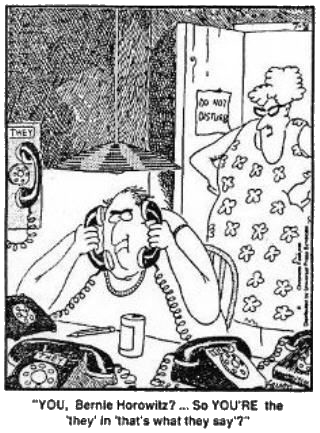
farsidetheyHere it comes again - 

Rosh Hashana....

Yom Kippur.....

Dip the apple. . .

(In how many days?)


Have you started working on your 25 Questions for the High Holidays?

Did you email your friendly rabbi to get an updated copy?

How did we ever live without email?

A hundred years ago, when telephones started to catch on, the great rabbi we call the Chofetz Chaim was very concerned about Jewish people owning one of these new devices.

The first question for your table this week is: What would you guess was his concern?

Answer: He was deeply worried it might increase lashon hara.

Question #2 - Was he right to be concerned?

Question #3 - Even if he was right, do the benefits of owning a phone outweigh the evil of lashon hara?

Well, that's all water under the bridge, right?

In terms of communications - voice, text etc., yep, it's completely water under the bridge.

But is everything about these smart phones a done deal?

Wwhat if we shift our focus from the communications part of the phone to

1. the always-on-internet-with-your-feed-controled-by-some-algorithm part, or
2. the every-tom-dick-and-harry-gets-a-soapbox part.

If you are a parent, or a grandparent, or if you have any young people in your life, or

If you are a human being who happens to be alive in 2018, then you are surely dealing with these two issues, know it or not.

1. Algorithms decide what's important for you to see.
2. All kinds of ignorant people manage to get their voices into your head.

Like it or not.


The only way to get through life with any sanity is to filter.

But software filters are imperfect. And they need to be updated.

But we Jews have another kind of filter - let's call it a soulware filter.

It's really simple.

Late in the afternoon on Friday, you shut off your phone.

Don't put it in airplane mode. Don't turn the ringer off.

Shut the whole thing off.

Hard to do, isn't it?

It's a litmust test for the robustness of your soulware.

The harder it is for you to turn off your phone and leave it off for a few hours or even 24 = the more your soulware needs an update.


Shabbat Shalom


Enjoyed this Table Talk? Vote with your fingers! Like it, tweet it, forward it....


Sunday, October 02, 2016

Rosh Hashana for Thinkers

The goal of this blog is a BOFA (breath of fresh air) at the Rosh Hashana table. Please share.

applesandhoneyLast Monday, with just a week left of the year 5776, we attended the funeral of my 19-year-old son's best friend.

I do not need to tell you that it was heart-wrenching.

He was a nice kid. Soft-spoken, smart. One summer a few years ago I hired him and my son to paint our fence. When they completed the job, he refused to accept payment, telling me that he didn't feel he had done a good enough job. I was satisfied, but his own sense of integrity prevented him from accepting payment.

(The official cause of death was accidental drowning.)

I share this unhappy news in the spirit of Rosh Hashana.

If you find that a bit ironic, it may be because you are thinking of Rosh Hashana like January 1: champagne, fireworks, saxophone, Scotch whiskey.


Nope.

Rosh Hashanah is that one day a year (OK, two) (OK, maybe one) to think about your life.

How fragile it is, how quickly it can end ....

How precious it is.

What it will take to make 5777 the best year ever.

My Rav used to tell us, "Yom Kippur is easy. You fast and say I'm sorry a bunch of times. Rosh Hashana is hard work. You have to think."

Tradition says that how you think on Rosh Hashana affects your entire year. The day has a certain karmic energy that causes your thoughts  to have more influence than on any other time of the year.

Rosh Hashana determines who will be healthy and who will get sick. Who will earn and who will lose. Who will live and who will die.

(The root of "hashana" is shina which means "change". Rosh Hashana = beginning of change.)

This need to think is the real reason for two days of Rosh Hashana: clarity matters, and most of us need two days to get it.

Whether you do it for one day or two, if you end Rosh Hashana before achieving greater clarity about your life, you just missed an opportunity.

Here are two questions to help those at your table hear the shofar a little differently this year:

1. If you knew that this was going to be the last year of your life, how would you live it?
2. If you had to stand in a court and justify living for another year, what would you say? What do you hope to accomplish that would justify another year of life?


(For 23 more questions for contemplation, or for my "Rosh Hashana Omens" sheet, send me an email.)

Wishing you and yours a good, sweet year of health, success and great happiness. May you be inscribed and sealed in the Book of Life.

If I have written or said anything in the past year to offend, kindly forgive me. And let's all pause around sunset tonight and forgive everyone who may have offended us.

L'shana tova!


"Men will forgive a man anything except bad prose." (Churchill)


Like this email? How about putting your gelt where your gab is: Like it, tweet it, or just forward it.

Friday, September 23, 2016

Why You're Surely Right

The goal of this blog is to create some moral indignation at the Shabbat table. Please share.

Why I'm rightYesterday someone said something truly remarkable to me.

But to underscore how remarkable it is, let's first turn to Dale Carnegie, author of How to Win Friends and Influence People.

Carnegie tells this fascinating story:

On May 7, 1931, the most sensational manhunt New York City had ever known had come to its climax. After weeks of search, "Two Gun" Crowley - the killer, the gunman who didn't smoke or drink - was at bay, trapped in hi sweetheart's apartment on West End Avenue.

One Hundred and fifty policemen and detectives laid siege to his top-floor hideaway. They chopped holes in the roof, they tried to smoke out Crowley, the "cop killer," with tear gas. Then they mounted their machine guns on surrounding buildings, and for more than an hour one of New York's fine residential areas reverberated with the crack of pistol fire and the rat-tat-tat of machine guns. Crowley, crouching behind an over-stuffed chair, fired incessantly at the police. Ten thousand excited people watched the battle. Nothing like it had ever been seen before on the sidewalks of New York.

When Crowley was captured, Police Commissioner E. P. Mulrooney declared that the two-gun desperado was one of the most dangerous criminals ever encountered in the history of New York. "He will kill," said the Commissioner, "at the drop of a feather."

But how did "Two Gun" Crowley regard himself? We know, because while the police were firing into his apartment, he wrote a letter addressed "To whom it may concern," And as he wrote, the blood flowing from his wounds left a crimson trail on the paper. In this letter, Crowley said, "Under my coat is a weary heart, but a kind one - one that would do nobody any harm."

Crowley was sentenced to the electric chair. When he arrived at the death house in Sing Sing, did he say, "This is what I get for killing people?"

No, he said, "This is what I get for defending myself."


Carnegie points out that Crowley's self-image as an innocent victim is common among criminals.

Al Capone, for instance, infamously said,

I have spent the best years of my life giving people the lighter pleasures, helping them have a good time, and all I get is abuse, the existence of a hunted man.

That would almost be comical if not coming from Scarface himself, Public Enemy #1 who murdered his way to the top of America's biggest mob enterprise.

To understand the self-righteous criminal mind, let's turn to Lewis Lawes, warden at Sing Sing for 21 years. He wrote,

Few of the criminals in Sing Sing regard themselves as bad men. They are just as human as you and I. So they rationalize, they explain. They can tell you why they had to crack a safe or be quick on the trigger finger. Most of them attempt a form of reasoning, fallacious or logical, to justify their antisocial acts even to themselves, consequently stoutly maintaining that they should never have been imprisoned at all.

It seems to me there are two take-aways from this observation. One I will make today, and the other next week.

I mentioned above that I heard something remarkable yesterday.

This person, after a long discussion about a problem he is having with a certain other person and the exasperation he is feeling due to the wrongness of the other person, asked, "Rabbi, do you think I'm being irrational? Am I way off base?"

It is so rare to ask this question. Most of us are so focused on the justness of our cause, on the injustice against us, that it never occurs to us that maybe we are off base.

The first question for your table is, Can you ever be fully honest with yourself? How do you find out if you are?

One way we know is learn ancient wisdom while examining your life (but choose your rabbi wisely!)

Or, make a pilgrimage to a far-away land where you can get some perspective on your life.

Or, at the very least, do some guided contemplation.

(For our Rosh Hashana self-assessment worksheet, shoot me an email.)


Second question for your table: Why is it so hard to say, "I'm wrong"?


Shabbat Shalom

PS: Do you know how many days until Rosh Hashana?

"It is a fine thing to be honest, but it is also very important to be right." (Churchill)


Like this email? How about putting your gelt where your gab is: Like it, tweet it, or just forward it.

Friday, September 09, 2016

Satisfact or Fiction?

The goal of this email is to please even the maximizers at the dinner table. Please share.
Happy Birthday shout-out to Shelli in SF


Contented CatWhen I first used the word "saticficer" five years ago, at least one reader thought it was a typo.

The word is indeed a neolgism, coined in 1956 by the brilliant polymath Herbert Simon.

A satisficer is a person who chooses a product or service that is "good enough" (satisfied with what will suffice).

As opposed to a maximizer, who is always trying to get the "best".

According to Barry Schwartz (his book; his TED talk; his research), satisficers are usually far happier than maximizers.

To put it simply, maximizers take forever to make choices, then often regret their choices.

Question 1 for your table - Test yourself to see if you are a satisficer or maximizer:

Imagine having the task of sewing a patch onto a pair of jeans. The best needle to do the threading is a certain 4" needle with a 3mm eye. The problem is that this needle is hidden in a haystack along with 100 other needles of various sizes. Would you the use the first needle that can sew on the patch, or spend the time searching for that one specific needle in the haystack
?

Maybe that's too crazy an example. So let's make it more realistic: Think of a few non-food items you recently purchased. Did you go for "good enough" (satisficer) or pursue the elusive "best" (maximizer)?

(Still not sure? Try this 6-question quiz.)

Question 2 - It's a mitzvah to be happy. Therefore, it's a mitzvah (usually) to act as a satisficer. But how can a maximizer become a satisficer?

(I've seen many attempts to answer this question, such as this and this, but none are satisfying me.)

(But Gretchen Rubin's blog post - and her readers' comments - are worth a quick read.)

Question 3 - this may be the hardest one - Are there any times when even a satisficer ought to act like a maximizer?


Shabbat Shalom


PS: Some Rosh Hashana links....

1. Rosh Hashana countdown timer: http://jsli.org
2. For my Rosh Hashana prep worksheet (appropriate for any age), reply to this email and ask!
3. Our four favorite honey dishes which make great gifts: Here's the link.


PPS - Just one hidden link this week - can you find it?

Like this email? How about putting your gelt where your gab is: Like it, tweet it, or just forward it.

Friday, September 18, 2015

To Bee or Not to Bee

The goal of this email is to create... yes, some buzz at your Shabbat table.... please print and share.
In honor of Todd and Calla's recent anniversary and Kyle and Shelli's upcoming anniversary. Mazal tov - you guys are amazing models of how to do a marriage right!


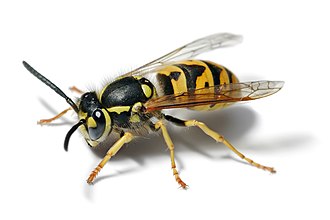
YellowjacketShana tova - happy new year.

Before I tell you about the lady on your left, it has come to my attention that some people out there in Email Land have lost their copy of my world-famous "25 Questions to Think About Between Rosh Hashana and Yom Kippur".


Here's the download link.

This year, you can also get the Yom Kippur Prep worksheet: here's the link.

(And if you'd like to hear the audio from San Francisco last week on how to use these two tools, shoot me an email.)

So now to the main story and question for your table....

Kids returning to school always hear that profound question, What's your best memory of the summer?

How come nobody asks, What's the worst memory of your summer? ??

Just askin'.

All that honey this week and an email in my inbox asking about the Jewish take on environmentalism reminded me of my own worst memory of this summer.

It was just a little bee sting.

But it wasn't an ordinary bee sting.

It was in fact a horrible, vicious, nightmare-inducing wasp sting.

Here's how it happened.

You'll undoubtedly be pleased to learn that your e-rabbi (iRabbi?) has a pretty good environmental record.

He conserves water.

He brings a reusable shopping bag.

He composts.

He plants trees.

He walks to work....sometimes.

He even sends out his annual Rosh-Hashana-Yom-Kippur mailer electronically (you're reading it right now) - think of how many trees did not have to die in order to send you this email.

(He does not hug trees.)

So now try to imagine him this summer, mid-July, innocently emptying the kitchen waste into the compost bin one early evening.

He goes to the shed to get the shovel. You may know the routine: good compost needs greens, browns, air and water.

He innocently shovels from the pile of last fall's leaves.

Evidently, a dead brach at the back of that pile is touching a wasp's nest behind the bin.

When the pile is shoveled in a certain way, the branch is distrubed, bumping the next.

This displeases the wasps.

Suddenly an insanely fast yellowjacket appears out of nowhere and aims straight for his head.

papabeesIt chases your unfortunate rabbi across the backyard like poor Papa Berenstain Bear, trying to defend himself with a heavy spade against an absolutely relentless vespula.

Fresh out of hap, your iRabbi ends up with a sting to the left ear that swells for three days and starts oozing puss on day 4.

And that's only the first time. Don't ask about the second time.

So this summer memory leads to three questions.

1. When I somehow disturbed their nest, I would have expected the entire colony to come out and attack me like Papa Bear in the picture above. Instead, it was one solo wasp. How did they decide which one would go out and sting?

2. The obvious next step is to call the Brody Brothers exterminators (their motto  is "nice Jewish boys with a license to kill"), but then I read that wasps like to eat those critter that have been eating my tomatoes. What do you think? Exterminate or accept our new insect overlords?

3. The first time I was stung in my left ear, the second time in my right ear. Is there a message in that?

Please let me know what the latter-day sages at your Shabbat table have to say about these three pressing issues.

l'Shabbat Shalom and l'Shana Tova!

May you and yours be sealed in the Book of Life for a sweet, healthy and restful-but-never-boring year.


It is customary to increase giving tzedakah at this time of year. JSL's educational mission is supported by tax-deductible donations from people like you. Please also consider supporting (or increasing your support for) your local Jewish schoolsdon't wait to be asked!

Like this blog? How about voting with your finger: Like it, tweet it, or just forward it.

Friday, September 11, 2015

Bent Into Shape

The goal of this email is to give some give-and-take for your Shabbat table.... please print and share.

shofarGreetings.

It has been a few months since Table Talk went on an extended holiday so that I could complete my dissertation.

As of this week, I feel done.

But am I?

Who decides?

One man: my dissertation advisor.

Some good news in my inbox this morning:

"I agree with you that we are coming near a wrap and passing your work to a committee...."

That's my advisor writing.

It ain't over folks, but I have less of an excuse now not to write this Friday email.

Here's a question for your table: Which of the following doesn't belong:

a. The Jewish New Year
b. Blow the shofar
c. Dip apples in honey
d. Go to shul

The answer is: b - blow the shofar.

Why doesn't it belong?

It's the only one on the list that is actually mentioned in the Torah. The other three are customs.

(In fact, choice a is just wrong. If you want to know why, shoot me a reply.)

So if you want to get to the essence of Rosh Hashana, you gotta get into the shofar.

There are plenty of online articles about this beautiful mitzvah.

I would like to direct your attention to one aspect of the shofar that is often overlooked, especially by people who hear it every year.

Why a curved horn? There are animals with straight horns, but the shofar traditions that we inherited are all curved?

The rabbis say that the curve is to remind us that one of the most important ingredients in having a great year to come is to begin with a bit of humility.

You are great. You are an amazing, incredible, unique, wonderful, invaluable human being.

Just don't let it go to your head.


The year feels almost over. But when is it? Who decides? An advisor? A committee?
Shabbat Shalom and l'Shana Tova!

May you and yours be inscribed and sealed for a good life. May your dreams and hopes be fulfilled. May you enjoy health and wealth, family and friends, and meaningful things to do.


Like this blog? How about voting with your finger: Like it, tweet it, or just forward it.

Wednesday, October 08, 2014

Do you say "rooof" or "ruf"?

In memory of Ronald Fischman, 54, was stabbed to death in his Philadelphia home last week by a man he had tried to help. He was described by his rabbi as "one of the most compassionate people I know - he had an enormous heart."
(To dedicate a future Table Talk, send an email.)


mendel-sukkahToday's title is a serious question - How do you pronounce the word "roof"?

Where I grew up, the top of your house was pronounced "ruf" (rhymes with book) and the horse's foot a "huf".

Then I moved to Mississippi. Down there folks say "reeuf" (sounds better in a phrase, like "cat on a hot tin reeuf").

Then my Mississippi buddy and I drove across the country in his pickup. His name is Billy Joe. I am not making this up.

When we got to California, we happened to arrive in time for my cousins wedding. He didn't want to stay for the whole wedding of distant cousins of mine that I myself hardly knew. But he stayed for the ceremony and reception.

Upon departure, BJ made this observation:

"That wan't no wedding."

"What are you talking about?"

"I'm telling you, that wan't no wedding. There ain't no wedding cake!"

(BJ likes cake.)

Here's the deal. The High Holidays are a banquet. Rosh Hashana is the Entrée. Yom Kippur (ironically because we fast) is the First Course. Sukkot is the Main Course. Simchat Torah is Dessert.

Now, if you had your Entrée and First Course but don't have your Main Course, you're going to leave the Banquet a bit hungry.

So first thing to do over the next 8 days is find a Sukka to sit in for a few minutes. Chances are there's one near you.

Now, you could have the Main Course but leave before dessert, but if you do, your soul is gonna say, "That wan't no wedding!"

And if and when you find yourself in a sukkah, here's the question to ask: What's the most important thing to have in a sukkah?

Happy Holidays and Shana Tova and don't forget to enjoy our beautiful new Fall Good News Newsletter.


(This blog will be enjoying the Banquet until October 24)


Like this email? How about putting your mouse where your mouth is: Like it, tweet it, or just forward it to someone who might enjoy it.

Tuesday, September 23, 2014

Overwhelmed? Here's what to do.

The goal of this blog is to inspire a new year of engaging dinner table discussions with the whole family. 
Dedicated in honor of Kyle and Shelli's anniversary - mazal tov! You are true roll models for how to create an amazing family.

I would especially like to wish
you and yours a healthy, happy and sweet new year. As many have noted, 5774 was a challenging year for the Jewish People and the world. May 5775 be a year of true peace.


bigstock-The-word-Everything-on-a-To-Do-45656401Last Friday, I asked, For you, what's a good life?
 

By now, I assume you've had deep meaningful discussions around that question. Therefore the goal today is to create some action points for Rosh Hashana, to turn theory into practice.
  
Let's make it global in perspective, local in action.
Globally, there's some highly disturbing news. So much so that it can be overwhelming.


First, there's global warming. It's happening too fast and is alarming. 

Second, the incredible rise in violence by the anti-idolatry group in Syria and Iraq (who named themselves after an ancient Egyptian goddess by the way).

Third, let's add the ebola tragedy. Some of the world's experts in infectious diseases are quite worried about this one. It is becoming an historic pandemic of biblical proportions.


To call the suffering heart-wrenching seems like an insultingly huge understatement. Is this what it takes to get Americans to wake up?


Fourth, let's not forget about the new reality of Big Brother. He appears here to stay.
( : -  ( >

 
What does all this have to do with Rosh Hashana?


More important what does it have to do with you and me?

Most important, what does it have to do with me?

The connection is through a little tidbit of rabbinic wisdom.

The rabbis tell us that in order to live a meaningful life, don't just absorb the news passively. Don't just react as if it's happening somewhere "over there".


Instead, react as if you are living in a Matrix-like virtual reality where everything that happens is custom-designed for you.

For example, take the ISIS stuff. A historian will react with detached historical question, a sociologist with a detached sociological question.

A Jew entering Rosh Hashana will ask a very attached question: What is the message here for me personally?

It is interesting that the ancient Pirkei Avot - the Jewish book of ethics, deals with these very two issues - an increase of knife violence and an increase of infectuous disease. The rabbis who wrote Pirkei Avot transmitted two very specific, very attached interpretations of these two news events.
The sword comes to the world for the procrastination of justice, the corruption of justice, and because of those who misinterpret the Torah.

Plagues increase....in the fourth year [of the seven-year cycle], because of [the neglect of] the tithe to the poor that must be given on the third year; in the seventh, because of the tithe to the poor that must be given on the sixth; on the year after the seventh, because of the produce of the sabbatical year; and following each festival, because of the robbing of the poor of the gifts due to them.
In other words, to use the current news as a call to action should mean increasing the learning and teaching of Torah, and increasing tithing (giving 1/10 of your income to charity).

What's the connection to Rosh Hashana?

Rosh Hashana is our annual chance to recalibrate. Where are you going? What kind of person do you want to be? Patient or impatient? Giving or selfish? Warm or cold? Energetic or lazy?

And why?

Rosh Hashana is an amazing day for revisiting yourself. My handy one-page sheet may be a useful guide (see below).

That said, Rambam (Maimonides) says that one of the best ways to change your personality is to start by changing a habit.

For example, a person who wants to become more friendly but doesn't feel like it could start by trying to smile more. That smiling will lead to a greater inner sense of friendliness.

I have a worksheet to help you think about these big questions on Rosh Hashana. I'd like to send it to you.

But the news is telling us - screaming at us - to do more: to increase Torah and increase tzedakah (charity).

Hey, great timing! There happens to be an ancient Jewish tradition of increasing Torah and tzedakah at this time of year. Giving tzedakah is the action Rambam was talking about - its a selfless action. Most of my shortcomings are rooted in selfishness! What a smart tradition!

In fact, there is a present need. As long-term subscribers know, I rarely ask for anything. Although there are expenses involved in creating this weekly email, it comes to you every week like public radio, free of charge. Once or twice a year I ask for your support. For the above reasons, this is the best time of year for you to become a partner, or to renew your partnership.

To thank you for your one-time or monthly donation to support JSL's teaching of Torah wisdom, we'll send you these new 2014 materials:

1. 25 Questions to Think About From Rosh Hashana to Yom Kippur (2014 edition)
2. Traditional Simanim-Omens for Rosh Hashana Dinner.
Here's a sample.

3. My Rosh Hashana prep class (audio) from last week

Here's the organization website: jsli.org.
Here's the donation link: jsli.org/donate.


Finally, I'd like to end with an update on our friend Harmon, in San Francisco.

Harmon loves to sail. So much so that when given the opportunity to put his life on hold and jump on a world-class sailboat in Alaska as a voluntary crew member, Harmon signed up. It was to be a month or more at sea.

Think of all the preparations you'd have to make to leave your family and business for a month. Not to mention the sailing-specific prep.

Think of the disappointment when the trip has to be cancelled due to weather etc. Docking for the winter. Yada yada yada.

The reason that Harmon's story is an inspirational Rosh Hashana story is because he dared to dream big. BIG. It didn't work out this time, but the dream is still there. The prep work, that's all the hard work, but it has to start with a dream, a vision.

That's Rosh Hashana - a day to clarify your dreams. What kind of person do you want to be? What kind of life do you want to live? Get my 25 Questions sheet and start to work it out, and use Rosh Hashana to set sail to a great year.


  Positive thinking can only get you shofar 
L'Shana Tova!

May you and your family be inscribed and sealed for life, health, happiness and peace in 5775. 

Have a sweet year.


PS - If you search youtube you may find my experimental RH/YK videos from a few years ago.

PPS – To find High Holiday books and activities for kids, or gifts for teachers (and other thoughtful adults), please use bestjewishkidsbooks.com.

Like this email? How about putting your mouse where your mouth is: Like it, tweet it, or just forward it to someone who might enjoy it.


Friday, September 19, 2014

For You, What's a Good Life?

The goal of this blog is leverage the last Shabbat of the year to steer us towards a meaningful Rosh Hashana.

We are working hard on a special Rosh Hashana Table Talk for next Wednesday. In the meantime, if you are still looking for books, activities and gifts for all ages, see our suggestions and links at bestjewishkidsbooks.com
.


I gave at the synagogueThis is the final regular Table Talk of the year, folks.

For today, to prepare you and your family for next Wednesday's Rosh Hashana email, I have three questions.

First, take a moment to look at the photo to the left then read on.

What was your first reaction to the photo? Did you see a poor sheep missing a horn, or a sheep that thankfully has a horn?

Think about your reaction for a moment and how that may reflect your general attitude towards life.

Second is a simple question that doesn't get asked often enough:

If you had to choose, what would you rather have:

A) A long and comfortable, healthy life devoid of meaning.
B) A long and uncomfortable life full of meaning.


Think before you answer.

I know you want to say an answer that isn't one of the choices. Stick to those two choices.

Now for today's third question, after everyone picks between those two choices, ask them to choose between their answer and option C:

C) A short and comfortable, healthy life full of meaning.

In other words, in the first round, you're asked to choose between comfort and meaning, and in the second round between comfort and longevity.

What do you choose?

Shabbat Shalom


To find Amazon's best High Holiday books, activities and gifts, please use bestjewishkidsbooks.com and help support JSL's work.

Like this post? How about putting your mouse where your mouth is: Like it, tweet it, or just forward it to someone who might enjoy it.


Wednesday, September 04, 2013

If I Can Do It, So Can You

The purpose of this email is to stimulate the cerebral cortex of those at your Rosh Hashana table. Please print and share.
Please see below for an important announcement.


Full mailboxWhen is losing gaining, and gaining losing?

Today, erev Rosh Hashana, I have a story for you to share at your table.

A true story of grit, sweat and determination.

It is the dramatic and ultimately cathartic tale of my...

INBOX.

Yes, it's true. The last Table Talk of the year (and the first, if you share it tonight) is a blog about the inbox.

Most of the time we are in such denial about our inbox that we pretend that it's not worthy of conversation.

But if you think about it, the inbox is an excellent indicator of a person's inner health.

Show me your inbox and I'll know what kind of person you are.

Show me a person with an endless inbox, and I'll show you a person who never seems to get projects finished, is always running from one thing to another and feeling quite overwhelmed by life.

(Or perhaps it's just a person who is using gmail. For some reason.)

Show me a person with an empty inbox, and I'll show you someone who is in charge of their life.

But (aside from those who suffer from gmail-itis) is an empty inbox even possible? And if it is possible, is it a goal worth striving for?

My personal story begins two years ago when I saw my inbox surge - after deleting spam and all low-hanging fruit - to over 900 messages. To some of you that probably seems petty, like someone bemoaning gaining five pounds.

It was indeed similar to the feeling I had around the same time when I noticed my waistline exceed 36 inches.

I could see the direction this was going.

And I didn't like it.

I knew it was going to be an epic battle, a clash of wills between me and.... myself.

Who was going to win?

There are multiple roads to success on trimming down. But what's the value if you lose but regain?

So the first step is setting up some new habits. Like folders to file away any email that doesn't get a reply within 1 week. For any reason. If it didn't get a reply in a week, it must not have been that urgent.

Well, like my weight loss, I was able to trim significant fat in the first year. But when I got to around 100 messages, it seemed like I just couldn't cut more. That inbox bounced up and down from about 75-125 for this past year.

It was crazy. And a bit frustrating.

Maybe a sane person would just give up and learn to live with himself.

Maybe I'm insane, but last Rosh Hashana I decided to dream big.

I dreamed of what I wanted to become, my greatest vision for myself.

And that was someone with an empty INBOX.

Frankly, it has been a brutal year. Up and down, up and down, more down than up, but then you go out of town and look what happens, you end up bloated... What kept me hopeful through it all was that vision.

And of course I had a plan, a system.

Well, today I'm happy to say, on the very last day of the year I did it.

I surely had a lot of help from Above, but the first thing I had was a vision, a dream.

What's your dream? What kind of person would you like to become?

Organized? Patient? Punctual? Calm?

Happy?

Visualize that potential you on Rosh Hashana. Ask for it when you hear the shofar.

Then on Sunday morning, write down on low-tech paper three steps you need to take to get there.

Tonight and over the next 2 days is our annual chance to  push RESET.

How is this year going to be differerent for you? Is it going to be the same old patterns and bad habits, or something new.

Think about what it would be like to have an EMPTY inbox.

Down to ZERO messages.

It feels great.

I recommend you do it to.

Not only with your email. With any clutter in your life.

If you knew you could absolutely accomplish one personal goal in the coming year, what would it be? Think about that yearning dream when you listen to the shofar tomorrow.

That vision is what will justify another year of life.

Important Announcement: At this time of year, many people try to give extra tzedaka. If you're that type, please help eleviate hunger or support Jewish education. This blog is supported exclusively by tax-deductible contributions from readers like you. This is one of two times each year we invite you to become a paid subscriber. Nothing is free, so if you're not a supporter, someone else is paying for you to enjoy this. If it's worth a nickel to you or more, please do the math and click here. It only takes a minute or so and any amount helps.

May you be inscribed and sealed for life, joy, health, wealth and peace...and an empty inbox.

RAS


PS - I've created a downloadable sheet of "significant omens" that are traditionally said at the Rosh Hashana meal. I've added a few jocular modern ones. Try adding your own, and encourage anyone you're with to do the same. The public sample is here, you can download the full one here (requires free logon if you don't already have one).