Showing posts with label death. Show all posts

Friday, October 12, 2018

But Are We Awake?

The purpose of this blog is to restore spirited conversation to the Shabbat table. Please print and share.
In honor of someone very special's birthday today.... Happy birthday, Mom!
And a big mazal tov to Shalev and Rocky on your wedding!
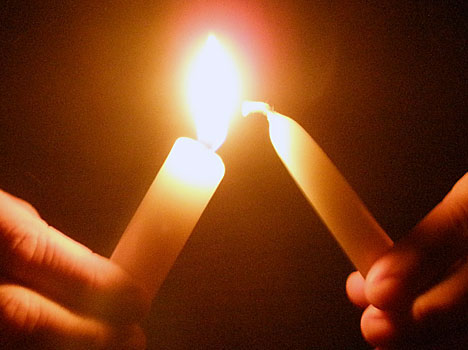

two-candles-in-handsA Jew I know just lost his non-Jewish mother.

Unlike the Jewish custom of quick burial, this Catholic family will not have the funeral for several weeks.

First 2 questions for your table - Have you ever been to a wake? Do you know why they call it that?

(No, it isn't because they hope the deceased will wake up.)

Once upon a time, I attended one. It wasn't Catholic, as far as I recall. They just called it that. It was in a funeral home. The deceased was a young man - 18 years old - who had drowned while swimming with friends in a rural swimming hole.

It was incredibly sad. But seeing him there, embalmed with makeup to make him look like he was merely sleeping, somehow made it more painful, to me.

Next 2 questions: Why don't Jews do embalming? Why do we hurry to bury our dead?

We obviously love life, we don't love death.

But we don't ignore it. We even have a beracha to say upon the death of a loved one.

Question 5 for your table - Why don't we like to talk about it? Why does it make us so uncomfortable?


Some say that the answer is because we live in a culture that really does glorify the physical aspect of existence (the human body and its pleasures) and we have all been trained from a very young age to  become deeply attached to that vitality.

Put it this way: the Olympics and Superbowl get a bit more attention than the World Chess Championship.

(Although it's always encouraging to see the media pay attention to the newest Nobel Prizes.)

Others point out that even spiritual people have trouble with death. They argue that we expect God to be good and loving and kind and taking a loved one away is painful and therefore unkind and that's a contradiction so we'd rather ignore it than grapple with the contradiction.

What say you?

According to the Talmud, there are 903 types of death.

(And if anyone cares, it even tells us which are the most and the least painful.)

Question 6 for your table - What would you say are the best and worst ways to die?

Question 7 - If the Talmud is going to talk about 903 ways to die, why doesn't it also tell us how many ways there are to live?


Shabbat Shalom

 
Enjoyed this Table Talk? Vote with your fingers!  , , forward it....


Friday, December 25, 2015

Make Beer, Not War

The purpose of this blog is to turn Friday night dinner into Shabbat.... Please print and share.
 
Jaffa-GateTwo days ago, on Wednesday morning, Rabbi Reuven Biermacher went to Jerusalem's Old City.

At 10 am the 45-year-old immigrant from Argentina taught a group of Panamanian 16-year-olds something from the Talmud.

They were on summer vacation and their counselor came by to ask the rabbi to give them a break.


The students demurred, “No! We don’t want a break. This is the best class of the day!”

At 11 am he gave his regular Talmud class, followed by a short talk to a group of South American students.

What all three classes had in common was a beloved, wise rabbi, "full of joy and life", who cared for each of his students.

At 12:45 he left the yeshiva and headed towards Jaffa Gate, which is the main route taken by Jewish residents and tourists, and anyone else who wants to use it. The footpath outside Jaffa Gate looks like any sidewalk in any large city.

It was an unseasonably warm, sunny December day in Jerusalem.

And there, returning home to his wife and seven children, Rabbi Biermacher encountered evil.

Two young men lunged at him with knives.

Ofer Ben-Ari, 46, happened to be driving by and witnessed the attack. With only his bare hands as weapons, he ran out of his car to save the rabbi's life.

Police arrived moments later and Ben-Ari was hit by a stray bullet.


Both victims were rushed to Shaare Zedek Medical Center where they died within an hour of each other.

Biermacher's 16-year-old daughter described him as "a man of gold who never harmed anyone." One of his colleagues said in a eulogy, "He was walking example of what we all aspire to be....He was always there for everyone.... We have to take responsibility to live up to his example and make a serious change in our lives..... To look at what happened as a message to me, to think that I deserved this more than he did, and I am lucky to be here. God has chosen the best among us deliberately.... Instead of thinking, 'Am I safe or am I not safe?' we should think, "What matters is that I'm doing my job."

Ben-Ari owned a recording studio in Jerusalem and opened it free of charge to distressed youth. He also provided temporary housing for the homeless in a property he owned. He is survived by his wife and two children and here is a brief report of his funeral.

2 victimsThese two tragedies leave one speechless.

But I am not sharing them with you to make you sad, rather to foster a discussion at your dinner table. Perhaps these two questions are appropriate:

We know that everyone has to die. But is it better to die quickly and suddenly as they did (in this case as heroes), but without a chance for anyone to say goodbye? Or to suffer a period of illness first?

We all know (but don't like to think about it too much) that anyone and everyone's fortune could change in a moment. So what?


Shabbat Shalom.

PS - Funds are being established to help the two widows and nine orphans. For more info, post a comment or send an email.


Like this post? How about voting with your finger: Like it, tweet it, or just forward it.

Friday, July 17, 2015

Champion of Justice

The goal of this blog is to evoke cathartic Shabbat-table discussion. Please print and share with someone tonight.
(To dedicate a future Table Talk, send an email.

Six Months Before He DiedAs promised in last week's anti-Cosby blog, here is Part 2 of a series in honor of my father's 10th yahrzeit.

Today:
1. Eulogy
2. Question
3. Special 4-min video.

The Eulogy is what I said ten years ago at his funeral. At the time I was speaking from notes and while people asked me for a copy of the speech, I just didn't have the wherewithall to type it up. It took a lot of work, so I hope that someone out there reading it, whether or not you were at the funeral ten years ago, will find something inspirational within this entirely inadequate summary of the life of my father.

After I agreed to speak, I felt I wasn’t up to task. I’ve only known my dad a short time, compared to most of you.

I was also a bit worried – how do I, coming from what appears to be a different spiritual take on life than my dad, speak about him, appropriately? Yet I was looking through some of his journal’s last night. When he traveled, he kept journals, detailed journals: when he ate, where he ate, what he liked about the food, what he didn’t like, the waiter’s name, how much the meal cost, what the exchange rate was….And I saw clues of a spiritual life there that looked very, very similar to my own.

But we never talked about these things in detail. Maybe because I was not trying to wear my spirituality on my sleeve (maybe on my head, but not on my sleeve). It just wasn’t a topic that came up. We were much more interested in what we had in common – we had so many things in common. It just wasn’t an issue.

There are seven people who are called “kerovim” – close family : the seven mourners: father, mother, brother, sister, son, daughter, and of course, wife. Those are the ones who are supposed to be comforted by everyone else. But I know, because I’m a product of this community, and I know, because I’m here now, and I know, because even though I don’t live here now I’m in touch with this community, constantly, that my dad was like a father or brother to many, many, many people. He wasn’t just a friend. He was a friend that was like a brother, like a father, a trusted counselor….

And what do I say, when someone like that calls me up to wish me comfort? What do I say to the G______s and the C______s and the W______s and the W_______s and on and on and on? We’re crying together. We kerovim are supposed to feel the greatest pain, the greatest agony and grief. Yet these words are empty compared to how we all feel right now. “Anguish” maybe. “Bereavement.”

As you know, I’m one of three children, whom my dad loved equally, and in addition to his children and grandchildren and extended family he had buddies. Someone called me yesterday who knew him since seventh grade. He had buddies from high school and college. I saw a picture last night from second grade with Freddy Warnick (that’s what it said: “Freddy” Warnick).

But who am I, what do I say, when Denny’s buddy from his childhood, or his friend from college, or his partner of many years, or his daily running mate, or his fellow board member, or the woman he hired, or the man whose business he helped save – what do we say when they call to comfort me? The extended family, the close and dear friends, the associates and clients, the employees and even adversaries, who felt that spark of closeness that none of us can even talk about him in the past tense?

There were so many people who were like kerovim to him, and I think the reason we all felt this way about him, why we all feel this way about him, is because he because he had this way, that I think was quite rare, of entering our lives individually. As if we were the most important people in the world when he was speaking to us – he was so empathetic in that way.

It doesn’t matter what the relationship was, whether it was professional, or whether it was friendly, whether you were a running buddy of his, whether he bought coffee from you once in awhile, or whether you were working with him on a big project.

There is something called kria which means tearing the clothing, which the seven kerovim do. It represents the feeling of someone having been torn from us. So many of us here today feel like we have lost a family member, we are all bereaved – of a person who was not just central to our lives, but essential to our lives and to the community. The shock we are feeling is the shock that someone would feel if he woke up without his left arm.  How do you cope? How do you process this? What do you do next? How do you say goodbye so fast? How do you sum up a life so quickly? A life that goes way back, and broad, and deep.

When people start talking about my dad, they use all kinds of words….

Personable
Professional
Empathetic
Zealous
Charitable
Easy-going
Humble

I’m not going to speak about all of these qualities, there will be time later today, people will be talking about these qualities, and people who knew him in ways that I didn’t know. And I think those are just starting to describe who he was. They are for sure all true and you could pick so many anecdotes to illustrate those.

I’m going to focus just for a couple minutes on three qualities that are not on the list.

You don’t hear people say these three qualities, but I think that that when you hear the depth of what I want to say, I think if you hear the concepts, you will agree with me that this touches upon something about my dad, about who Denny Seinfeld was. And not only what he was, what we admired about him, and what we all want to strive to be, and how we want to remain inspired by him.

My father had a very Talmudic way of discussing things. If you ever discussed anything with him, and I know you all did…. He called it Socratic: he would pose a question to you. Instead of tealling you his opinion, he’d ask you a tough question and make you think like, “Oh, he’s got me on that one”, and you’d really have to think fast.

So in Talmudic fashion, in Dad’s honor, I’m going to ask you a question. I’ll ask you about these three qualities that I found in the Talmud, and ask you to tell me if you think he was any of these three things, and why, and of course it’s a trick question:

Was my father a wise man?
Was he a strong man?
Was he a wealthy man?

The first one’s easy to answer, right? People went to him for advice. Isn’t that what a wise man is, someone you go to for advice? Could be…. But not in the Talmudic sense: that’s not what the Talmud means by “wise”.

My dad, Dovid ben Eliezer was also known as Dennis Gary – Denny – Dad – his eight grandchildren knew him as Saba…. We all knew him in our own special way, with our special name.

You know where he got that trait from? From his parents, his parents whom many of us escorted to this very spot only a couple years ago. I think his parents were optimists. They had two children during the painful depths of the Depression, while war was looming. Most of the country waited until after the war to have their baby boom, but the Seinfelds didn’t wait. Bringing not one but two children into the world named D-D and Denny was a simple (and very Jewish) act of pure hope and optimism. My Dad, a great empathizer, who really celebrated and suffered other people’s celebrations and suffering, also learned from his father how to say, “Life goes on.”

Some of you here remember him as a kid. His 6th grade teacher, Mrs. Marsh, had a different perspective on his social skills, writing that he “could show more initiative and exercise leadership by looking ahead and anticipating situations.” In other words, she was saying he was little short-sighted, not able to see the outcome of situations. However, Mrs. Marsh was also confident that he would develop those qualities as the elected class president, and by the spring report card, she reported that he indeed had.

So you know the Talmud does ask the question, “What does it mean to be a wise person?” and of course when a rabbi asks you that question, you know that the right answer is not “knowing a lot of stuff.” It says that wise means someone who foresees the outcome of a situation.

You know you read in the obituary that he served on so many committees, on so many boards, you have to wonder, why did they want him so much? Because he could foresee the outcome. He thought ahead. He was the kind of person you love to have on your committee and you hate to have on your committee at the same time. You love to have him there because he asks the tough questions. You hate having him there because he asks the tough questions. He had not only the ability but the all-important tenacity to ask the tough questions, to push us – believe you me, his children included – to consider all the possible outcomes. He didn’t mind that painful thing called thinking, and making other people do so too. I think he taught this to us too — all of us who are his disciples. All of us: his children and everyone else.

The Talmud’s other answer to the question is that a wise person is someone who learns from every one else. That’s what it means to be wise. It’s very interesting the way the Talmud says this, which is only clear in the Hebrew. It doesn’t say every other adult, it doesn’t say from every other Jewish person, it doesn’t say from every other man…. It says from every other human being. Is there a better description of my father’s relationship toward other human beings? All he wanted from people was to hear their ideas, their beliefs, their hopes and dreams – from the elderly to young children. My dad was a feminist before anyone thought of the term (although I suspect he may have picked some of this up from a certain woman he met in college). He didn’t mind learning from anybody, from his children, from his grandchildren. Everybody was a universe to him, and everybody meant something to him. He got their story. When he was on the TCC Board, he was so thrilled to be participating in those people’s lives, who would bring themselves up, and although he felt he had so little to do with it, he felt so inspired by them, taking htemselves from having a poor educational and economic foundation and making something out of their lives, and he wanted to learn about them and learn from them.

I know he talked that way about his family and his cousins.

His treatment of others was so natural to himself that it disarmed you if you weren’t used to it. Even when two of his children went (by local standards) off the deep end, if he was judgmental, he kept it to himself, he certainly didn’t ever make us feel ashamed of having chosen a different path than his own.

He simply had so few, if any, pretensions.  I remember when Jerry Seinfeld came to Tacoma. It was 1984 or 85, I think. Dad couldn’t care less that Jerry was a comedian – what mattered to him was that here was another Seinfeld and we didn’t know of any other Seinfelds before then. You see, my dad had this family tree that he made when he was a teenager, and there were some missing holes in it, and Here’s another Seinfeld! So he went down that night, a Saturday night, to the nightclub, and he met Jerry afterwards and came back with this new branch of the family tree all filled in, it was so exciting. The fact that Jerry became famous was interesting, but he wasn’t so concerned about that. He loved the idea that there were connections between people. Some years later he even flew down to LA for a taping of the show, because he was family. And I think this genuine love of people and respect for their wisdom is what drove him in all the non-profit work he did.

This wisdom I think is what drove his passion for Tacoma Community College. I don’t remember him more proud than when he told me about the award ceremony where they would honor students who had come from nothing – no education, no money, no support – and graduated from TCC..  Displaced people, people with no direction, who found their way. He loved getting to know the student, finding out their story.

I asked my mom, I understand why he served on the the TCC Board, but why did he go so far as to set up a scholarship fund there, not at one of his own prestigious colleges? And why did he put his name on it? That seems out of character. You know what she said to me? He was performing one of the highest levels of tzeddaka, which is: be a role model. Encourage others! If you don’t put your name on it and do it locally, then no one’s going to know about it. You have to show others, you have to pave the way. He wanted everybody to follow suit. He wanted people to be part of the community and to contribute. That’s what he was all about. You know that. And if you and I are not living up to that, well that’s our fault, because he certainly gave us all the signals of what we should be doing.

You know, both my Dad and Mom raised their children with this value from a very young age: A slice of what you make, you have to give back. How much? Oh, about ten percent. When I started learning in yeshiva in Israel I shared with my dad that it says in Jewish books that it’s supposed to be ten percent, and he said, “Wow, that’s kind of neat.” I mean, he had intuited that; no one had ever taught him that. He just felt that ten percent of what you make, you give back.

How many people in this community can we stand here and say that about them? How is this community going to replace that kind of attitude, which wasn’t a philosophy, it was part of who he was? Who is going to fill his shoes?


He loved to tell people how much “bang for your buck” everyone gets out of a CC education –for 1000/year you can have a year of education – nurses, dental technicians, people who would really benefit society.

We know how he loved life, how he cultivated things. He wasn’t necessarily so great at things. He wasn’t a world-class tennis player. But he could play tennis. And squash, and raquet ball, and down-hill skiing, and water skiing and cross-country skiing…. basketball? Did I mention he was an avid swimmer and runner? Not like a fanatic; he just loved doing it. He loved the pleasure of it. He cultivated drinking wine. He went berry-picking on a daily basis. He would call me and say, “I’m just sitting here eating these berries and I’m waiting for you to come here and share them with me.” And now we have the last bucket of berries that he picked. You know he was just preparing for us to come. And when I told my daughter Goldy what happened (she’s six years old), she said, “Saba just told me last Friday how he was looking forward to us coming.”

And we came….

You know the only thing my dad loved more than all these things I’m talking about? There’s only one thing he liked better, and that was sharing them with other people.

He used to drag me out of bed at five-thirty or six in the morning to go for a run with him. Why? Because he enjoyed it so much he wanted to share it! You would go visit him and he would overload you with whatever he had at that moment. He had these little “Poke Boats”, a type of kayak, and he’d make you go out with him, he’d be very disappointed if you weren’t into it with him. That was his personality: he got pleasure from sharing and being part of your life.

Some of you may remember something he did in 1986. As part of a charity auction for Stadium High School, he was determined to be the highest bidder for the right to conduct the Stadium High School Band. He won that right. It was to be for the final concert at the Pantages Theatre. And it was to be for The Stars and Stripes Forever — with the big fanfare at the end with the trumpets and trombones coming out front. You know he got a John Phillip Sousa tape from the library, and he walked around the house conducting, practicing. And he just couldn’t get it. He couldn’t get the beat. He listened, he tried, and I tried to help him, I coached him as much as I could, and when the final performance came we thought he was ready, and fortunately we in the band knew the song by heart because we played it all the time in parades and everything, because he wasn’t with us at all, but he was so happy. Because he was doing tzedaka, and his children were there, and he was participating, and he was having fun, and that’s what life is supposed to be about. He was living. He was living! He wasn’t talking about living, he was doing it! He knew how to live.

A simlar thing happened many years later when he was going on a trip to France. Here is a man who had learned German in college and had been fluent in German, but hadn’t studied a foreign language since then. But he was going to make a trip to France, and he knew that the way you really enjoy a country is you speak the language. So he started putting up French vocabulary words all over the house. My mother would open drawers and there were French words, here, there and everywhere, everything was labeled. For six months, and he taught himself French. And I was skeptical. I heard about this over the phone. I was actually living in France at the time. I was thinking, “That’s cute.” And he came, and… he was doing it. He actually was communicating in French, at a passable level — enough that Parisians were not snobbish towards him. He just lived life.

Did anyone here ever see my dad angry? Of course not. He never got angry. Maybe a little, everyone does once in awhile, but so seldom. He never had that problem. He had such self-control.

The first question I’ve answered, “Was he wise?” The second question is, “Was he strong?” The Talmud says someone is strong who is in control of himself. Someone who doesn’t let his ego get out of hand. That’s my dad: no ego. Nothing was for himself, it was for his wife, his children, his community.

And the third question, what about wealthy? Was he wealthy.

The Talmudic answer is that you’re only wealthy if you’re happy with what you have. If you have a hundred million dollars and you want a hundred million and one, you’re a poor man. If you have nine dollars a week to spend, as my parents had in law school, and my mother had to come up with seven different ways to cook the same potatoes, they were happy. It was an adventure for them. My parents were known in the community as people who would go outdoors, hiking and camping, They didn’t grow up with that. They got a little ten-dollar pup-tent….(maybe it wasn’t ten dollars, that would be more than a week of food, it was probably more like two dollars), and they just found a campground on the map and went up there. You know, here’s all the New Englanders in their fancy tents and their fancy camping stoves, and here’s my parents trying not to touch the wall of the tent because if it rains then you get soaking wet….and that’s how they were, and life was an adventure for them. And they shared that together, every step of the way. In my mother’s house right now there are three books from the library, tour books for their planned next destination this fall.

I think that if my father had lived to his father’s age, to ninety, if he had lived as he should have, twenty-five more years, we would all stand here sad, but fulfilled. We had a full Denny! We had a full Dennis! We got a full Dad. We got everything out of him. We had so much more to get from him. I had so much more – I’m speaking personally. I have a whole list of things I wanted to discuss with him this summer. I was saving them. I can’t discuss them with anybody else. In that way he was what we call in Judaism a “rebbe” for a lot of people. He would know you and he had the wisdom, and he could put them together in a certain way. How is that fair? This person who is written up in the Tribune as “Champion of Justice” — how is it just, that he is taken away, not only from us, we’re not the only ones: he didn’t get the life either. Another twenty-five years.

There is a midrash (story) about Jacob the patriarch, a very interesting story. It says that before Jacob lived, everybody died suddenly. Nobody got sick before they died. Everybody, they would sneeze and they were dead, and that’s where we get the expression “God bless you” or “Gezuntheit” when people sneeze, it goes way back, because someone could sneeze and that could be the end. And Jacob prayed and said, “You know what? Can it be, God, that I get sick first and give people a chance to say goodbye to me?”

And so that’s why people do get sick and they get that chance, but we didn’t have that chance with Dad! It happened like that! I mean I couldn’t even….

We want you to know up there, if you’re listening: it’s a really good guy you took from us, and you took him too early.

There’s one other story I’ll tell you. This is also in the Talmud. It’s about one of the most righteous, learned women in Jewish history. Her name was Bruria. She was one of the great scholars of her generation, about eighteen hundred years ago. And her husband was a rabbi named Rabbi Meir, who was maybe as learned as she was. They had two children, two boys, who passed away, suddenly and unexpectedly on the Sabbath. He was out – her husband was out – and she put them on their beds and covered them with blankets and didn’t tell him, because you’re not supposed to tell someone bad news on the Sabbath. She waited until afterwards. And what she said to him was like this:

“What’s the law if someone gives you a security deposit, and they come back and want to collect it.”
He said (thinking I guess it’s a strange question for his learned wife to be asking him), “You have to give it back right away.”
She said, “We’ve had a deposit… and it has been collected.”

We had our time, and he was a gift. It’s not ours to say when a person gets collected. And it’s not ours to say it’s too soon. Because we’re not in control.

Such a precious, sweet and pure soul. So full of spiritual attachments, so distant from material attachments. So distant from pettiness.

Dad, we’re really grateful that you didn’t suffer pain at the end, that it happened quickly. That was a gift. We’re glad that you went out that way, in a way, even though we couldn’t say goodbye to you they way we wanted. You didn’t suffer.

How fitting it is, I think, if you think about it that my dad went out while he was reaching up to the sky. That’s how he lived, and that’s how he went out.

We’re going to miss you more than anything, Dad. And we are going to be so enriched by these years. And they’re not just words, and they’re not photographs, they’re what you put into us. They’re right here. We’re going to try to lay your broken body down here, cover it with dirt, we’ll say a little prayer, and let you go where evidently you need to go right now. And we’ll carry you with us all the time.


2. Question for your table:


What do you you want them to say at your funeral?


3. The important video
that I hope you'll watch and share with as many people as you can (especially anyone who knows anyone in Mexico):
https://www.youtube.com/watch?v=Ng4jP8wTZDI
Shabbat Shalom


Like this email? How about voting with your finger: Like it, tweet it, or just forward it.

Friday, April 19, 2013

Explosive News

In memory of my father, who would have turned 73 today.
The purpose of this blog is to promote soul-stirring conversation at the Shabbat table. Please print and share.


Photo credit: ABC News
Who said it:

"A tragedy and devastation that has stolen our innocence, forced our children to grow up way too soon to experience a pain that nobody should ever know, and to confront questions that simply have no answers."

Can you guess???

We all heard about two terrifying explosions this week (I'm counting Boston as one).

But there was a third that made fewer headlines.

The quote above was a response to the one you didn't hear about.

It happened this past Sunday, but the story begins twenty years ago.

Twenty years ago, yours, truly wandered into Jerusalem looking for a place to learn about Judaism.

Some Jews I'd met in Paris told me that there were these schools called yeshivas where beginners like me could learn.

In English.

For free.

(Although it isn't always easy to decide to go.)

(Nor to find them when you do decide to go.)

(Nor to learn once you get there.)

OK, I wasn't a total beginner, but I knew all of about 10 words in Hebrew, didn't know what the Western Wall was west of, and couldn't have told you why Jacob was the good guy and Esav was the bad guy (although I somehow knew that much).

There's a long story here, but let's cut to the chase.

rabbimikestern
One of the several yeshivas I tried out put me up in an apartment with a couple other guys in it.

One of these guys was a rabbinical student named Mike.

Mike was about two days from his wedding.

He was one of the happiest guys I'd ever met.

He invited me to the wedding and it had a profound impact on me. That night I wrote in my journal, "I don't know if I'll ever become religious, but I know that I want to get married like that!"

Later I often visited Mike and Denise in their Jerusalem apartment. I helped with the baby, etc. And I discovered that Mike (and Denise) was happy all the time, it wasn't just because of his wedding.

That happy energy made Mike and Denise a magnet for all kinds of people, Jewish and Gentile. They set up rabbi-shop in Philly for a few years, then in Milwaukee, and most recently in Boca Raton.

Over the past twenty years, they have hosted thousands at their Shabbat table. The impact of their kindness is immeasuraable.

Twelve years ago, while they were still in Philly and the world was still innocent, they had a baby girl, their second daughter and fourth child.

MIke and Denise named her Shoshana Rachel, which means "the Rose of Rachel".

Shoshie grew up in a family whose middle name was Lovingkindness.

shoshieShe grew up with a natural compassion, second nature to her.  She was the rare kid who never complained where she had to sit in the carpool, or next to whom, she was happy and she connected with all kinds of people.

Shoshie was also a natural athlete, and on Sunday afternoon, she went out sliding (reportedly a form of skateboarding).

She was crossing a street at the crosswalk. She waited for the light. She was not wearing headphones or otherwise distracted. She passed in front of a car waiting at the light and smiled her warm smile at the driver, perhaps she recognized him, a member of her Jewish community.

This happy smile was her final communication.

To his horror, the driver watched the light change before Shoshie reached the other side. He realized that she was in mortal danger but there was nothing he could do. A moment later,  a car (not speeding) hit her, she was in the air and she was gone. This eyewitness, a doctor, leaped out of his own car and rushed to the scene but her soul had already departed.

An hour later when Denise went out looking for her daughter, the ambulance had already come and gone and the police were doing their investigation.

The 1,000 people at Shoshie's funeral Tuesday, arriving from all corners of the country, were a testament to what Mike and Denise mean to us.

By "us" I mean you and me.

I paid a shiva call yesterday, and would like to leave you with two things that Denise told me. Maybe you'll share them with your table.

First, I asked her, "If you had known 12 years ago that you would have only been able to have Shoshie around for 12 years, would you have wanted to have her, or is the pain of losing her too great?"

Denise said, "Are you kidding? I hate that she's gone, it hurts, but I'm grateful that she was in my life. She was a light. I'm a religious person, I was in Jerusalem for eight years. I believe that everything happens for a reason, even if I don't know the reason."

Shoshie had just recently prepared for her parents a gift of a collage of photos of herself, and a birthday gift for her sister two months in advance. These were bizarre things for her to do and Denise said that Shoshie must have known subconsciously that her time here was running out.

"What is an example of how she was a light?"

"When we moved here, Shoshie was a new kid in school. But she wasted no time making an impact. There was some kind of feud going on between two girls and each one had gotten into her own clique, and Shoshie made them make up. She told them, 'I'm not going to be friends with either of you unless you make up.' And they listened to her. That's the kind of girl she was."

May her memory be for a blessing.


Shabbat Shalom

PS - The best way to honor the departed is to try to emulate their goodness and to teach it to our children. JSL's Simi Yellen is offering her incomparable parenting course via telephone, beginning next week. Click here for details. Whether for yourself or a parent you know, we only get one chance to raise a Shoshie, this is the time to put in the time and effort.

Friday, July 29, 2011

Older But Wiser?

In memory of my father, Dennis Seinfeld (Dovid ben Eliezer).


Last Friday night I went as usual to the nearby assisted-living home.

Small place, only about 30 residents.

As a rule, by the time I arrive (after dinner) the only residents I see are those who want to participate in the Shabbat program (kiddush + story). Everyone else go up to their rooms straight after dinner.

So it surprised me to see Mr. Aaron still sitting there. At 103 years old and nearly deaf, I doubted he had stayed around for me, maybe he was just feeling too tired to get up.

Anyway, after the program, as I rose to leave, he suddenly stood up and asked me, "Would you walk me to my room?"

He was shuffling with a walker. Big man. Strong man. You could tell he had been fit once upon a time.

We walked to the elevator. I wish I could say we had a meaningful conversation. With his hearing loss, it was next to impossible. I knew that he had a lot going on inside there, because over the course of the past few years knowing him, a great sense of humor occasionally came out.

Like the time 2 years ago he had been in the hospital. When he returned home, I told him, "Good to see you on your feet!"

"Better than on someone else's feet!" he retorted.

Last Friday night was the last I saw him. He was "niftar" this week and the funeral was yesterday.

Yesterday was also the 6th Yahrzeit (anniversary) of my father's petira.

Many people don't know the word "petira" (and niftar, the adjective form) but it's a great word to add to your Jewish vocabulary.

It doesn't mean "passing" or "death".

It literally means "exemption" or better, "absolution".

Exemption from what?

From doing mitzvot (mitzvos).

Isn't that a strange way to refer to someone's passing?

Well, what does "passing" mean?

Think about it.

I did several things in his memory yesterday.

- Lit a 24-hour candle Wednesday night.
- Said kaddish in a minyan
- Learned a little bit of Torah in his honor.

I also went to a funeral.

Of course, the funeral had nothing to do with my father, but it brought back memories.

I sat in the back, and listened to Mr. Aaron's grandchildren (he had outlived his children) talking about this man's long, productive life.

Like my father, he had been an attorney. Like my father, he had been the epitome of compassion.

One time, a grandson told, they were having lunch at a restaurant and his grandfather ordered an extra sandwich to go. What was this for? For a hungry person he had seen outside on the way in.

It's great to hear these kinds of stories, because if you only know someone as a 103-year-old man, you only know him as a disabled, hard-of-hearing wrinkled old fella.

My dad, in contrast, never reached old age. He was niftar in his prime.

Sometimes I wonder what my dad would have been like at age 70, or 80, or 90, or 100.

Sometimes I wonder what I will be like at those ages, should I enjoy living so long.

(Apparently, this site will transform your photo to show you past and future selves.)

First question for your table - What kind of person do you see yourself as in 10 years? In 20? In 40?

One of the things I learned about Mr. Aaron was that he had always had a sense of humor.

Riva, the nurse who cares for the seniors over there, observed after the funeral how for most people, when they age their personality doesn't change.

So it sounds like if you are a complaining person today, you have a high chance of ending up a cranky old man or woman.

If you are a cheerful person today, you have a high chance of ending up a cheerful old man or woman.

Some people feel that they are stuck. They are stuck in their bodies, stuck in their personalities. Change may be possible, but it's just too darn hard.

Question #2
- If there were one thing you could change about yourself between now and when you reach 103, what would it be?

Shabbat Shalom

PS - Here is a recent video of Mr. Aaron

PS - Looking for a bargain birthday gift for someone? For 99¢ send them the amazing Jewish iphone/ipad app that they will love and use every day - http://tinyurl.com/amazingcalendarlink

Thursday, September 24, 2009

Higher

I know of several people who are terribly ill right now. This week’s TT is dedicated to them all. Please consider printing this page to share at the dinner table tonight.

+ + +

There is this story, it’s a little hard to believe it’s true, but still a good story for the season….

So this couple are going on vacation to Florida. George and Louise. Only Louise has a crisis at work and has to delay her trip by a day. George goes down as scheduled and that evening sends her a quick email from the hotel computer.

The problem is that in his haste, he mistyped her address. Instead of louise42@yahoo.com he wrote louise43@yahoo.com.

By an amazing coincidence, louise43 ALSO had a husband named George, who had passed away just the day before. When she received the email from a “George” she was shocked but when she read the email she fainted. Out cold.

His email read:

“My darling wife – Arrived safely, everything fine and prepared for your arrival tomorrow. xoxo George. PS – sure is hot down here!”

+ + + +

Why is this a Rosh Hashana / Yom Kippur story?

Because it’s healthy for us to remind ourselves once a year that the end could be at any time. Literally. We all know people who passed away suddenly. Could happen to anyone.

Once a year, justify why you deserve another year of life.

The fasting on Yom Kippur is supposed to help us concentrate.

Q for your table
: How do you concentrate when you’re hungry?

My answer: you can’t, until about 5:00 or 6:00 p.m. At that point, you get beyond the huger and thirst. You transcend your body, as it were.

Then you can truly get in touch with that inner self that we call “soul.”

My recommendation, for a Yom Kippur that will really stick….The 1-2-3 method:

1, Get in the mood by saying “sorry” to everyone especially your family, forgiving everyone else, and giving tzedaka. (The idea of tzedaka is generosity. This includes, but is not limited to, giving money.)

2, Before Sunday night, identify a single personality trait that you know you could fix if you really tried – impatience, lateness, laziness, anger, jealousy, you know which one.

3, On YK afternoon, close to sunset, make a commitment to work on it for 5 minutes a day. That’s all it takes. But you have to put in the 5 minutes. That means really really really committing to it. Really.

Summary:
1: Apologies and tzedaka
2. ID the personality trait
3. Make the 5 min/day commitment. (you can email me for suggested readings)

If you want it, you can get it. But you have to really want it.

And how do you tell if you had a good Yom Kippur? By how you behave the next day.

It’s hard work. Really hard. But it’s the best way to break out of our shells and to start living on a higher plane.


Shabbat Shalom


PS -

“If Not Higher” is a classic Yiddish story by I L Peretz. Worth printing and sharing with anyone, young or old, who enjoys being inspired. Here’s the link.

Also includes an audio link there if you prefer to listen or download to your ipod.

Continuous effort – not strength or intelligence – is the key to unlocking our potential. - Churchill