Friday, August 07, 2026

Brilliant, or Irrelevant?

-


Shabbat Table Talk from the desk of Rabbi Alexander Seinfeld
Aug 7-8, 2026 • 25 Menachem Av 5786 • Re'ei (Deut 11-16)
 
Top Hat Dave Hearn GIFOver the past couple weeks, several women in their 90s have left us.

When you hear about the lives of people of that generation, a common theme is dignity. They have/had a certain sense of human dignity that today can seem out of sync with modern times.

For example: a woman named Mrs. Brilliant (her real name) whose shiva I attended this week. She was 98, a survivor thanks to the Kindertransport and a host family in England. Here's how a neighbor remembered her: 

Over a decade ago, a lovely old lady who lived down the block from us complimented my son on his hat, explaining that, “a man isn't fully dressed without a hat; it brings together his entire appearance.”

In this case, that briefest of comment landed on target, forever changing my son’s life. Because to this day, my son thinks of that lovely lady every time he leaves the house, and remembers to snag one of his cowboy hats. He remembers that Mrs. Brilliant told him that this is how a man comports himself, and she was not the sort of lady one would ever want to disappoint.

Indeed, her smile and words lifted everyone up, all the time. Mrs. Brilliant was the very embodiment of how seemingly little things become the glue and then the foundation for all the really important big things.

And, perhaps thanks to the combination of a German and British upbringing, she advocated for all things to be done in the right way, with a sense of ongoing duty and propriety. Even wearing a hat in public. She invariably would ask her children and grandchildren “whether that sort of thing would be acceptable in Buckingham Palace?”


For your table—Is he right? Is this value thanks to German and British culture, or can native Americans also achieve that level of dignity? Do Europeans continue to cultivate such attitudes, or are they indeed relics of bygone times? Does it even matter? 

BTW, when Mrs. Brilliant came to America, she wasn't very religious. But she became strictly observant in order to marry her husband, and by all accounts, doing so was good for her and her family. Another recent nonagenarian loss, Mrs. Katz, also had a certain "European" dignity (South African technically). She became quite devout in her 90s, even though (or perhaps because?) she was severely physically limited in her old age home. Judaism had always been part of her life, but brought her such great serenity in her final years.

​May the families be comforted, and may we all be inspired.  

Shabbat Shalom


Friday, July 31, 2026

Rabbi, Rebbe, Rav...?

-


Shabbat Table Talk from the desk of Rabbi Alexander Seinfeld
July 31-Aug 1, 2026 • 18 Menachem Av 5786 • Eikev (Deut 7-11)

Eikev-RRRHere's a conversation-starter for your Shabbat table based on Chapter 5 of the new book:

What's the difference between a rabbi, a rebbe, a rav, and a reb?

Part of the confusion is that the meanings of these words have changed over time.

In general, a rabbi nowadays means a certified ("ordained") expert on one or more Torah topics. 

For instance (typically), people often earn ordination in kashrut, enabling them to work in the kashrut supervision industry or to be a community rabbi and answer people's kashrut questions.

rebbe means a mentor—either in learning Torah, or in life.

rav means a teacher of Torah. Someone can be a rav without being a rabbi, or a rabbi without being a rav. 

Reb just means "mister."

Some people use the word "rav" in the sense of "rebbe"—like a personal mentor. This usage dates back to the Mishnah, which states:

    Aseh l'chah rav—Make a rav for yourself. (Avot 1:6)

It's an interesting choice of words and suggests an additional question for your table: How do you make a rav for yourself?


Shabbat Shalom


Friday, July 24, 2026

Restoring the Talmud

-


Shabbat Table Talk from the desk of Rabbi Alexander Seinfeld
July 24-25, 2026 • 11 Menachem Av 5786 • Va'etchanan (Deut 3-7)

RestoringTalmudCover1Try asking these at your table:

What do you know about the Talmud?
Have you ever learned any amount of Talmud?
How many people do you know who have learned a minimum of 1 page of Talmud?
Can you guess how many pages are in the Talmud? [2,711 double-sided pages]

Do you know when the Talmud was written? [completed ca. 500 CE]
Can you guess what proportion of the Talmud is legalistic? 
[about ⅔; the other ⅓ is philosophical/moral stories]
A sugiya is a Talmudic topic. Can you guess how many sugiyot are in the Talmud? 
[about 10,000]
What does the Talmud say about airplanes? 
Why do some Jews consider the Talmud authoritative, while others don't?
Why do Jew-haters like to attack it?


To answer these questions and more, I'm pleased to announce the newest book in our Restoring Judaism series (please click the pic).

Since its completion around 500 CE, the Talmud has traveled with Jews wherever we have wandered in the Diaspora. It is like a suitcase of Jewish wisdom—a didactic mixture of law and lore. Yet modernity has brought divergent views on how to frame this uniquely Jewish text.

Restoring the Talmud will give you a clear understanding of what the Talmud is, what it does, and why it matters.

TABLE OF CONTENTS

Introduction: Why It Matters 1
1. Who Wrote It, and Why? 7
2. Attack or Correction? 27
3. Moses in Akiva’s Classroom 39
4. The Achnai Oven 57
5. Talmudic Science  91
6. Cannon Fodder  107
7. Three Sugyos 117
Conclusion: Your Talmud? 129
Recommended Further Reading 137
Appendices

Please use the link in the image above for hardcover/paperback/Kindle.
There is also an iBooks version.

"The Talmud is one of the most remarkable literary productions of antiquity... It embodies the mental labors of ancient Jewish teachers during a period of about eight hundred years... The pages of this great work are replete with wise observations, ethical maxims, beautiful legends and parables, and exegetical explanations." – Hermann L. Strack (1848–1922), German Protestant Professor of Theology at the University of Berlin

"Wherever Jews have won influence they have taught men to make finer distinctions, more rigorous inferences, and to write in a more luminous and cleanly fashion; their task was ever to bring a people 'to listen to reason'... Europe owes the Jews no small thanks for making people think more logically, and for establishing cleanlier intellectual habits" – Friedrich Nietzsche

"The Talmud is a colossal collection of human wisdom and human ingenuity... a vast sea of discussions where the mind is sharpened to a needle’s point by endless debate over duty and righteousness." – G. K. Chesterton (1874–1936)

"Priestley knew no more of the Talmud or Cabala than I do, and that is just nothing at all.... The Talmud is a collection of Jewish traditions, explanations, and commentary on the Hebrew Scriptures. It contains a vast mass of matter, much of it curious, much of it absurd, much of it profound, and much of it nonsense. It is the work of many ages and many hands. To understand it thoroughly would require the labor of a long life, dedicated to that single object." – John Adams (in a letter to Thomas Jefferson, November 14, 1813)


Final question for your table: If not now, when?


Shabbat Shalom


Appreciated this Table Talk? Like ittweet it, email it...  

Thursday, July 16, 2026

Tooth Big, Tooth Fail

-


Shabbat Table Talk from the desk of Rabbi Alexander Seinfeld
July 17-18, 2026 • 4 Menachem Av 5786 • Devarim (Deut 1-3)

Tooth Big, Tooth Fail

toothGot a call yesterday from a woman who had a stroke of bad luck.

So she went to her scheduled dental surgery a few days ago for the extraction of a bum tooth. It was a large dental office with a lot of hustle and bustle.

Remember Murphy's Law? Anything that can go wrong will go wrong.

(I always loved Murphy's Law. Click on the image for my favorite Murphy's Law book.)

You can probably guess where this is going... would you believe that the surgeon walked in and carelessly and cavalierly removed the wrong tooth?!!!

Without going into the web of medical, legal, and ethical issues here, let's just process one single point: she did nothing wrong, she was a 100 percent victim.

Sometimes we can sort of blame the victim. We can say that they shouldn't have been on that road at that hour. Even if we would never say so out loud, but we all know that people put themselves in dangerous situations all the time. 

This was not such a case. It was a routine dental procedure. It was complete negligence and victimhood.

Now for privacy reasons I am not going to say much about the case including what city it occurred in. But I would like to suggest taking a contrarian approach to the story as a trigger for some interesting Shabbat table conversation.

While she is a victim and the dentist was negligent, I highly doubt that the dentist is a bad person. In fact, she told me that he was extremely remorseful and already offering to try to make her "whole" with an expensive dental implant (free of charge). 

Haven't we all been there? Haven't we all inadvertently hurt someone, maybe through carelessness?

My question for your table is this: Is making her "whole" by replacing the wrongly-extracted tooth with the best implant that money can buy enough? Is there anything more that he can do, or should do? What would you do?

Shabbat Shalom


Friday, July 10, 2026

Love Your Neighbor's Journey?

-
 
 
Shabbat Table Talk from the desk of Rabbi Alexander Seinfeld
July 10-11, 2026 • 26 Tamuz 5786 • M-Masei (Num 32--36)
In memory of my father Dovid ben Eliezer whose yahrzeit is tonight.


Love Your Neighbor's Journey?

SabaFor some people, reunions are dangerous.

They haven't seen someone for years, and then they reconnect. They start hearing about their successes and failures in life and can't help but compare their life with their friend's life, for better or for worse.

The question for your table is: Isn't that just inevitable? Doesn't everyone do that?

I know at least one person who did not do that. He is not with us anymore, tonight is his 21st yahrzeit (see above and pic to the left).

My father genuinely rejoiced in other people's successes and shared with them their struggles, without any of his own ego mixed in. What was his secret?

I suspect he was able to fully achieve "love your neighbor" because he naturally fulfilled the latter part of the verse: "as yourself." When you know your own intrinsic value (which is infinitely precious, by the way), then you're able to see the full intrinsic value in other people, no comparison needed.

So that leads to the obvious question: How can a person cultivate one's own intrinsic value?  

Shabbat Shalom


Appreciated this Table Talk? Like ittweet it, email it...  


Friday, July 03, 2026

Was the 4th Good For the Jews?

-


Shabbat Table Talk from the desk of Rabbi Alexander Seinfeld
July 3-4, 2026 • 19 Tamuz 5786 • Pinchas (Num 25-30)

Ai-JewishlifeThe The 4th of July, 1776, as an act of rebellion, triggered a war. The Star Spangled Banner is a song about war (have you ever seen the full version?)

Was it inevitable? Was it necessary?

​Was it as revolutionary as we like to think?

A thoughtful discussion on this week's New Yorker Radio Hour podcast asked the question, "What did the American Revolution look like from Britain?"

More provocatively, host David Remnick asked, "In the long-run, are we better off than we would have been had we remained part of the Commonwealth like Canada, Australia, and New Zealand?"

I would like to suggest a Jewish angle to this question for your Shabbat table:

Which country has been better for Jews and Jewish life: the USA, Canada, Australia, or New Zealand?

Some points to consider:

  • Social freedom: Despite the past discrimination (eg, Jewish immigrants having to forsake Shabbat in order to keep a job, being barred from universities and jobs, and so on), Jewish life in America was almost always better than elsewhere and the First Amendment has been the special sauce, expanding our freedom.
  • Religious freedom: Under the Canadian Charter system, if a traditional Jew in Montreal or Toronto runs into a condo association rule banning structures on balconies, the law shields them powerfully. In the landmark case Syndicat Northcrest v. Amselem (2004), the Supreme Court of Canada ruled that if a person sincerely believes a practice is a religious necessity, the law will aggressively protect their right to do it, overriding private property contracts or aesthetic bylaws. For the daily practitioner, this means a massive level of reassurance. In the U.S., despite the First Amendment, private homeowners' associations (HOAs) and local city zoning laws routinely tie Orthodox Jews in knots over sukkahs, eruvin (Sabbath boundaries), and home-based synagogues. While the First Amendment stops the federal government from interfering, local municipalities use neutral zoning codes to restrict religious structures, forcing communities into expensive, exhausting federal lawsuits under specialized statutes like RLUIPA (Religious Land Use and Institutionalized Persons Act) just to run a local shul or build an eruv.
  • Shechita (kosher slaughtering): In the U.S., the First Amendment acts as an absolute brick wall against any animal-rights or secular legislation trying to ban shechita. The Supreme Court views religious ritual as practically untouchable by the state. In Australia, Canada, and New Zealand, there is no absolute constitutional shield for ritual slaughter. Instead, shechita exists because the community’s leadership has successfully negotiated explicit exemptions within secular animal welfare acts. If public sentiment shifts heavily, those exemptions can theoretically be amended or stripped away by a simple majority vote in Parliament—as has happened in several European countries.
  • Education: Because the Commonwealth doesn’t share America's rigid interpretation of the "Separation of Church and State," their governments routinely pours millions of tax dollars directly into private religious day schools—tradition is financially viable for the middle class. In America, the First Amendment's Establishment Clause means that the U.S. government cannot directly fund religious education. Consequently, an American Jewish family must pay 100 percent of the cost of their children's intensive religious education entirely out of pocket, leading to a crushing, structural "tuition crisis" that dictates where families (especially larger ones) can afford to live and how they structure their entire economic lives.
  • Education: While Jewish day schools in the US were historically limited to the Orthodox and Conservative, Australia pioneered a model where 80 percent of all Jewish children—regardless of their parents' personal level of observance—attend Jewish day schools, creating a community with a universally high baseline of Jewish literacy.
  • Community: Remnants of the great European yeshivas and Hasidic dynasties relocated to the U.S., building robust traditional communities. Yet Melbourne received the highest per-capita concentration of Holocaust survivors outside of Israel, many of whom were deeply traditional Eastern European Jews.
  • Social cohesion: America's Jews are polarized between the various streams; in Melbourne, secular and traditional Jews share the same communal roof.
  • Comfort: The U.S. pioneered the modern industrialization of kosher food. Because of American corporate scale, kosher certification became a default global standard, making traditional observance easier across the continent.
  • Self-defense: In Commonwealth countries, the state maintains a strict monopoly on lethal force and the safety of the community relies on the local police and the insulation provided by strict national gun laws, which significantly limit the availability of high-capacity firearms to potential attackers in the first place. In America, the 2nd Amendment has given Jews the first country in our long Diaspora that allows communities to protect themselves when seconds count. And if you're going to say, the 2nd Amendment allowed Tree of Life to happen, one could retort that a 2nd Amendment could have prevented Bondi Beach from happening.


Which country has been better...what do you think?

Shabbat Shalom

This message may also be read online at Blogspot and Times of Israel.
Appreciated this Table Talk? Like ittweet it, email it...  


Friday, June 26, 2026

Is Life Always Messy?

-


Shabbat Table Talk from the desk of Rabbi Alexander Seinfeld
June 26-7, 2026 • 12 Tamuz 5786 • Chuk-Balak (Num 19-25)

AI-chef2Thank you to all those who showed appreciation for last week's joke-evolution post.

This week I received one of the biggest compliments of my life.

A 20-something who has started reading the Art of Amazement said to me,

"I can't believe you created this without AI!"

As most people have learned by now, there are two sure-fire ways to spot an AI creation

a) It made mistakes.
b) It's too perfect.

Think about the irony of what I just said.

Of course, (a) refers to mistakes that a human wouldn't make, like giving a person six fingers.

How dumb do you have to be to do that???

Sometimes the AI makes such obvious mistakes that I wonder if it's programmed to do that intentionally, in order to appear more human...??

Like when I prompted, "Give me a list of comments in the Talmud that could be called 'scientific'" and it simply invented them - entire quotations in Aramaic with tractate and page numbers.

But how about this:

In 2024, identical twin brothers Moshe and Yosef Mizrachi welcomed baby daughters into the world. On the exact same day. What are the odds?

​Flash forward exactly two years later (last week): God does a copy-paste.

Moshe and Yosef are back at Shaare Zedek Hospital with their wives who both gave birth on the very same day yet again.

​This time around: both babies are boys.

​Two identical twin brothers. Two different years. Four births. All falling on the exact same calendar days.

First twin girls, then twin boys.

Life isn't supposed to be so neat and perfect, is it? 

Or is life somehow better when it's a bit messy?

What do you think?


Shabbat Shalom

Friday, June 19, 2026

How Many Leaders Does It Take (to Change a Light Bulb)?

-


Shabbat Table Talk from the desk of Rabbi Alexander Seinfeld
June 19-20, 2026 • 5 Tamuz 5786 • Korach (Num 16-18)

millionPMsThere are many versions of this joke; it may be mere political folklore:

1. The Ben-Gurion & Eisenhower Version

Eisenhower lamented how difficult it was to be the president of 170 million people. David Ben-Gurion fired back: "You think that's hard? Try being the prime minister of two million prime ministers." 

2. The Golda Meir & Richard Nixon Version

During Golda Meir’s first state visit to Washington in September, 1969, seeking critical military aid, Nixon suggested she didn't appreciate the difficulty getting things done in America: "Madam Prime Minister, you have to understand, it's difficult to get things done here, America is not like Israel; I'm the president of 150 million Americans."

Meir countered, "Mr. President, I assure you I do understand, and if you think that your job is difficult, consider: I am the prime minister of three million prime ministers!"

3. The Charles de Gaulle Version

The joke is so perfect for capturing a national psyche that it actually collided with another famous quote. French President Charles de Gaulle famously grumbled in front of Golda Meir, "How can you govern a country which has 246 varieties of cheese?" Meir responds: "Can you imagine how difficult it is to lead a country that has three million prime ministers?"

4. The Shimon Peres Version

When Shimon Peres served as Prime Minister, he frequently retold this joke on the international diplomatic circuit, but he updated the numbers to reflect Israel's late-20th and early-21st-century population booms. He would often tell American or European dignitaries: "You are the leader of millions of citizens. I am the prime minister of seven million prime ministers."

5. The Benjamin Netanyahu Defense-Minister Version

In more recent decades, the joke evolved to reflect how specialized and deeply invested the Israeli public is regarding military and security strategy. Bibi and other modern Israeli politicians have occasionally shifted the punchline slightly to fit cabinet roles, joking: "It is not hard to be the Defense Minister of a country. What is hard is that I am the Defense Minister of nine million Defense Ministers, all of whom know exactly how the military should be run better than I do."

6. The Restaurant Kitchen Version

"Running a Michelin-starred kitchen isn't about cooking. It's about trying to convince a room full of twenty-something culinary school graduates—all of whom think they are the next Gordon Ramsay—to stop reinventing the menu for five minutes and just chop the onions."

7. The Software Engineering Version

In tech, there is a famous axiom known as Sayre’s Law ("In any dispute, the intensity of feeling is inversely proportional to the value of the stakes at issue"), which engineers turned into a classic industry joke: 

"If you ask a team of 50 senior software engineers to build a nuclear power plant backend, they will approve it in ten minutes without looking. If you ask them what color to paint the bicycle shed in the employee parking lot, you will get 50 different blueprint designs and a three-week corporate civil war."


This joke is funny because it reveals a truth. Question for your table: What is that truth? And if it's true, is it inevitable? (Is there a version of this joke that works for your place of work or family or social setting?)


Shabbat Shalom


This message may also be read at Times of Israel.
Appreciated this Table Talk? Like ittweet it, email it...  


Friday, June 12, 2026

Who's In Recovery?

-


Shabbat Table Talk from the desk of Rabbi Alexander Seinfeld
June 12-13, 2026 • 28 Sivan 5786 • Shelach (Num 13-15)

MezuzadoveHow did you do with last week's no-complaining challenge?

Speaking of changing habits, yesterday I had the pleasure of speaking at a Jewish men's recovery house.

People in addiction recovery are the most amazing people. They are turning their lives around in a profound way. They have decided that they want to travel on a different path that is less harmful to themselves and their relationships.

It's incredibly hard but they are doing it, and learning to take it one day at a time.

So why a "recovery house"? And what might make it "Jewish"? And why do you suppose they call it being "in recovery"????

I'll leave those questions for your dinner table discussion. I hope it will be fruitful.


Shabbat Shalom

PS - For a Torah perspective on addiction, click the above image.

Thursday, June 04, 2026

Is Complaining Ever Justified?

-


Shabbat Table Talk from the desk of Rabbi Alexander Seinfeld
June 5-6, 2026 • 21 Sivan 5786 • Behalotecha (Num 13-15)

complaintboxI know someone who wanted to kick the habit of complaining. What did he do?

Every day, he updated a line in his email signature: 

"___ days of no complaining."

That's called accountability.

And it suggests a couple questions for your Shabbat table:

1. Would that system work for you?

2. Would that system work for changing other habits? How about eating habits?

3. What's wrong with complaining anyhow?

Regarding the latter question, it seems to me that most complaining is un-constructive (at best):

"It's boiling outside!"
"It's freezing outside!"
"This company has the worst customer service!"


And so on. 

And those are benign examples. It can be worse:

"You're always late."
"You're so messy."
"You're a neat-freak."


It seems to me that complaining is like finger cracking—it's a habit that relieves some tension for the person doing the complaining but annoys everyone else.

(It also seems to me that there is a difference between a complaint and a request. Asking for something to be different is not the same as merely complaining about it—even if the complaint is intended to provoke change. What do you think?)

So this is a question for all complainers out there (which may be any one of us at any given time): What's more important, is releasing your tension by complaining worth it even if it brings everyone else down? Is there any other way a person could cultivate to release that tension?

Expert hack: If you feel an urge to complain, go ahead and let it out, but then add something positive. For instance: "The store was packed today... but I found everything on my list!"

Shabbat Shalom


Thursday, May 28, 2026

Who Invented the "Jewish Soul"?

-


Shabbat Table Talk from the desk of Rabbi Alexander Seinfeld
May 28-29, 2026 • 13-14 Sivan 5786 • Naso (Num 4-7.

Who Invented the "Jewish Soul"?

Not-in-heavenLast week's topic — Once Upon a Time a Jew? (a true story of a lapsed convert) — struck a chord with many people, but not all for the same reason.

For some, the issue of membership in the Tribe is one of sincerity—if you're a sincere convert, how could you possibly revert to your previous idolatry?

For others, the issue is one of kindness—it's the community's responsibility to welcome and nurture the stranger.

For others the main issue is neither legal nor social, it's spiritual—about gaining a "Jewish soul."

Yet as one person wrote,

I've always wondered about the Jewish Soul, if it exists, when it comes online for converts, or if it's always been there. The people I've seen rail against the idea so clearly have one, whereas the people who push the idea, I'm not so sure about. and what does that mean for those of us, that no one can figure out their halachic status? that one day we have a jewish soul, the next we don't, depending on paperwork? at a certain point, it's absurd.

Her sense of absurdity comes (I believe) from the fact that you won't find any mention of a "Jewish Soul" in the Written Torah, only in the Oral Tradition.

Perhaps that fact points us to what's ultimately at stake but also to a resolution to the feeling of absurdity.

What's at stake is the fundamental nature of Torah. Is Torah—including its application to real-world questions—in Heaven or on Earth?

If the Talmud famously insists that the Torah is lo b'shamayim hee (it is not in Heaven), then perhaps the soul operates by the same rule. Is holiness something dropped perfectly from heaven, governed by rigid, celestial paperwork? Or is it realized here on Earth, through the deeply human process of wrestling with identity, law, and community?

If the tradition tells us that the Torah is not in heaven, is it possible that the soul isn't either? Is it perhaps found—and forged—right here in the struggle?

What do you think?


Shabbat Shalom


This message may also be read at Times of Israel.
Appreciated this Table Talk? Like ittweet it, email it...  

Thursday, May 21, 2026

Once Upon a Time a Jew?

-


Shabbat Table Talk from the desk of Rabbi Alexander Seinfeld
May 21-23, 2026 • 6-7 Sivan 5786 • Tomorrow: Shavuot (Exod 19-20); Shabbat: Naso (Num 4-7in Israel; Shavuot II (Deut 14-16 everywhere else.

jewishhead

Shavuot—beginning tonight—is our annual occasion to revisit the meaning of "Torah" and our relationship to it.

In Ramban's teaching, it's truly the 8th day of Passover when our freedom  journey reaches it's climax. 

As Rav Hirsch says throughout his Commentary, moral freedom requires Torah. So when we contemplate and embrace the Torah on Shavuot, we are contemplating and embracing moral freedom.  

But what happens if someone has a change of heart?

For instance, what if a Gentile embraces the Torah but then later changes her mind?

Everyone knows that Judaism doesn't seek converts but welcomes them. 

But is that a one-way journey or a revolving door?

This topic was broached this week by an individual who had indeed experienced such a change of heart. In her own words:

A year or so after my conversion and after marrying my now husband, I've been so disgustingly disappointed in my community. They started rumors about me not being 'really Jewish' or not Jewish enough since I eat kosher at my family's homes, etc. I'm so hurt by the whole thing I've gone totally OTD. I relinquished all association with Judaism, my husband too. I haven't gone back since hearing this. I write this since it's a different and rare experience after converting orthodox, since nobody really talks about leaving, ever. I don't want to bring anyone down, just sharing my experiences.​

She then went on to describe how her ongoing search for meaning has led her to embrace Christianity.

Leading back to our first question:

Is she still Jewish? Was she ever Jewish? What do you think?


Wishing you and yours a 

Chag Shavuot Sameach (tonight and tomorrow) and a

Shabbat Shalom


Friday, May 15, 2026

Alt-Right, Musk-Left?

Shabbat Table Talk from the desk of Rabbi Alexander Seinfeld
May 15-16-9, 2026 • 29 Iyar 5786 • BeMidbar (Num 1-4).

muskaltman1This public squabble between billionaires lends itself to so many Table Talk-worthy discussion questions.

One, as you know, happens to be Jewish, while the other is a classic Jew-hater.

(Forgive me for not using the term anti-Semite; doing so honors and perpetuates its origins as a way to high-brow Jew-hatred.)

I'm happy to see that the Paper of Record has finally come clean on its Jew-hatred. It has been an open secret for decades, but until now they've managed hide it in a mere anti-Israel slant, seducing many thoughtful people who would otherwise have cancelled their subscriptions long ago. Now anyone with a moral compass must respond in the only language that the Times will understand. Moreover, why would you want to give a dime to such an organization? 

The fact is that these very public events give us an opportunity for self-reflection and the following question for your table: 

The Jew-haters seem to think that Jews matter (for the wrong reasons); what do you think? Do we matter for the right reasons?


Wishing you and yours a 

Shabbat Shalom,

Chodesh tov (Sunday), and

Chag Shavuot Sameach (Thursday night/Friday)


Friday, May 08, 2026

Labor of Love?


Shabbat Table Talk from the desk of Rabbi Alexander Seinfeld
May 8-9, 2026 • 22 Iyar 5786 • BeHar-Bechuk. (Lev 25–27).

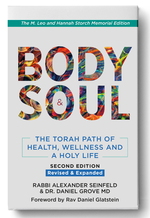
NewBodycover-front-3drevThis morning I watched a neighbor gingerly walking—with a walker and two helpers—from her house to a minibus that takes seniors to an activity center.

She has been our neighbor for 25 years. Her decline has been steady downward slope. And from what I can tell, mostly due to inactivity.

It is a fact, first recorded in Pirkei Avot, that left alone, your muscles will naturally start to disappear after age 30, accelerating each decade. 

With muscle training—as little as five minutes a week for each muscle group!—you can slow, stop, or even reverse the decline.

On that note, you may have noticed that it has been awhile since I updated you on the Torah Health and Wellness program/project.

First of all, on the theme of getting stronger, if you click on the above link, our "I Wanna Dance At My Grandchildren's Weddings" daily workout schedule. 

No, walking/swimming/elliptical/cycling is NOT enough. 

(BTW, the website has many updates on both the homepage and deep inside—if you are interested in the latest inspiration and information on being healthy, you may want to look around.)

Now, if you are a creative person you can probably relate to the following.

Even before the book was published in June, 2023, I was already working on a 2nd edition. 

At first it was tiny tweaks, fixing typos and so on. But slowly the 2nd Edition took on a life of its own... The improvements are on nearly every page. 

I do believe that we will have it available by Rosh Hashanah. But because the matter (for some people) is urgent, I decided to move the e-Book forward faster. I know that most people prefer a hard copy but those of you who read e-books may want to check it out—and I'd love to hear your feedback. The format allows me to make edits pretty quickly. The above link takes you to the e-Book (Kindle) page on Amazon (not yet ready for Apple's iBooks).

Please note—I uploaded the new file this morning, so it may take an hour or two before the site updates. If the image on the website looks like the above (with the REVISED AND EXPANDED bar), then you know it's the 2nd Edition.

Wishing you and yours a 

Shabbat Shalom

(v'Healthy)


Friday, May 01, 2026

How Do You React?

Shabbat Table Talk from the desk of Rabbi Alexander Seinfeld

May 1-2, 2026 • 15 Iyar 5786 • Emor (Lev 21–24).


spilledwineLast week's theme (

"Trouble With a Capital 'T'") was about an inward struggle.

This week, outward.

Scenario #1:

You have company at your dinner table. It's Shabbat, there's a white tablecloth (did you know that's a mitzvah?) and the nicer dishes and so on.

One of your guests is a bit clumsy and spills his wine—that's red wine.

Question for your table: how do you react?

Scenario #2 - your sitting at the dining room table with a book open—not a cheap paperback, but an expensive hardcover book, let's value it at least a $100. Someone (maybe your spouse or other member of your family) brings you a cup of juice or tea or other colorful beverage, and while setting it down, it sloshes onto your book.

How do you react?

These exact scenarios occurred in the lives of two famous rabbis, and their reactions should be instructive to all of us.

In the first scenario, the rabbi was Rav Yisoel Salanter zl and his immediate reaction was to spill some of his own wine and remark, "This table sure is wobbly!"

In the second scenario, the rabbi was Rav Moshe Feinstein zl. The expensive book was the Talmud and the liquid was ink and the spiller was his wife... his immediate reaction was, "That's actually a very pretty color!"

If you think about it, when someone makes a mistake, they already feel bad enough about it, why should you rub it in?

Our job is not to hit them over the head, it's to say, "You are 100% loved despite your mistake and what you have done did not diminish that even a bit!"

Easier said than done, no?


Shabbat Shalom