Thursday, May 28, 2026

Who Invented the "Jewish Soul"?

-


Shabbat Table Talk from the desk of Rabbi Alexander Seinfeld
May 28-29, 2026 • 13-14 Sivan 5786 • Naso (Num 4-7.

Who Invented the "Jewish Soul"?

Not-in-heavenLast week's topic — Once Upon a Time a Jew? (a true story of a lapsed convert) — struck a chord with many people, but not all for the same reason.

For some, the issue of membership in the Tribe is one of sincerity—if you're a sincere convert, how could you possibly revert to your previous idolatry?

For others, the issue is one of kindness—it's the community's responsibility to welcome and nurture the stranger.

For others the main issue is neither legal nor social, it's spiritual—about gaining a "Jewish soul."

Yet as one person wrote,

I've always wondered about the Jewish Soul, if it exists, when it comes online for converts, or if it's always been there. The people I've seen rail against the idea so clearly have one, whereas the people who push the idea, I'm not so sure about. and what does that mean for those of us, that no one can figure out their halachic status? that one day we have a jewish soul, the next we don't, depending on paperwork? at a certain point, it's absurd.

Her sense of absurdity comes (I believe) from the fact that you won't find any mention of a "Jewish Soul" in the Written Torah, only in the Oral Tradition.

Perhaps that fact points us to what's ultimately at stake but also to a resolution to the feeling of absurdity.

What's at stake is the fundamental nature of Torah. Is Torah—including its application to real-world questions—in Heaven or on Earth?

If the Talmud famously insists that the Torah is lo b'shamayim hee (it is not in Heaven), then perhaps the soul operates by the same rule. Is holiness something dropped perfectly from heaven, governed by rigid, celestial paperwork? Or is it realized here on Earth, through the deeply human process of wrestling with identity, law, and community?

If the tradition tells us that the Torah is not in heaven, is it possible that the soul isn't either? Is it perhaps found—and forged—right here in the struggle?

What do you think?


Shabbat Shalom


This message may also be read at Times of Israel.
Appreciated this Table Talk? Like ittweet it, email it...  

Thursday, May 21, 2026

Once Upon a Time a Jew?

-


Shabbat Table Talk from the desk of Rabbi Alexander Seinfeld
May 21-23, 2026 • 6-7 Sivan 5786 • Tomorrow: Shavuot (Exod 19-20); Shabbat: Naso (Num 4-7in Israel; Shavuot II (Deut 14-16 everywhere else.

jewishhead

Shavuot—beginning tonight—is our annual occasion to revisit the meaning of "Torah" and our relationship to it.

In Ramban's teaching, it's truly the 8th day of Passover when our freedom  journey reaches it's climax. 

As Rav Hirsch says throughout his Commentary, moral freedom requires Torah. So when we contemplate and embrace the Torah on Shavuot, we are contemplating and embracing moral freedom.  

But what happens if someone has a change of heart?

For instance, what if a Gentile embraces the Torah but then later changes her mind?

Everyone knows that Judaism doesn't seek converts but welcomes them. 

But is that a one-way journey or a revolving door?

This topic was broached this week by an individual who had indeed experienced such a change of heart. In her own words:

A year or so after my conversion and after marrying my now husband, I've been so disgustingly disappointed in my community. They started rumors about me not being 'really Jewish' or not Jewish enough since I eat kosher at my family's homes, etc. I'm so hurt by the whole thing I've gone totally OTD. I relinquished all association with Judaism, my husband too. I haven't gone back since hearing this. I write this since it's a different and rare experience after converting orthodox, since nobody really talks about leaving, ever. I don't want to bring anyone down, just sharing my experiences.​

She then went on to describe how her ongoing search for meaning has led her to embrace Christianity.

Leading back to our first question:

Is she still Jewish? Was she ever Jewish? What do you think?


Wishing you and yours a 

Chag Shavuot Sameach (tonight and tomorrow) and a

Shabbat Shalom


Friday, May 15, 2026

Alt-Right, Musk-Left?

Shabbat Table Talk from the desk of Rabbi Alexander Seinfeld
May 15-16-9, 2026 • 29 Iyar 5786 • BeMidbar (Num 1-4).

muskaltman1This public squabble between billionaires lends itself to so many Table Talk-worthy discussion questions.

One, as you know, happens to be Jewish, while the other is a classic Jew-hater.

(Forgive me for not using the term anti-Semite; doing so honors and perpetuates its origins as a way to high-brow Jew-hatred.)

I'm happy to see that the Paper of Record has finally come clean on its Jew-hatred. It has been an open secret for decades, but until now they've managed hide it in a mere anti-Israel slant, seducing many thoughtful people who would otherwise have cancelled their subscriptions long ago. Now anyone with a moral compass must respond in the only language that the Times will understand. Moreover, why would you want to give a dime to such an organization? 

The fact is that these very public events give us an opportunity for self-reflection and the following question for your table: 

The Jew-haters seem to think that Jews matter (for the wrong reasons); what do you think? Do we matter for the right reasons?


Wishing you and yours a 

Shabbat Shalom,

Chodesh tov (Sunday), and

Chag Shavuot Sameach (Thursday night/Friday)


Friday, May 08, 2026

Labor of Love?


Shabbat Table Talk from the desk of Rabbi Alexander Seinfeld
May 8-9, 2026 • 22 Iyar 5786 • BeHar-Bechuk. (Lev 25–27).

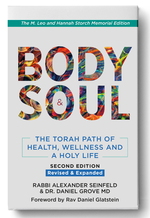
NewBodycover-front-3drevThis morning I watched a neighbor gingerly walking—with a walker and two helpers—from her house to a minibus that takes seniors to an activity center.

She has been our neighbor for 25 years. Her decline has been steady downward slope. And from what I can tell, mostly due to inactivity.

It is a fact, first recorded in Pirkei Avot, that left alone, your muscles will naturally start to disappear after age 30, accelerating each decade. 

With muscle training—as little as five minutes a week for each muscle group!—you can slow, stop, or even reverse the decline.

On that note, you may have noticed that it has been awhile since I updated you on the Torah Health and Wellness program/project.

First of all, on the theme of getting stronger, if you click on the above link, our "I Wanna Dance At My Grandchildren's Weddings" daily workout schedule. 

No, walking/swimming/elliptical/cycling is NOT enough. 

(BTW, the website has many updates on both the homepage and deep inside—if you are interested in the latest inspiration and information on being healthy, you may want to look around.)

Now, if you are a creative person you can probably relate to the following.

Even before the book was published in June, 2023, I was already working on a 2nd edition. 

At first it was tiny tweaks, fixing typos and so on. But slowly the 2nd Edition took on a life of its own... The improvements are on nearly every page. 

I do believe that we will have it available by Rosh Hashanah. But because the matter (for some people) is urgent, I decided to move the e-Book forward faster. I know that most people prefer a hard copy but those of you who read e-books may want to check it out—and I'd love to hear your feedback. The format allows me to make edits pretty quickly. The above link takes you to the e-Book (Kindle) page on Amazon (not yet ready for Apple's iBooks).

Please note—I uploaded the new file this morning, so it may take an hour or two before the site updates. If the image on the website looks like the above (with the REVISED AND EXPANDED bar), then you know it's the 2nd Edition.

Wishing you and yours a 

Shabbat Shalom

(v'Healthy)


Friday, May 01, 2026

How Do You React?

Shabbat Table Talk from the desk of Rabbi Alexander Seinfeld

May 1-2, 2026 • 15 Iyar 5786 • Emor (Lev 21–24).


spilledwineLast week's theme (

"Trouble With a Capital 'T'") was about an inward struggle.

This week, outward.

Scenario #1:

You have company at your dinner table. It's Shabbat, there's a white tablecloth (did you know that's a mitzvah?) and the nicer dishes and so on.

One of your guests is a bit clumsy and spills his wine—that's red wine.

Question for your table: how do you react?

Scenario #2 - your sitting at the dining room table with a book open—not a cheap paperback, but an expensive hardcover book, let's value it at least a $100. Someone (maybe your spouse or other member of your family) brings you a cup of juice or tea or other colorful beverage, and while setting it down, it sloshes onto your book.

How do you react?

These exact scenarios occurred in the lives of two famous rabbis, and their reactions should be instructive to all of us.

In the first scenario, the rabbi was Rav Yisoel Salanter zl and his immediate reaction was to spill some of his own wine and remark, "This table sure is wobbly!"

In the second scenario, the rabbi was Rav Moshe Feinstein zl. The expensive book was the Talmud and the liquid was ink and the spiller was his wife... his immediate reaction was, "That's actually a very pretty color!"

If you think about it, when someone makes a mistake, they already feel bad enough about it, why should you rub it in?

Our job is not to hit them over the head, it's to say, "You are 100% loved despite your mistake and what you have done did not diminish that even a bit!"

Easier said than done, no?


Shabbat Shalom