Showing posts with label mourning. Show all posts

Friday, October 12, 2018

But Are We Awake?

The purpose of this blog is to restore spirited conversation to the Shabbat table. Please print and share.
In honor of someone very special's birthday today.... Happy birthday, Mom!
And a big mazal tov to Shalev and Rocky on your wedding!
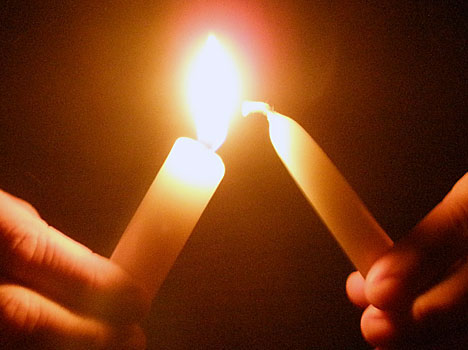

two-candles-in-handsA Jew I know just lost his non-Jewish mother.

Unlike the Jewish custom of quick burial, this Catholic family will not have the funeral for several weeks.

First 2 questions for your table - Have you ever been to a wake? Do you know why they call it that?

(No, it isn't because they hope the deceased will wake up.)

Once upon a time, I attended one. It wasn't Catholic, as far as I recall. They just called it that. It was in a funeral home. The deceased was a young man - 18 years old - who had drowned while swimming with friends in a rural swimming hole.

It was incredibly sad. But seeing him there, embalmed with makeup to make him look like he was merely sleeping, somehow made it more painful, to me.

Next 2 questions: Why don't Jews do embalming? Why do we hurry to bury our dead?

We obviously love life, we don't love death.

But we don't ignore it. We even have a beracha to say upon the death of a loved one.

Question 5 for your table - Why don't we like to talk about it? Why does it make us so uncomfortable?


Some say that the answer is because we live in a culture that really does glorify the physical aspect of existence (the human body and its pleasures) and we have all been trained from a very young age to  become deeply attached to that vitality.

Put it this way: the Olympics and Superbowl get a bit more attention than the World Chess Championship.

(Although it's always encouraging to see the media pay attention to the newest Nobel Prizes.)

Others point out that even spiritual people have trouble with death. They argue that we expect God to be good and loving and kind and taking a loved one away is painful and therefore unkind and that's a contradiction so we'd rather ignore it than grapple with the contradiction.

What say you?

According to the Talmud, there are 903 types of death.

(And if anyone cares, it even tells us which are the most and the least painful.)

Question 6 for your table - What would you say are the best and worst ways to die?

Question 7 - If the Talmud is going to talk about 903 ways to die, why doesn't it also tell us how many ways there are to live?


Shabbat Shalom

 
Enjoyed this Table Talk? Vote with your fingers!  , , forward it....


Friday, October 20, 2017

Into the Wind

  The purpose of this blog is to bring some closure to your Shabbat table. Please like it, tweet it, forward it or print and share.

JeremyD3This smiling face will forever be etched in my mind.

For the past couple years, it has appeared (sans helicopter) on my computer screen every week, usually Friday.

Always smiling, occasionally groggy (he was six hours behind me - guess where that may be?)

Both of us with our copies of the best-seller


He was proud of his copy of the Book. He knew that it was a source of wisdom.

And as much as he loved the internal experience of the pursuit of wisdom, he also loved the external experience of
the wind.

The wind made him feel something.
 
When he cycled around a sharp curve, flying down a steep hill, the wind in his face, he felt something.

When he was catching a wave early in the morning on one of his five surfboards, he felt something.

But it wasn't until he started flying helicopters - which coincided with his learning Torah - that he could articulate that feeling.

He said it made him feel connected to God.


Here is a photo he sent me from one of his first solo flights in northern California:
Jeremy Solo


But the California skies were not high enough. He moved to Hawaii to train under tougher conditions with the best of the best.

There, one of the bread-and-butter flights to master is to Molokai, "the Friendly Isle".

This is what he saw:


The sunsets at Molokai must have been phenomenal from 4,000 feet up.

Maybe that's why, on Monday this week, he and his instructor did a quick run out there, just in time to catch the sunset.

I'm just guessing, but maybe Jeremy had never been there at sunset and since it was his last week as a student before graduation, it was something like a celebration, or maybe a last chance.

Regardless, it wasn't their first time making that trip and it should have been easy enough.

But at 7:30 pm, on a moonless night, that same wind that Jeremy loved so much became unfriendly. 


It suddenly refused to do its job of holding them aloft, dropping the chopper like a tree releases an autumn leaf.
 
A man fishing on the beach saw their chopper plunge into the wine-dark sea.

And yesterday, after three days of meticulous searching day and night, the Coast Guard has found no identifiable remains, neither of the helicopter nor its pilots.

Jeremy and I should have been studying Torah today - our first session of the New Year.


He was on an upward trajectory in life. He was growing spiritually and mentally, looking forward to completing his training and eventually taking me up on my offer to bring him to Israel. Most of all, he was looking forward to making a difference.

He was truly one of the nicest, most thoughtful, kindest, gentlest, warmest, happiest, people I’ve ever known.

Baruch Dayan Emet.

The questions for your table about this event are as obvious as they are enormous. Are there any answers?


Shabbat Shalom

Did this Table Talk speak to you? Vote with your fingers! Like it, tweet it, forward it....


Friday, December 16, 2016

Wheel of Fortune.... How does it turn?

The goal of this blog is to not leave the Friday night table talk to chance.... Please share.
In memory of Moshe Simcha Moskowitz and wishing a speedy recovery to Tamar Adina bas Kayna Shulamis.


Dreidel RouletteA horrific accident this week.

A mother and her son drop older sister off at the airport, going to Israel to study. What a happy goodbye!

On the way back, in front of her is a disabled vehicle on the highway - she slows down, but the semi behind her does not slow down and rams her into the stalled vehicle.

How long it took first responders to arrive, who knows and who wants to know. Both mother and son were airlifted to separate hospitals in DC.

The mother is presently in ICU, fighting for her life.

The son - a 13-year-old in our son's school - did not make it.

The funeral was yesterday.

It looked like the entire Jewish community was there. Not only were all 600 seats filled in the huge sanctuary, so was every foot of the standing room, so was the overflow room, spilling out into the hallways and the foyer.

First question for your table: Was it because the parents are well known and loved?

But speaker after speaker told of how special this boy was. His name was Moshe Simcha - and he was always happy (simcha means happiness). He wasn't an extroverted, joking kid. He was mild-mannered, soft-spoken, but extremely friendly and even more than friendly, he was helpful.

His seventh-grade teacher said, "You know those days when you come in to school and you really need a coffee but you don't have time because you have to go copy your handout? Moshe would make sure you had a coffee on your desk and the copies made before you even had a chance to ask him for help."

His father said, "At home, he was always asking, 'What can I do to help?'"

It seems that he had perfected the
mitzvah of honoring your parents.
 
Other kids loved him, because he was super nice to everyone, of all ages.

Our son called him "really nice". (That is a very rare compliment.)

He was a fighter - he didn't let diabetes stop him from training for and completing a 120-mile bike-a-thon to raise money to help disabled kids go to camp.

He was a learner - he recently asked his father if they could spend five minutes a day learning together the laws of lashon hara. Why? "Because it's really important and I don't think I know it well enough."

His father, a beloved first-grade teacher, said, "Moshe taught us all something. He was a teacher - a rebbe - to all of us."

Even those of us who never met him.

(Even those of us who merely read about him in an email?)

His family ask:

• In his memory, that we aspire to emulate him;
• As a collective "prayer" for his mother, that we light Shabbat candles five minutes early today.

Hence I share the story with you, and ask you to
forward it to everyone you love.

Second question for your table: What's a greater tragedy - a meaningful life cut short at 13, or a long, healthy life without meaning or mission?


Shabbat Shalom


PS - After 2,500 years, there is finally a new way to play dreidel. Click on the image above.

Like this post? How about putting your gelt where your gab is: Like it, tweet it, or just forward it.

Friday, December 25, 2015

Make Beer, Not War

The purpose of this blog is to turn Friday night dinner into Shabbat.... Please print and share.
 
Jaffa-GateTwo days ago, on Wednesday morning, Rabbi Reuven Biermacher went to Jerusalem's Old City.

At 10 am the 45-year-old immigrant from Argentina taught a group of Panamanian 16-year-olds something from the Talmud.

They were on summer vacation and their counselor came by to ask the rabbi to give them a break.


The students demurred, “No! We don’t want a break. This is the best class of the day!”

At 11 am he gave his regular Talmud class, followed by a short talk to a group of South American students.

What all three classes had in common was a beloved, wise rabbi, "full of joy and life", who cared for each of his students.

At 12:45 he left the yeshiva and headed towards Jaffa Gate, which is the main route taken by Jewish residents and tourists, and anyone else who wants to use it. The footpath outside Jaffa Gate looks like any sidewalk in any large city.

It was an unseasonably warm, sunny December day in Jerusalem.

And there, returning home to his wife and seven children, Rabbi Biermacher encountered evil.

Two young men lunged at him with knives.

Ofer Ben-Ari, 46, happened to be driving by and witnessed the attack. With only his bare hands as weapons, he ran out of his car to save the rabbi's life.

Police arrived moments later and Ben-Ari was hit by a stray bullet.


Both victims were rushed to Shaare Zedek Medical Center where they died within an hour of each other.

Biermacher's 16-year-old daughter described him as "a man of gold who never harmed anyone." One of his colleagues said in a eulogy, "He was walking example of what we all aspire to be....He was always there for everyone.... We have to take responsibility to live up to his example and make a serious change in our lives..... To look at what happened as a message to me, to think that I deserved this more than he did, and I am lucky to be here. God has chosen the best among us deliberately.... Instead of thinking, 'Am I safe or am I not safe?' we should think, "What matters is that I'm doing my job."

Ben-Ari owned a recording studio in Jerusalem and opened it free of charge to distressed youth. He also provided temporary housing for the homeless in a property he owned. He is survived by his wife and two children and here is a brief report of his funeral.

2 victimsThese two tragedies leave one speechless.

But I am not sharing them with you to make you sad, rather to foster a discussion at your dinner table. Perhaps these two questions are appropriate:

We know that everyone has to die. But is it better to die quickly and suddenly as they did (in this case as heroes), but without a chance for anyone to say goodbye? Or to suffer a period of illness first?

We all know (but don't like to think about it too much) that anyone and everyone's fortune could change in a moment. So what?


Shabbat Shalom.

PS - Funds are being established to help the two widows and nine orphans. For more info, post a comment or send an email.


Like this post? How about voting with your finger: Like it, tweet it, or just forward it.

Friday, January 06, 2012

Memory

We lost a friend and neighbor this week, Steve Goldstein.

After two brain surgeries and chemo, the cancer won.

He was a guy who collected broken lawnmowers. By the end of this eulogy, I hope you'll appreciate why.

Steve was one of those rare guys who was both sensible and 100 percent genuine. He never did things to be "politically correct". That meant that if he said something, you knew he meant it.

No one else in our neighborhood would mow the lawn shirtless. But if it's hot out, that's the most sensible thing to do, right?

Steve also helped everyone, and I mean everyone, with any kind of problem with their home.

Your pilot light went out and you can't figure out how to turn it on? Ask Steve.
You have a loose shingle on the roof? Steve would notice it before you and be up on his ladder fixing it before you could blink.
You need help cutting a board for a DIY project? Borrow a tool? And so on.

Most men like to have their "cave" as John Gray calls it, a place to retreat and do whatever men like to do, smoke cigars or whatever.

Steve built the greatest man-cave in his back yard, a 50x30x20 (that's feet) shed.

That's where he did his projects, that's where he stored his "stuff".

A woman's nightmare. But every man reading this will nod his head in understanding.

As I said, he collected broken lawnmowers. Maybe that would be a good question for your table - "Why do you think the guy collected broken lawnmowers?"

The answer, of course, is because he enjoyed fixing them and then giving them away to his neighbors.

That's the kind of guy he was.

But he was also a reverential guy. In his youth, he had the good fortune of spending a few years in a New York yeshiva. Somehow he ended up there even though he was born and raised in Pensacola. And that experience fostered in him an indelible respect for Torah and Torah scholars. None of his other life experiences could erase that. Not his service in Vietnam, not his years on the road as a salesman, to places that one might think are the diametric opposite of a yeshiva experience.

Almost to the end he attended Baltimore's most famous weekly class, the "Thursday night class". I saw him walking home Thursday night. Here's how the interaction would go:

"How was the class?"
"Good. It was a good class. I didn't understand half of it, but the half I understood was good."

Often after helping a neighbor such as us, we'd feel so much gratitude that we would try to pay him something. He wouldn't hear of it. "I'll tell you what, have us over for a Shabbos meal."

And so we did. Many times. After his brain surgeries, with giant stitches on his skull, the kids thought he looked a little scary, like Frankenstein's monster. But they all loved him, they could tell there was something special about him, about his intelligent frankness.

The decline was swift. As recently as Thanksgiving he had his wits. But by Channuka he was having trouble finding familiar things.


Our street will never be the same. Condolences to Abby, his wife of 25 years, and the rest of the family.


To end on an "up" note - one of the eulogists at the funeral mentioned that he hadn't known Steve as well as he would have liked, and now it's too late.

Question for your table - Is there anyone in your life whom you'd like to know better before it's too late? Is there anyone you'd like to do an act of kindness (chesed) for, before it's too late? Here's a zinger - How do you want people to remember you at their Friday night dinner tables?


Shabbat Shalom


PS - to see today's "Amazing Jewish Fact" - on Reincarnation - click here.