Showing posts with label spirituality. Show all posts

Friday, December 30, 2016

Are You In the Gutteral?

The goal of this blog is to add eightness to the Shabbat table talk ...  Please share.
Continuing to wish a speedy recovery to Tamar Adina bas Kayna Shulamis and to Ruth bat Sarah.
In honor of Tehila's seventh birthday.
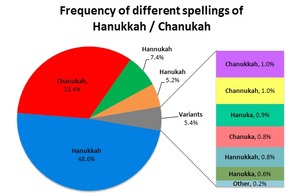

Hanukkah-Chanukah-frequencyPhilosophically-speaking, why should it be eight days?

Isn't the standard number in the Torah seven?

(Try asking this at your table - ask them how many sevens they can think of in the Torah. For that matter, how many sevens can they think of in nature? Notes on a major scale, etc. I've come up with nineteen so far - email me if you want my full list.)


To answer the philosophical question, here's a little philosophy for you, followed by a brief word from Jerusalem.

Last week, I asked if it matters (and why) how you say "Channuka".

One reader, William in Brookline, sent a beautiful answer.

He notices that the difference between the two pronunciations is a single Hebrew letter - "chet" v. "hey". Numerically, the difference only 3, which could be represented by the word "av" which means father....


"Using Google Translate, הנוכה ["Hanukah"] means, "seasonally"; חנוכה [Chanukah] means,
"dedication".  We have more than a seasonal holiday here: we dedicate ourselves to אבינו שבשמים [God], so if we add the אב to the seasonal festival, we have our Dedication."


If William will permit me to riff off of him a bit.... It is interesting that Channuka is related to the word for "education" — "chinuch". Eduation isn't just dedicating a child, it's preparing the child for life.

The idea of Chanuka is to re-dedicate yourself — that is, to prepare yourself.

Maybe you thought you were prepared?

But you're not. None of us were.

We were maybe prepared on the level of seven, but not on the level of eight.


The other day I was speaking with my 12-year-old nephew in Jerusalem.

He asked me, "If there was enough oil for one day, then the miracle was only seven days. The last day it burned up, so it wasn't a miracle!"

His answer: For most of the world, it's only a miracle when oil doesn't burn. But for a Jew, it's even a miracle when it does burn. Everything in nature is miraculous.

As long as you are waiting for that miraculous success, that miraculous recovery, that divine intervention in marriage or childbirth or winning the lottery, then you are still living in the world of seven.

When you start to realize the miracle of the quotidian, you are living in the eight.

That's why it matters how you say it. Because this world matters. The here-and-now matters. Beauty matters. If you pronounce something wrong, you are marring the cosmic harmony.

So the real magic of Channuka - the real preparation - happens tomorrow night, when you light those eight candles.

Take a good gander and think about re-dedicating yourself to living in this beautiful moment.


Channukah sameach and

Shabbat Shalom


Like this email? How about putting your gelt where your gab is: Like it, tweet it, or just forward it.


PS - Thanks to those who responded to last week's "word from our sponsor"....

Do
you have a favorite Table Talk? Maybe it was last summer's story about the greatest Olympic champion or Satisfact or Fiction. Maybe the Sandy Hook one did it for you. Perhaps it was We of the Storm. One of the most popular of all time was Late for the Train (2006). Some still remember the musical Chinese Food on Xmas.

Please consider an end-of-the-year tax-deductible contribution to support this weekly Table Talk. If you had paid a buck for your favorite one, would you have said, "Money well spent"? What of the fact that it comes to your inbox for free every Friday? Does that make worthless? (or priceless?)

This blog actually costs several nickels to produce, and we rely on readers like you to keep it going. There are the costs of the 10-year-old computers and the rest of the office overhead. There is staff time.

Yet this blog is provided as a free service by JSL in order to achieve our mission of fostering a paradigm-shift in Jewish education. You have the opportunity today to enjoy being being an active partner in this mission. At any level of contribution, you will be a partner.
http://jsli.org/donate/

Friday, November 18, 2016

Do You Believe You Have a Soul?

The goal of this blog is some brain-cleansing at the Friday night dinner table. Please share.
Happy birthday this week to Stuart in California.


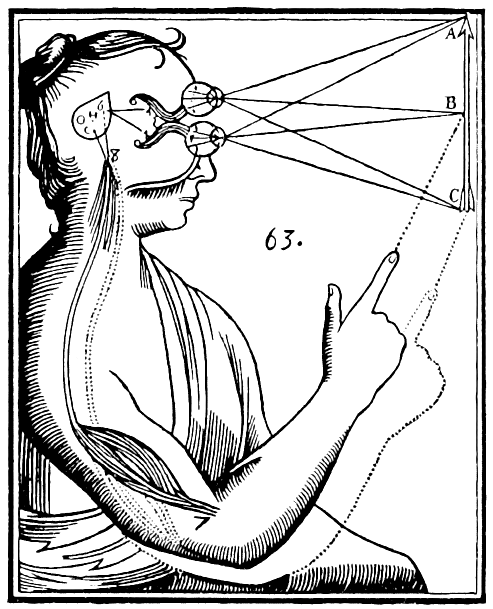
Descartes_mind_and_bodyYesterday there was a voice message that worried me.

"Someone quoted something you said and I wanted to make sure I understood it right."

Uh-oh.

What was quoted as saying? Who is this person? What are they saying about me? What am I going to be asked to defend?

I phoned him back this morning.

The quote in question goes something like this (it actually works very well as a conversation piece for your Shabbat table).

Ask everyone:

Raise you hand if you believe you have a soul.

Most people will raise their hands. In most groups, everyone raises their hands.

Then say, Let me be the first to tell you: I heard from a card-carrying rabbi that you're wrong. You don't have a soul.

Pause and let that sink in.

Then say, You don't have a soul. You have a body. And the fact that you could raise your hand so quickly shows me how confused you really are.

The problem is that we are brainwashed, day-in and day-out, to think of ourselves as bodies. The media around us are constantly shouting, "You're a body, you're a body!" and we come to think that way.

But if your head is on straight, when someone asks you if you have a soul, your reaction should be the same as if they asked you, "Do you have a person?"

"Whaddya mean, do I have a person - I am a person."

Judaism teaches that some aspect of self exists before a person is born, and some aspect continues to exist after a person dies. We call that "soul".

Spirituality is learning how to live with the awareness of yourself as soul and not as body.

One of the most effective ways to become more spiritual is to lock yourself in the bathroom every day and look in the mirror and say, "You're a soul, you're a soul, you're a soul."

The degree to which you live each day with soul-awareness is the degree to which you are spiritual.

And it's a level playing-field. You don't have to be particularly wise, learned or righteous to walk this spiritual path.

You could end the conversation here, and indeed at this point the gentleman was ready to thank me and go about his day.

But there is one vital clarification.

This soul-body (or mind-body) split is a classic problem of epistemology, theology, psychiatry and even neurology.

Some religions teach that the split is so complete that spirituality means minimizing the body (by fasting, celibacy, etc.)

Our tradition says differently.

Mind-body dualism is only hypothetical. At this stage of reality, we are a soul that is fused to a body.

That body is inherently neutral, and can become uplifted and rarefied by using it with soul-awareness.

You can do this every time you give tzeddaka (even to the pushke) or to invite guests (which is hard to do right). Or stop some weekday activity on Shabbat.

Question for the table: When is it hardest to have soul-awareness, and what's the solution?


Shabbat Shalom

PS - Hope you're still counting down the days to Channuka....

PPS - Yes, this week there is a new easter egg....
When you forgive, you in no way change the past - but you sure do change the future.
Read more at: http://www.brainyquote.com/quotes/topics/topic_forgiveness.html
When you forgive, you in no way change the past - but you sure do change the future.
Read more at: http://www.brainyquote.com/quotes/topics/topic_forgivene

dfdfd

Like this email? How about putting your gelt where your gab is: Like it, tweet it, or just forward it.

Sunday, October 02, 2016

Rosh Hashana for Thinkers

The goal of this blog is a BOFA (breath of fresh air) at the Rosh Hashana table. Please share.

applesandhoneyLast Monday, with just a week left of the year 5776, we attended the funeral of my 19-year-old son's best friend.

I do not need to tell you that it was heart-wrenching.

He was a nice kid. Soft-spoken, smart. One summer a few years ago I hired him and my son to paint our fence. When they completed the job, he refused to accept payment, telling me that he didn't feel he had done a good enough job. I was satisfied, but his own sense of integrity prevented him from accepting payment.

(The official cause of death was accidental drowning.)

I share this unhappy news in the spirit of Rosh Hashana.

If you find that a bit ironic, it may be because you are thinking of Rosh Hashana like January 1: champagne, fireworks, saxophone, Scotch whiskey.


Nope.

Rosh Hashanah is that one day a year (OK, two) (OK, maybe one) to think about your life.

How fragile it is, how quickly it can end ....

How precious it is.

What it will take to make 5777 the best year ever.

My Rav used to tell us, "Yom Kippur is easy. You fast and say I'm sorry a bunch of times. Rosh Hashana is hard work. You have to think."

Tradition says that how you think on Rosh Hashana affects your entire year. The day has a certain karmic energy that causes your thoughts  to have more influence than on any other time of the year.

Rosh Hashana determines who will be healthy and who will get sick. Who will earn and who will lose. Who will live and who will die.

(The root of "hashana" is shina which means "change". Rosh Hashana = beginning of change.)

This need to think is the real reason for two days of Rosh Hashana: clarity matters, and most of us need two days to get it.

Whether you do it for one day or two, if you end Rosh Hashana before achieving greater clarity about your life, you just missed an opportunity.

Here are two questions to help those at your table hear the shofar a little differently this year:

1. If you knew that this was going to be the last year of your life, how would you live it?
2. If you had to stand in a court and justify living for another year, what would you say? What do you hope to accomplish that would justify another year of life?


(For 23 more questions for contemplation, or for my "Rosh Hashana Omens" sheet, send me an email.)

Wishing you and yours a good, sweet year of health, success and great happiness. May you be inscribed and sealed in the Book of Life.

If I have written or said anything in the past year to offend, kindly forgive me. And let's all pause around sunset tonight and forgive everyone who may have offended us.

L'shana tova!


"Men will forgive a man anything except bad prose." (Churchill)


Like this email? How about putting your gelt where your gab is: Like it, tweet it, or just forward it.

Friday, September 02, 2016

Permission to Speed?

The goal of this blog is to slow everybody down for a few minutes. Please share.
Wishing Yisrael ben Sarah a speedy recovery from his surgery.


speed-limit-snailFollowing last week's story about the greatest Olympian (thanks for all of the positive feedback), here are four speed vignettes that all happened this week, leading to one vital question for your table.

1. A couple days ago, my wife is driving with our six-year-old on a city street where most drivers see the 30 MPH speed limit as a mere suggestion. If you drive 30, you will typically find someone tail-gating you, and everyone else racing past you as if you were standing still.

Maybe they like to get to the next red light quickly so they have more time to check their messages.

So out of the blue, our daughter says, "Mommy, you know you are allowed to speed here."

Oy, Mommy thinks, she's learning by example.

"How do you know that?"

"Because I saw a sign, it said, 'speed'!"

2. I myself was driving on a highway this week with someone who didn't like that I was going the speed limit, telling me that I am required to stay with the flow of traffic, even if it's over the speed limit.

(Not everyone agrees. The thrust of this discussion seems to conclude that it makes sense, but not sound legal advice. These guys all seem to agree that although many people do it, it's still illegal. But here we learn that the law varies by state.)

3. Somebody tells me yesterday that he has so little on his agenda, he doesn't know what to do. Not busy enough.

4. In the airport this week, we find ourselves sitting opposite a Tibetan monk. The kids are fascinated. One asks, "Why is he wearing a dress?"

His travel companion gives him a slice of pizza, which he places on his lap and meditates for a full five minutes before eating it.

That's pretty impressive. When we say a beracha, it might take us five seconds. Five minutes is major-league spirituality.

Now, after he finishes meditating, there is no outward indication that he is eating his pizza any differently than anyone else. Perhaps that's the point. Perhaps his meditation was all about not experiencing the pizza. Perhaps he's having an incredible experience of nothingness.

(It is interesting that many versions of Buddhist "mindful eating" do not seem to care about the taste of the food. See this Tibetan buddhist nun, this woman who attended a Triartna Buddhism retreat. According to this Theravadic monk, it is wrong to eat "for pleasure". Yet Zen master Thich Nhat Hanh demurs.
)

So now for this week's question:

Let's go back to the Jewish version of pre-eating meditation, the bracha. The Talmud says that saying a bracha is a way of "paying" for the food. I may own it legally, but I don't have an ethical right to consume it until I say, "Wow, thank you."

But is it enough to say, "Wow, thank you" before I eat? Even if I say it with tremendous feeling?

Hos should the wow-thanks affect how I eat?


What say you and your table-mates?

Shabbat Shalom
PS - Here's a secular book with some practical wisdom on mindful eating. Here's a Jewish-oriented book with the same.

PPS - If you are thinking about Rosh Hashana gifts for any teacher, try
our unique online resource for people like you.

Like this email? How about putting your gelt where your gab is: Like it, tweet it, or just forward it.

Friday, May 27, 2016

What You Can Learn From a Tomato

The goal of this blog is to create an heirloom-quality Friday night  - please print and share, repost, forward, tweet, etc.

Heirloom tomatoesBefore today's main topic, a correction from last week.

Many people tried to view the video about the "Humanity Being" and the link was initially broken.

It was later corrected. If you haven't seen it, or want to see it again, here is the working link:

https://www.youtube.com/watch?v=jmN3ubufUA4

Now, what's this business about tomatoes?

I'm not much of a gardener, but how hard is it to buy a couple starters from the Home Depot and stick them in the ground?

Well, it turns out I have a lot to learn.

First of all, my thoughtful wife reminds me, you have to prepare the soil. Mix in all of that compost you've been making all winter.

That's not so hard to understand.

What surprised me was when I read the instructions on the starter plants. They write them in tiny print on the plastic label around the plant. I would ordinarily just ignore such things, but on whim decided to read it:

"Plant deep enough for soil to reach the base of plant. Plant tomatoes deeper, covering 2/3 of plant."

Did I read that right? Bury 2/3 of the plant?

Yep, say the experts. Especially if you're trying to grow succulent heirlooms.

Here's a superb blog that tells you how to do it.

Why 2/3 deep?

They say it allows the plant to grow stronger roots. It will actually grow roots right out of the sides of the plant.

With those stronger roots, it will grow taller and stronger and produce better fruit.

I didn't know that.

I think maybe there is something to learn here, but I'll put it in the form of a Question for your table:

How is a person like a tomato?


Shabbat Shalom


Like this email? How about putting your gelt where your gab is: Like it, tweet it, or just forward it.

Friday, February 12, 2016

How to Make Waves

The goal of this email is to add some gravity to the Shabbat table.
Wishing Lily in SF a happy birthday this week!
Wishing Mom (Chaya bas Yehudis) a continued recovery.


gravity waves1. Get two black holes.

Let one of them be 36 times more massive than our sun.

Let the second one be 29 times the mass of our sun.

2. Put them in a blender and mix.

3. Do the math: the resulting super black hole will be how many times more massive than our sun?

If you guessed 65, you are happily mistaken.

The correct answer: 62.

How could that be?

It turns out when you mix two black holes together, it's impossible to keep it all in the mixing bowl. There is a 5 percent splatter rate.

But every sixth grader knows that not even light can escape from a black hole! How can any energy escape?

It turns out that black hole splatters are more awesome than light. They make space itself ripple, whatever that means.

Not big ripples, but tiny, tiny ripples that are so tiny, to detect them you need a really awesome seismograph.

The one they came up with is a five-mile electric eye. Sort of like the one in elevators to keep people from being crushed by the closing doors, but about a million times more expensive.

And just to be safe, they built two of them, 1,800 miles apart.

But you only heard the headlines of this gravitational-waves story you may have missed the following detail:


To prevent false positives, LIGO has an elaborate system in place to occasionally inject ersatz signals. Only three scientists on the team know the truth in such cases, and in at least one instance their colleagues were prepared to publish the results when they finally revealed the ruse.

Consider the greatness of that system. These scientists are so interested in getting the truth....they know that their fancy machine is very, very good yet imperfect and they know that they are very smart yet imperfect, so they create a system to push themselves towards greater perfection.

That's like you trying to get in shape and having a trainer occasionally tempt you with appropriate distractions. Because whenever you conquer an urge or a distraction, it makes you stronger and greater.

What if the entire universe were set up in such a way that each of us got karmic tests at just the right time to make us stronger and greater?

For the kids at your table: Do you ever feel tested in that way?
For the adults at your table: If it turns out that the philosophical "what if" above were not true, w
ould believing it and living according to it be a net good or net harm?


Shabbat Shalom 

PS - great infographics on LIGO here.

Friday, January 02, 2015

Music to Your Ears?

The goal of this blog is to add harmony to your Friday night dinner table. Please print and share.

Headphones-Star-300x274One of my favorite quotes about music comes from the great Wynton Marsalis.

It is told here about the time a young person asked him, "Wynton, how do I break into the music business?"

The reply: "Break into a practice room."

Doesn't that answer really apply to a lot of things in life?

(For your table: Can you name one?)

On this theme of music, this week I have one simple question for your table, followed by an important music-related announcement, followed by my own answer to the question.

The simple question:

What's the most important secret to two or more people making great music together?

Think about it.

While you're pondering that one, here's the important music-related announcement:

We've started to add music to BestJewishKidsBooks.com.
 

For kids - try Shmuel Kunda's blend of music and storytelling.
For pre-teens, try Miami Boys Choir.
For teens - try Baruch Levine.
For adults - try Tzvi Gluckin's bluesy album. Or this one.


(Do you have some favorite Jewish or Jewish-inspired music that you think we should add to the site? Please let me know.)

Now, for the rabbi's answer to today's question:

The most important secret to making great music together....

....can be summed up in one word....

Listening.


If you are listening to each other, you can create a sublime harmony. If you're not, the music will be nothing special.

Great musicians know this secret.

Great orchestras earn their bread by this secret.

Rabbi Cardozo once compared all the complexities of Judaism to all the complexities (and rules) in music. Jewish life has the potential to be a great symphony, but it will only become a beautiful harmony to the extent that:

a. We are all playing the same song.
b. We are listening to each other.


Think about it.


On a scale of 1-10, how important is music in your life?


Shabbat Shalom


Let me guess - you made a resolution to become more generous in 2015? Put your $$ where your ) is with a gift subscription to the Amazing Nature for Teachers program - AmazingNature4Teachers.com. Great for a teacher, parent or anyone who enjoys a daily dose of inspiration.

Or start 2015 on the right foot with a tax-deductible contribution to help keep these emails coming, and takes about a minute here: http://jsli.org/donate.


Like this email? How about putting your gelt where your gab is: Like it, tweet it, or just forward it.


Friday, August 08, 2014

What's in a Doorpost?

The goal of this blog is to turn Friday night into Shabbat. Please print and share.

Mezuzah scrollToday: two questions, followed by a story, followed a question, for your table.
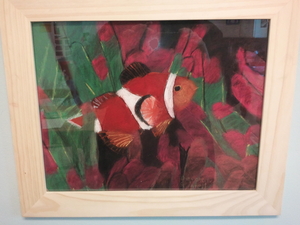
First question: What's a mezuza?

I'm guessing that many people reading this don't know, so here's a cliffnotes answer:

A hand-written scroll of sacred parchment with verses from the Torah that talk about mindfulness of God, love, unity and karma - affixed (usually in a decorative box) on the right side of a doorway into a room.

Second question: How many mezuzas should go on a house?

Many Jewish homes have only one mezuza, on the front door. Some have one on the back door as well.

But the ancient custom, following the Torah, is on just about every doorway of the house, exterior and interior. The reason is simple: the message (mindfulness of God, love, unity, karma) is something one may want to keep in mind througout the house, not just when arriving and leaving.

Think about it: you arrive home and see the mezuza. You're reminded of those wonderful things.

Then you're inside and get busy with your chores, your family, your whatever... so easy to forget.

But if there are mezuzas throughout the home (and you get in the habit of touching them as you pass), there's a chance you may develop that mindfulness.

So here's the story:

Yesterday, I had the privilege of participating in a mezuza-affixing (affixation?) on a new home.

The home, by any measure, is beautiful. A dream house by the pristine waters of the picturesque Puget Sound.

By my original count, made a year ago, the home required 23 mezuzot. But walking through the finished home, I discovered three additional spots that were arguably "doorways".

The home owner, realizing that we were going to be short several scrolls, tried to persuade me that those were not true doorways. I explained that according to Maimonides she would be right, but that the majority of rabbinic opinions require one.

She tried valiantly: "Well, in our family, I think we go like Maimonides."

"Umm.... besides the fact that you are not impartial in this discussion, the general rule is to go by the majority," I said with a smile.

Gosh, so many rules! Why should there be so many rules?

There obviously have to be some rules, in order to have a common tradition. When there are no rules, there is no tradition.

But an interesting thing about the mezuza is that it has a subjective element to it. The mezuza goes on the right side when entering a room. What if a room has two doorways? Which way is entering? That depends on you, on how you use that room.

In other words, while the mezuza is truly the completion of the home, unlike the rest of the home which is a purely physical shell, the mezuza is the interface between the physical house and the spiritual being (you) who occupies it.

Therefore, to end the story, you maybe can imagine that putting up 23 — or in the end, 26 — mezuzas was not merely a handyman's job. It required the input of the homeowner — not only for which decorative box to put on what doorway, but in some cases, which way is entering and which way is leaving?

All this took a long time, a lot of concentrated discussion.

Hours, actually.

And the guests for the chanuka (dedication) celebration were arriving and the hostess and I were .... unavailable.

But in a way, all that visible effort became part of the party — everyone saw that by affixing mezuzas throughout, we were completing the house into a Jewish home.

So here's your third question: There are 15 verses in a mezuza. Which one is the most famous?


Shabbat Shalom

Israeli soldiers prayingPS - Here's a hint to the answer: Roy Klein's story.

PPS - This amazing story is a table talk unto itself.

PPPS - Teachers around the country are joining the Amazing Nature for Teachers program - does your child's or grandchild's school know about it?

Like this blog? How about putting your mouse where your mouth is: Like it, tweet it, or just forward it to someone who might enjoy it.

Thursday, January 30, 2014

How Do You Define "Good Art"?

The purpose of this blog is to help your family and friends turn your Shabbat table into a work of art. Please print and share.

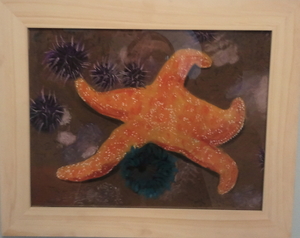
Emuna's starfish 3Please look at the picture to the left.

What do you see?

A. A starfish
B. A work of art
C. A proud father of a budding art student's first effort
D. Some wood, some glass, some pastels.

Our daughter spent many hours on this creation, during six sessions of her first-ever art class.

Question 1 for your table: Does knowing that background information make it more beautiful?

devorah fish1While we're at it, I might as well show you her sister's first creation as well:

Truly stunningly fabulously thrillingly amazingly earth-shatteringly beautiful, right?

Great art teachers often say that the main skill to learn is not how to draw, not how to paint, but how to see.

How to get started learning to see?

You could take the neuroscientist's route and read Inside a Dog: What Dogs See, Smell and Know.

Or you could go the artist's route and read the classic Drawing on the Right Side of the Brain.

This is all a build up to Question 2 for your table: What's the point of art?

And what does all of this have to do with being Jewish?


Shabbat Shalom

"Wagner's music isn't as bad as it sounds." - Mark Twain

PS - If you like, please like, tweet, or just forward to someone who might enjoy.

Friday, January 25, 2013

Feeling Sappy

The goal of this blog is stimulate warm conversation at your Shabbat table. Don't read it now - print and share!


treeblue

Feeling Sappy

Tonight is Tubishvat, the festival of the trees.

In past years I've made some suggestions how to make it meaningful for the kids: here and here.

This year I want to try a different approach for your and your table.

The Talmud occasionally compares a person to a tree.

So first question for your table: How is a person like a tree?

Let's think for a moment.

We are exactly 4 months after Rosh Hashana, one third of the year has passed.

A tree is the ultimate symbol of wisdom as in the "tree of knowledge" in the Garden of Eden.

On Tubishvat, saith the Talmud, the sap starts to stir in trees.

Think about that - in the middle of the winter with snow on the ground, the potential for new fruit has already begun.   

So just when we think we can spiritually slumber - after all, we have 8 more months until Rosh Hashana! - it's time to let something stir inside of us.

Here is a list of "middot" - A to Z - that we ought to cultivate:

  • A good name, Attentiveness,
  • Bearing your own burden, Being pleasant,
  • Cleanliness, Compassion, Courage,
  • Decisiveness, Derech eretz (Common Decency),
  • Equanimity,
  • Fear/awe/yirah, Flexibility, Forgiveness, Friendship,
  • Gemilut chasadim (Lovingkindness), Generosity of heart, Goodwill, Gratitude,
  • Holiness, Humility,
  • Joy
  • Kavod
  • Leadership, Love,
  • Moderation,
  • Not embarrassing,
  • Order,
  • Patience, Peace, Privacy/modesty, Purity,
  • Recognizing the good, Respect, Responsibility,
  • Separation, Sharing the burden, Silence, Simplicity, Soft-heartedness, Strength,
  • Taking Care of the Body, Trust, Truth, Tzedakah,
  • Watchfulness, Welcoming guests, Willingness,
  • Zeal
Source: madrega.com

What is the key to the sap inside a person?

Maybe the answer came in an email I received this week from a rabbi I know:

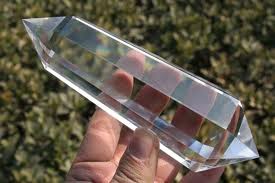
crystal"One of my promising students, who has a large crystal collection, is really keen to find out the mystical aspect of crystals."

Most people asking such questions believe in the healing power of crystals. Sorry to say, I'm afraid this isn't going to be a fruitful search.

But Maimonides says that studying nature is the first step towards developing the most fundamental of all middot: appreciation.

Crystals are awesome. So are cells. And orchids.

So I suggested to the rabbi that he show his student two mentions of crystals in the Torah.

1. The book of Job
:

"But where shall wisdom be found? And where is the place of understanding? Man does not know its price; nor is it found in the land of the living. The depth says, It is not in me; and the sea says, It is not with me.  It cannot be acquired for gold, nor shall silver be weighed for its price. It cannot be valued with the gold of Ophir, with the precious onyx, or the sapphire. Gold and glass cannot equal it; nor can it be exchanged for jewels of fine gold. No mention shall be made of coral, or of crystal; for the price of wisdom is above rubies." (28:12-18)

2. The Talmud:

"R. Ashi made a marriage feast for his son. He saw that the Rabbis were growing [overly] merry, so he brought a cup of white crystal and broke it before them and they became serious." (Brachot 31a)

Second Question for your table: What's the moral of the story?

Evidently we are to understand crystal as something very, very precious. But wisdom is even more precious, as are proper middot.


Shabbat Shalom 


PS - In case you missed you missed it, wo weeks ago during the Jerusalem snowstorm, I sent you some Jewish ideas about snow.

This blog can be received via email. Subscribe at jsli.org. If you enjoyed it, please "like" it, "tweet" it, or simply forward the link to others who may enjoy it.


Friday, October 15, 2010

Climb Out of That Hole


Life underground seems to be a theme of the week.

And patience.

Just as Switzerland completed a 20-year project to build the world’s longest tunnel... (http://tinyurl.com/swisstunnelcompleted)

Just as the Chilean miners were emerging from their 70-day ultra slim-down retreat….

Two patience-required milestones happened in my life that were causes for personal joy. I just wanted to share these with you before I ask this week’s question.

Event #1 – after 12 years of work – yes, that’s not a typo, 12 years – I have in my hands the Hebrew version of the Art of Amazement. It was published just after Rosh Hashana in Jerusalem and it is exactly how I envisioned it. Small, paperback, beautiful cover.

1,000 extra copies were printed to send to Jewish centers around the world where young Israelis are wandering. (15,000 copies were requested, by the way.)

Event #2 – after 8 years of work, yesterday I submitted my very first iphone app to Apple.

How could it be, you ask, since the iphone hasn’t been around for 8 years?

I’ll leave that question unanswered for now. When the app is approved and I can unveil it to the world, then I will tell all.

Now, here’s the stumper for your table:

We live in a time of instant gratification. Food, information, communication, entertainment and you name it – can be enjoyed with the push of a button.

Some of us (including yours, truly) enjoy the slow, delayed gratification of home-grown vegetables.

But let’s face it. We’re all somewhat addicted to instant results. If a computer becomes sluggish, we get impatient, forgetting what computers were like just a few years ago.

One day I imagine our grandchildren are going to ask, “Tell us again that story about how phones used to drop the call…” or “Tell us that story about how you had to push buttons in order to call someone.”

So here’s the question: How can you get instant “spiritual” gratification?

(Remember the rules, there are no wrong answers, but ask at your table

Of course, there is the long-winded answer that I put into a book:

http://www.jsli.org/discount (that’s cheaper than you can get it anywhere else)

Here’s a short-winded answer:

Give to someone.

The moment that you give to someone, you are getting outside of your own bubble. That’s the most basic spiritual experience.

We all pay lip-service to becoming more spiritually-connected.

Time to put your mullah where your mouth is.

Our friend Captain Shulman is now on assignment on the US base in Korea. He just sent a list of Jewish soldiers currently serving overseas.

Why don’t we – you and I – try to make sure that every one of these soldiers gets something for Hannuka. A card, some chocolate gelt, a box of small candles, a book, a silly toy. You name it.

If you know any kids, get them to MAKE cards. Hand-made cards are the best.

Email me for the names. Let me know how many you want.

(The cost of mailing is the same as a US address, but needs 10-14 days.)

Think about it.

(But not too hard.)


Shabbat Shalom

Friday, September 17, 2010

Feel More Human

Happy new year! Welcome to volume 5771 of Table Talk.

I have some really good news.

After 10 years of effort, the Hebrew edition of The Art of Amazement is now in print. I haven't actually put my hands on a copy yet, but 1,000 copies were sent out to teachers and organizations around the world, thanks to contributions and pledges from many readers of this blog. $9 enables me to put one book into the hands of one young Israeli and follow-up with him or her. Another shipment will hopefully go out soon, and hopefully we'll eventually fulfill the requests we have for 15,000 copies.

This week - three steps to feeling more human:

1. A timely update
2. An important addition
3. A child's plea for mercy

First, the update:

I gave a few Yom Kippur classes this week. In case you missed them, here are links to two handouts that I used - great Yom Kippur table talk for all ages:

Get the free handouts

+ + + + +

Second, even if you were with me, here is something that I did not say.

Something that is arguably the #1 most important thing to do before Yom Kippur.

Something that has nothing to do with being "religious".

Something that has nothing to do with fasting, praying, yada yada yada.

This afternoon, try finding a moment and place of solitude, and saying aloud the following words:

"I hereby forgive anyone who has hurt me in any way in the past, whether it was intentional or unintentional, knowing or unknowing, negligent or unavoidable. (If they owe me money or an apology, they may still repay or apologize, but I am not going to harbor grudges or bad feelings.) Beginning right now, I am looking forward and not backward in all of my relationships."

Guaranteed to make you feel more human than you felt before you did it.

(What do you have to lose, besides your pride?)

+ + + + +

Finally, people sometimes ask me what's the best way for a non-religious person to do Yom Kippur? How about kids? Make them sit through a long service bored out of their minds?

Are you crazy?

If you are not inspired to sit in shul, PLEASE do not go to services just because “I’m supposed to.” That’s a great way to kill your soul.

If you have any influence over children, PLEASE do not drag them to services just because "I’m supposed to". That's a great way to kill their souls.

A better use of Yom Kippur: go visit an assisted living facility. Go see how your single/divorced/widowed neighbor is doing.

And if you are one of the pious ones who likes to be in shul, make sure to read the words of the Yom Kippur Haftara - this is exactly what the Prophet Isaiah is telling us to do.

Think about it.

Happy Yom Kippur

Yes, happy!

PS - there may not be an update the next 2 weeks because I'll be sitting in my Sukka.

PS – this inspired 104-second video is all about changing one’s perspective:

Friday, February 05, 2010

Regenerative Break

Question for you...

What's the most memorable news you've heard recently?

Is it:

A. The devastation of Haiti, and the heroic efforts to help?
B. The world's biggest car maker, Toyota, has become the world's biggest lemonade maker?
C. The Saints are marching in?
D. Something else?

I vote for D - the announcement that functional MRI can be used to communicate with some people in vegetative state.

If you didn't see this, here is a link. This is a story you can share with the entire family.

The science is not being universally applauded. In fact, comments to the NYT health blog are running about 4 in favor, 3 against, and 10 skeptical about this development.

(FYI - Here is a story worth sharing about someone who was in a "permanent" vegetative state for 14 years, and now can communicate.)

So this gives us 2 questions for your table, one practical and one tangential:

1 - How do you react to this story? Amazed? Skeptical? Disappointed?
2 - If you were in a vegetative state, fully aware of what was going on around you but unable to communicate, would you want them to keep you on life support, or pull the plug?

As you know by now, I like to spin the news "Jewishly".

Remember The Matrix? In this film, the hero learns that everything we perceive as reality is really an artificial virtual reality. One of the best scenes in the movie is when one character who goes in and out of the matrix says,

"You know, I know that this steak doesn't really exist. I know that the Matrix is telling my brain that it's juicy and delicious. After nine years, you know I realize? Ignorance is bliss."


In other words, he'd rather live in a blissful illusion than a challenging reality.

What a Jewish metaphor.

(If you want to learn the three Jewish techniques for waking up from our rather permanent vegetative state, send me an email. If there is enough interest, we'll do an online class.)

Shabbat Shalom

PS - Here's the matrix scene.


It is a good thing for an uneducated man to read books of quotations… The quotations, when engraved upon the memory, give you good thoughts. They also make you anxious to read the authors and look for more. - Churchill

Friday, December 12, 2008

Split Personality

This week: 3 questions.

Do you ever feel like you have a split personality?

Let’s say you have a sweet tooth. OK, you probably don’t have one, but maybe you know someone who does. This person gets up every morning and declares, “Today I’m not going to eat those sweets! I’m going to stick to my healthy diet!”

And they go to bed each night feeling, “I blew it again! How could I have let myself do that?”

There is a secret to our dual nature.

There were originally 12 tribes in Israel.

Each tribe was like a unique wavelength of color that combine to make the rainbow.

Most Jews today are “Jews” - i.e., from Judah, which means appreciation.

All the tribes together - the full spectrum - is called both “Jacob” (as in children of Jacob) and “Israel” (as in children of Israel).

“Jacob” is the person who is always devising plans, figuring out how to be successful in life. Jacob is often reacting to other people and situations.

“Israel” is the person who is struggling with his or her own self, struggling to master one’s own self-destructive tendencies.

First question for your table
: As an appreciative person, are you more of a “Jacob” or more of an “Israel”?

+ + +

This morning, someone sent me a list of “isn’t it funny” questions. Here are three:

Isn't it funny that $10 seems like a lot when we give tzedaka, but so little when we go shopping?

Isn't it funny how one hour seems so long in shul, and so short when we watch a ball game?

Isn't it funny how readily we forward email jokes and hoaxes, but when we receive something about Judaism or spirituality, we don't
re-send them to anyone?


Second question - a thought-experiment: Try reading the questions first as a “Jacob” then as an “Israel”.

+ + +

NATIONAL HANNUKA CLASS

Are you tired of all the end-of-the-year fundraising pitches? Donate now, get your tax deduction (as if any of us need one this year!)

Last year at this time, I devoted an entire week’s Table Talk to ask you to support the organization (JSL) that makes Table Talk possible. I suggested 25¢/week as a reasonable level, and many people responded much more generously than that.

This year, I thought it would be interesting for you to have something other than an old-fashioned plea. How about a Chinese auction? But what can I auction that would be meaningful to Table Talk readers? I know, how about a class on Happiness? But would it work? Would people want to bid on happiness? Last week, if you read the blog, I challenged you to do just that – bid on happiness. If you do so, do so with a happy spirit, that you are really showing how much you value getting this email. If you read it from time to time, I assume you value it. Is it worth two-bits a week?

In addition to spending my Friday morning conjuring up “great”, “thought-provoking” “ really nice”, “enjoyable”, “beautiful and touching” stories and questions [actual reader comments] for your spiritual nourishment, I spend the rest of the week bringing Art-of-Amazement type of Judaism to individuals and groups around the country.

Some pay their way and others – notably college students – cannot. We also train teachers both live and via our website, jewishspirituality.net, how to teach the Art-of-Amazement style Judaism. AND we give away (or sell at a loss) thousands of books every year. You should see the kind of feedback we’re getting from readers! We are enabling individuals of all ages to discover a Judaism that works, and helping teachers and parents to transmit a Judaism that works.

By reading this weekly blog, you are part of a national effort to uncover and promote this kind of engaging, down-to-earth, spiritual Judaism.

To close out 2008, I would like to ask you to become my partner in this national effort for 25¢ per week.

To make it fun, here’s the question: How much is happiness worth to you? The highest 20 bids will be invited to a new class (via conference call): “Hannuka and the Secret of the Darkness”.

Every pledge will be thanked with a recording of last year’s Hannuka class: “Hannuka and the Secret of the 36”.

Third question of the week: Is the weekly thought-provoking Table Talk worth a quarter to you?

If so, please use the info below to send in your 2-bits. But if you want, I’ll offer you something on top of partnership just to sweeten the relationship. 25¢ a week comes to 13 bucks a year. If you are willing to double that – 50¢ a week or $26 for the year, I’ll send you a thank you gift that I know you’re going to enjoy. I’ll send you an audio CD of a new class that premiered last August: A Jewish View of the Hinduism and Buddhism. The audience feedback was tremendous.


Please send your tax-deductible donation via: On-line
or via Paypal: donate@jsli.org

Donated frequent-flyer miles are also a huge help.

If there is an honoree or dedication, please let me know. All gifts will be gratefully acknowledged.

Finally - here’s a short movie that made me smile and I’ll bet it will do the same for you.

Shabbat Shalom


Click here to help rebuild the Chabad House of Mumbai

Other Chabad centers in India are in dire need – email me for details how you can help them


Speaking schedule:

December 25 – Baltimore (Etz Chaim) - “A Spiritual Interpretation of the Economic Crisis”

Friday, October 31, 2008

Rain, Rain Go-Away

"So, do your kids celebrate Halloween?"

That's what someone asked me this morning.

I said, "Sure, but we do it in February and we call it Purim."

He laughed. "I guess once a year is enough, right?"

"It's not only that. Think about what you're teaching your kids. On Halloween, people teach their kids to ring doorbells asking for gifts of food. On Purim, people teach their kids to ring doorbells to give gifts of food."

That's the thing about spiritual values. When you really start to plumb them, you often find that they are the diametric opposite of modern mores.

Question for your table - did you ever find yourself wanting to go against the grain and march to a different drummer than your neighbors all around you? Did you ever succeed? (and did they think you were crazy?)

By the way, last week - in my zeal to tell the story, I left off the punch line. After all that effort to rain-proof our sukkah - for the first time in 6 years, it didn't rain!

My neighbors gave me credit for the beautiful weather.

Anything like that ever happen to you? Where you go to a lot of trouble to prepare for some "rain", and the weather turned out fair? (post your answer below)


Watch (Purple Rain)Superbowl Halftime Performance - Prince in Music Videos  |  View More Free Videos Online at Veoh.com

Shabbat Shalom.

Friday, August 24, 2007

This Just In Talk

Dedicated to the speedy and complete recovery of Rabbi Tzvi Shur, who has a scheduled heart surgery this coming Tuesday - he had had a routine test for a minor treatment two weeks ago and the doctors discovered a major problem in his heart. We are grateful for the gift of modern medicine. (Tzvi Gershon ben Shaindel Shaina Raizel)


Question for your table: What’s the most significant news of the summer?

Summer’s almost over, time for a roundup.

First, do you remember the family who had the terrible accident last October? I wrote about it here:

http://tinyurl.com/ynuz62 ....

Most of the children have recovered 99%. The youngest victim, seven-year-old Rafoel Dovid ben Brocha, has been making the slowest progress. He had severe brain trauma, but slowly, slowly is getting better. Here is a summary of what his father wrote three weeks ago:

Dovid was discharged from the hospital on February 16 and on the 19th he began his day care therapies at Ranken Jordon Children’s Rehab Hospital. After a month ,he returned to school for an hour in the morning to daven with his class and then proceeded to his therapies. Since school has ended, he has been attending a day camp along with a personal shadow/tutor and is going for out patient therapies 3 times a week.
It’s hard to describe his mental status. He is not what or who he was and his brain is still in need of much healing. His abilities are compromised due to the severity of the brain trauma and injury. Nevertheless, he has made and continues to make tremendous strides. His long term memory is better than his short term memory. His short term memory which was of the greatest concern seems to be getting stronger. He is remembering things that happened yesterday or in the recent past more than the doctors would believe possible. It’s not always on target or lucid, but we see continued improvements and are grateful for this and daven that he’ll come back all the way.
Every doctor and therapist who sees him, especially those who don’t see him regularly, has been wowed by his remarkable progress, albeit he has a very long way to go. Dovid’s left side of his body has made significant improvements. He still doesn’t move his left hand or fingers voluntarily, but we are hopeful and optimistic that it’s a matter of time when this function will return. His vision is basically good. He sees near and far and recognizes everything.
Dovid’s swallowing has been like a roller coaster. During Pesach his eating was great. After Pesach he had some setbacks, and it was a painstaking 20-40 minutes between each bite.
Dovid has been walking slowly with someone holding on to him. It’s a slow process like teaching a child how to walk. Yesterday and today I’ve been encouraging him to stand by himself. This morning we got up to 15 seconds, he then takes one step before falling over. He traditionally says after someone catches him, “nice catch”.
Since May I have been taking Dovid swimming as much as possible.
Dovid is in great spirits. He often asks me, “Are you thinking what I’m thinking?” I ask him, “Dovid, what are you thinking?” He responds, “About me getting much better”.
This Wednesday, my wife and I are taking Dovid to New York where he was accepted into Camp Simcha. On August 14th we are taking Dovid to the University of Michigan in Ann Arbor where he will be evaluated and enrolled in an intensive rehab program for approximately 5 hours each day for a minimum of 2 weeks.

If that heart-wrenching saga of faith and hishtadlus isn’t enough to wow you, try this awesome animated video from Harvard, based on current knowledge of cellular biology:


Second Question for your Table: What’s more awesome, the human being or the universe?


On the BBC this morning, after rattling off the usual humdrum news, the announcer concluded with this:

“...and Scientists in the United States have found a giant hole in the universe, far bigger than any that has previously been found.”

That’s all she said – no elaboration. Try reading that with a British accent and see how odd it sounds.

What does it mean? Who knows?


Shabbat Shalom.


Einstein quote of the week:
"The most beautiful thing we can experience is the mysterious."
-Albert Einstein


Israel fact of the week:
ISRAEL LEADS THE GLOBE IN R&D INVESTMENTS, 4.4% of GDP (77% by the business sector), ahead of Sweden - 3.7%, Finland - 3.5%, Japan - 3.3%, US - 2.2% and Canada - 1.7% (The Marker, Aug. 2, 2007).

Announcements:
New Amazement website about to launch – sneak preview: http://jewishspirituality.net – please send your feedback!


Speaking schedule:
Monday, August 27 – Baltimore: “In the Beginning”
Tuesday, August 28 – Baltimore: “Let There be Light”
September 12-14 - Rosh Hashana - Baltimore (“The Un-Shul” for people who want to connect but don’t connect to shul)
September 21-22 – Yom Kippur - Los Angeles (“The Happiest Yom Kippur of Your Life”)

(For details, send an email)


Yiddish of the week:
hishtadlus — effort, due diligence; as in, “Do your hishtadlus and let Hashem worry about it.”

Yiddish review - how many do you know?
anee — poor person
koptsen — panhandler
ballaboss — homeowner; layman
nu — various meanings (see archives)
mishpocha — family
mameh — mother
tateh — father
mazal – (MAH-z’l) luck or fortune, as in, “It was good mazal that....”
beshert – (b’shairt) - meant to be, as in “It was beshert that...”
mine eltern – my parents
mine lair-er – my teacher
hamantashen – Haman-pockets
zeigezunt – all the best (said upon parting)
kesher - connection
Ikh volt veln a kave, zayt azoy gut. - I'd like a coffee, please.
...kave mit shmant. – ...a coffee with cream.
...kave mit milkh. – ...a coffee with milk.
...kave mit tsuker. - ...a coffee with sugar.
Di Fir Kashes - The Four Questions
Oy vey! - Good grief!
mensch — a decent person
rachmanos — mercy
neshoma (neh-SHOH-ma) — soul
minig — custom, as in, "Why do you do that?" "It's my minig!"
Gavaltig — wonderful
Oy gavalt — how wonderful (sarcastic)
Azoy gait es! — That’s how it goes!
Shabbos — Cessation; stopping; day of stopping; weekly sabbatical experience
"Gut Shabbos" — "Enjoy your weekly sabbatical experience"
Neshoma — Soul
meshugass — insanity
meshuganeh — insane
kyna hara — no evil eye
shvitz — sweat
shanda — shame
Lechayim! — Cheers!
Pinteleh Yid — the Jewish feeling in the heart of every Jew
Zreezus — zeal
Mkohm — place (pl. mkohmas)
mamalashen — mother tongue
bentch — make a bracha
bashert – meant to be, pre-destined, as in, “He’s my bashert” or “It was bashert that...”
kvetch — complain
kvell — burst with pride