Showing posts with label purpose. Show all posts

Friday, January 07, 2022

Dying to Regret?

The purpose of this blog is a no-regrets Shabbat table....please print and share...

Happy Birthday shoutout to Donna in Tacoma!

5 Regrets bookHave you ever heard of Bronnie Ware?

Me neither, before this week.

(I was not even aware that "Bronnie" existed as a given name, perhaps because I've never been Down Under. Today, however, I am Bronnie aware.)

Bronnie's story dovetails with last week's light-hearted comparison of Queen Elizabeth and Pharaoh.

(By the way, I was surprised that no one pointed out another parallel - Queen Elizabeth and Pharaoh have the distinction of being the longest-reining monarch in their country's history.)


Today's dovetail is about people who are fortunate to live long lives but sadly approach the end of their years with regrets.

Bronnie Ware is an Australian nurse who turned her patients' dying regrets into a virulently-popular blog who then turned the blog into a best-selling book (who then turned the book into a new career).

Before we spill the beans, try asking this at the dinner table:

What would you guess are the top 5 regrets of average people on their death bed?

Here is Bronnie's list (along with her comments):


1. I wish I'd had the courage to live a life true to myself, not the life others expected of me.

"This was the most common regret of all. When people realise that their life is almost over and look back clearly on it, it is easy to see how many dreams have gone unfulfilled. Most people had not honoured even a half of their dreams and had to die knowing that it was due to choices they had made, or not made. Health brings a freedom very few realise, until they no longer have it."

2. I wish I hadn't worked so hard.

"This came from every male patient that I nursed. They missed their children's youth and their partner's companionship. Women also spoke of this regret, but as most were from an older generation, many of the female patients had not been breadwinners. All of the men I nursed deeply regretted spending so much of their lives on the treadmill of a work existence."

3. I wish I'd had the courage to express my feelings.

"Many people suppressed their feelings in order to keep peace with others. As a result, they settled for a mediocre existence and never became who they were truly capable of becoming. Many developed illnesses relating to the bitterness and resentment they carried as a result."

4. I wish I had stayed in touch with my friends.

"Often they would not truly realise the full benefits of old friends until their dying weeks and it was not always possible to track them down. Many had become so caught up in their own lives that they had let golden friendships slip by over the years. There were many deep regrets about not giving friendships the time and effort that they deserved. Everyone misses their friends when they are dying."

5. I wish that I had let myself be happier.

"This is a surprisingly common one. Many did not realise until the end that happiness is a choice. They had stayed stuck in old patterns and habits. The so-called 'comfort' of familiarity overflowed into their emotions, as well as their physical lives. Fear of change had them pretending to others, and to their selves, that they were content, when deep within, they longed to laugh properly and have silliness in their life again."


Final question for your table: her data set comes from people who all were confined to nursing homes at the end of their lives. Would you expect that a broader sample would yield different top regrets?

Shabbat Shalom


PS -  There are 10 ways to hear this week's highly-acclaimed 10-minute Body & Soul podcast, "A Drop of Golden Sun" :

iTunes/iPhone … YidPod … Spotify … Google Podcasts … Pocketcasts … Stitcher … Podbean … Amazon Podcasts … RSS … or just on the web.

Appreciated this Table Talk? Like it, tweet it, forward it....


Friday, October 16, 2020

Why on Earth Are You Here-o?


The purpose of this blog is to make the Shabbat Table epic. Please print and share.

Dedicated to the memory of Yermiyahu Matan (Jeremy Dossetter) - whose yahrzeit was this week (please remember him here);
Happy birthday shout-out to his dear mother Susan;
and Mazal tov to Yaakov Felson on becoming bar mitzvah. 

Announcement: To become a partner in the publication of groundbreaking new book, Body and Soul: A Torah Guide to Health, Fitness, and Longevity, Medically-Annotated, it is now possible to contribute a dedication in someone's honor or memory to be printed in the book, please send an email to dedications@jsli.org for instructions and may the merit of your contribution uplift them and the Jewish People and the world. Eight years in the making, this collaboration of Torah scholars, doctors and dietitians will, we hope, change the way we relate to our bodies and to food.

Hero-

Try starting off the conversation with this couplet:

Who's your hero?
Whose hero are you?


I wonder how many people think about such questions. Or about this week's title question....

Why in the world are we here?
Surely not to live in pain and fear....

The question is arguably the fundamental problem driving the entire Torah.

It seems to me the Torah's answer to that question is: You're here to be a hero.

Like all great heroes, you only become a hero through trial and tribulation.

Of course, the tests often come when we're least expecting them. The surprise too is part of the test.

So here is a true story that happened to my friend the other day.

He was filling up at a service station near the highway. Two women approached him and told him that they were en route to the airport, but the person driving them had ditched them while they were using the ladies' room. He had driven off with their luggage. 

For your table: Put yourself in his shoes. What would you do?

Less dramatic versions of this encounter happen every day: a panhandler at the red light; a spouse asking for help; a child whining; a parent lecturing; any of the above nagging....


I'm guessing everyone at the table can come up with many better examples.

If you find yourself resisting playing the hero, just wanting to be left alone and not get involved, it's a sure sign you're being tested.

What about a test of your patience? Is that also a test of your heroism?

What about when you make a mistake and someone calls you on it - is that also a call to heroism?

Now we can bring it full circle:

Who's your hero?
Whose hero are you?


Shabbat Shalom


Enjoyed this Table Talk? Vote with your fingers! Like ittweet it, forward it....
  

Friday, August 31, 2018

In Search of Your Inner Great-Grandparent

The purpose of this blog is to get things ticking at the Shabbat table. Please print and share.


pocketwatchAll faucets become leaky. — Ancient Chinese proverb

OK, so it's not so ancient and not so Chinese.

Maybe it's only true chez Seinfeld.

But every leaky faucet makes me think that Chinua Achebe was right.

The dairy sink's leak had been easy enough - remove the handle, pop in a new washer, cleaned up in under 10 minutes.

But last night's struggle with the other side was meatier. I felt like I'd met my match and it's name is Moen which rhymes with moan. It was one of those DIY jobs that gets you rationalizing: Is a leaky faucet really such a big deal?

Or: Can't this wait until after Rosh Hashana?

So....(for your table), What does matter before Rosh Hashana?

This is a follow-up to
last week's question, "Why does Rosh Hashana matter anyway?"

You've had a whole week to think about it. Ready for an answer?


If statisticians are to be believed, there's a high probability that everyone reading this (or hearing it read) has or had 2 parents.

(Maybe in this day and age I should say "at least" 2 parents.)

And I'm no statistician, but I'm fairly certain that these odds extend to having 4 grandparents.

I'm even willing to bet that you have (or had) 8 great-grandparents.

OK, let's pause right there.

I've never met anyone who could pull this one off:

Raise your hand if you can name your 8 great-grandparents and tell one interesting thing about each of them.

If you happen to be the one-in-a-million who can do that, then extend it back to your 16 great-great-grandparents.

At some point most humans fade into the background. Even those lucky enough to have children eventually become someone's forgotten great-grandparent.

And don't assume that there will even be a digital record of your life.

Maybe you'll be lucky enough to die with sufficient drama for them to display one of your possessions in a museum.

(I hope you're clicking on all the links as you read - they are all quite interesting.)


Bottom line - there are two proverbial books open on Rosh Hashana.

What's the secret to being written in the Book of Life?

Come up with a reason why your life is going to matter for at least another year.

Friendly suggestion: you might want to get a copy of this year's new 40 Meditations for the High Holidays....

One day you'll be at best a distant, remote, faint memory. How are you going to create a legacy?


Shabbat Shalom
 

Enjoyed this Table Talk? Vote with your fingers! Like it, tweet it, forward it....


Friday, July 22, 2016

PG-613? (Pokemon Go, is it a Mitzvah?)

The goal of this email is to augment reality at the Friday night dinner table....

twitter v. pokemonI heard that the new Pokemon-Go game works like a pedometer and knows when you are walking, giving extra points for being on your feet.

I also heard that it rewards sportsmanship and teamwork.

Is that icing on the cake, or a silver lining on a gray cloud?


The cake is that people are obviously having a lot of fun with it.

The gray cloud is that it's a hammer in our ADD-toolbox.

(And perhaps some other pushback.)

There is a solution, based on last week's Hellen Keller piece.

This is a tool that you can use right now to enact Keller's vision (pardon the pun).

It's called NATURE.

Ironically, it works best when your smart phone runs out of juice.

If you're one of the unfortunate few to have an ultra-long battery life, it may require shutting off your phone. Or leaving it in the car.

(Hard to do, right? I know.)

It's great to be out in nature.

It makes you mentally and physically healthier.


But what do you do when you have to return home, and get back to work/school/life?

How about this: bring nature home with you.

Here's how:

Two years ago we launched the Amazing Nature for Teachers curriculum.

The site is now called teachamazingnature.com.

Last year, we trifurcated it:

1. Amazing Nature - for secular teachers
2. Nifla'ot - for Judaics teachers
3. Ma Rabu - for teaching tefila (prayer)


There are three ways you can play:

1. Register your kid's teacher or school for next year.
2. Sign up your family.
3. Subscribe yourself.

Go ahead - give it a try! I guarantee it will give you 301x more long-term gratification than Pokemon-Go, or your money back.

Now let's get to this week's first question for your table - Why is Pokemon Go so popular, even though it is PG (pardon the second pun)?


Is it the instant gratification? Is it the challenge?

Is it that it's safe (well, most of the time anyway)?

Is it the energy and synergy?

When you watch people play, it seems like are striving for something that seems intangible, like the energy of a fire.

In Jewish wisdom, fire represents the evil inclination. And the only way to cool it down is through the Torah.

Yet the Torah, too, is compared to a fire. Fight fire with fire? The Torah is also a challenge that is also nearly instantly gratifying, and is 100% safe.

Some say it's the greatest "game" ever played.

We have an ancient tradition that just as Jerusalem was destroyed with fire, it will be rebuilt with (metaphorical) fire.

It so happens that "Pokemon Go" in Hebrew has the gematria (numerical value) of 301, which is the same as eish (fire).

Hmm....Will Jerusalem be rebuilt through Pokemon?

Or through millions of people waking up from their augmented-insanity, deleting that app and making room in their heads for a bit of Jewish wisdom?


Shabbat Shalom


Like this post? How about putting your gelt where your gab is: Like it, tweet it, or just forward it.

Friday, July 11, 2014

Could it Be Any Other Way?

The goal of this blog is to bring peaceful conversation to your Friday night dinner. Please print and share.
In honor of our great friend in Jerusalem, whose birthday was this week - Happy Birthday, Pinchas.


669928.503perseverance_orig

A young woman phoned me the other day - someone I've never met - with a burning Jewish question, that is so good I offer to you as this week's Table Talk question:

Did God have to create a world with pain and suffering?


It seems to me the answer must be yes....

....or no


Let's start with the no.

The question assumes that we're talking about creating a world with a specific purpose. Let's say that purpuse is for us to achieve a certain thing. So the question is, did God have to create this purposeful world with pain and suffering - was it impossible to create a world with the same potential but without the pain and suffering?

If the answer is "no" - that God could have created creatures with the same potential yet without the pain and suffering, then it seems to point to God the sadist. Why would God make us suffer unnecessarily?

OK, so perhaps God is a sadist.

But if that's so, then God isn't a very successful god. After all, millions of people are happy. Millions of people - despite their pains and sufferings - are enjoying many blessings. If God were a sadist, he's not batting 1000.

So we have to reject the "no" answer and turn to the "yes" answer - that God had to create this purposeful world with pain and suffering, or at least with the potential for pain and suffering (perhaps triggered by our own actions).

That is, we need pain and suffering in order to achieve our purpose.

What is that purpose?

Simply put: knowledge of God.

In other words: the pain and suffering are custom-designed for each person to achieve divine knowledge.

The reason people are confused by this is because our materialistic culture teaches us that our purpose is material (money, leisure).

Judaism is a spiritual culture, teaching us that our purpose is spiritual.

In a materialistic culture, pain and suffering are inherently bad, because they are the opposite of comfort.

In a spiritual culture, comfort is not the goal. The goal is enlightenment, and usually this only comes through discomfort.

The girl's question was, Couldn't God have made a world with the same enlightenment but without the discomfort (pain)?

The answer is no, because learning to deal with discomfort is part of the enlightenment. Without discomfort, we would be missing certain facets of the jewel of enlightenment:

Without someone testing my patience, how will I learn patience?
Without someone testing my calmness, how will I learn calmness?
Without having my honesty tested, how will I learn honesty?
Without feelings of laziness, how will I learn zeal?


And so on.

And here's the real zinger for your table:

What's the greatest discomfort (pain) in the world?

I'm interested in your answers. Here's mine:

The greatest pain in the world is the bruised ego.

That's why the Torah starts with the legend of Adam and Eve in the Garden. Their great mistake wasn't eating the fruit - it was their refusal or inability to admit they'd done something wrong.

Thus the singlemost important thing you and I can do right now in order to become enlightened is to look in the mirror and practice over and over saying the two hardest phrases in the English language:

- "You are right - I'm wrong"
- "I'm sorry."


Only by embracing the pain of saying those two phrases can a person become truly great.

Good luck....

....and Shabbat Shalom


PS - There is another, less painful, route to enlightenment, and you can find it here.


Friday, June 27, 2014

Floating Through Life?

The goal of this email is to help your Friday night dinner float above the first six days of the week. Please print and share.
In memory of my grandmother Yehudis bat Alexander, whose yahrzeit is remembered tonight.


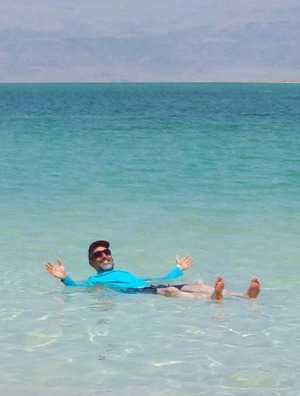
Dead Sea Float

Greetings from Terra Santa!

Here's my take on the Dead Sea, the lowest spot on Planet Earth.

You've heard about how you can't sink?

You wondered if it's true?

OK, so it's true. See the picture? I'm truly not sinking.

But here's the thing.

There's nothing refreshing to me about the Dead Sea. It's called "dead" for a reason.

One wouldn't enjoy swimming there. One ends up quite slimy.

They say it restores health. I'm not convinced.

I'm pretty sure the only reason to go is to get a picture of yourself floating in it.

"Look Ma, no hands!"

"Now where are those showers?"

(I should add here that I'm exaggererating to make a point. For those who are into sunbathing or being slimy, it's a fabulous spot.)

So here's this week's question for your table: How often do you do something just to be able to say you did it, but with no actual cultivation? Is this a problem? If so, what's the solution?

(Hint: it has something to do with this word.)


Shabbat Shalom


PS - Speaking of not floating thru life, check this out

Friday, November 15, 2013

LIfe is a Pyramid

Looking for a Channuka gift, book or activity? Here's the web's best list of the best.


Life is a Pyramid
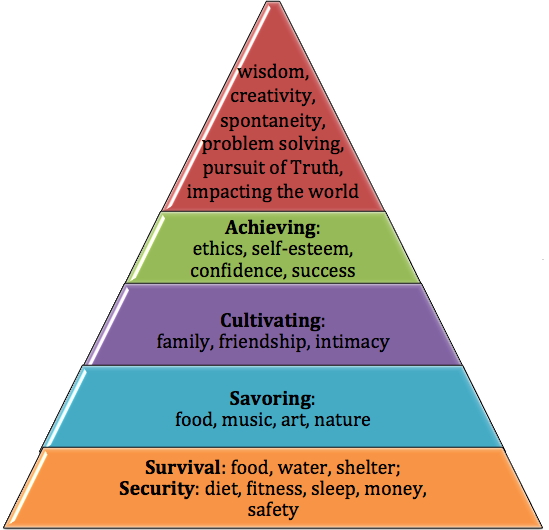
Three questions for your table: jewishspirituality.net_lifepyramid

1. Raise your hand if you ever felt like you just wasted a lot of time.

2. Why does this happen?

3. What's the solution?

Recently I joined Quora and have been asking myself if it is a good or poor use of my time.

In asking the question, I noticed that I'm able to rationalize just about anything.

Ever have that problem?

So someone on Quora recently asked:

What's the best way to manage your time?

The answers were quite interesting and if you'd like to see my compendium of the best ones, send me an email.

One of the answers included a pyramid similar to the one above.

I took one look at his pyramid and felt like I was having déjà vu all over again.

It's uncannily similar to the structure of Chapter 3 of my book (The Art of Amazement).

I borrowed his idea for the colored pyramid and tweaked the words to match my own orientation, and now present it to you as a self-assessment.

Color version
Black-and-white version

(Note the point system!)

Please print a copy for everyone at your Shabbat table and let me know if they agree or disagree that this is the surest path to living every day to the fullest.

Shabbat Shalom


PS - Please follow me on Twitter, or tweet this week's message, or like it, or just forward it to someone you love...


Friday, November 01, 2013

Luck, Fate or Karma?

The purpose of this blog is to get kids of all ages talking at the Friday night dinner table. Print and share.

image001 Here's a true story for your table tonight, followed by an inescapable question.
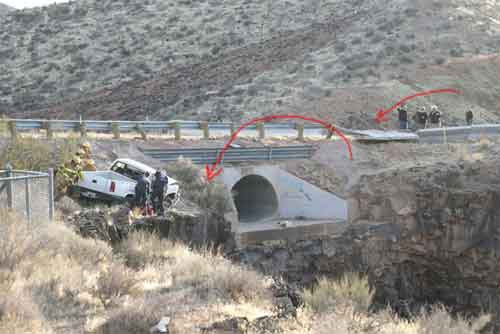

Take a look at this photo, to the left.

Take your time to study it carefully.

Notice the position of the white pickup truck. How do you think it got there?

Notice where the guardrail is broken where the people are standing?

Notice how the breach is on the other side of the culvert (tunnel)?

According to police, the pickup was traveling about 80 mph when it crashed through the guardrail.

It flipped end-over-end bounced off and across the culvert and landed right side up on the left side of the culvert, now facing the opposite direction from which the driver was traveling.

The 22-year-old driver and his 18-year-old passenger were unhurt except for minor cuts and bruises.

This occurred near Hurricane, Utah on Highway 59, on December 30, 2006.

Here's one speculation of how the accident occurred:

culvert-flip1

Now look at this perspective on the same scene:

image002


Think it's a photoshop hoax?

I thought so too, but Snopes doesn't think so.

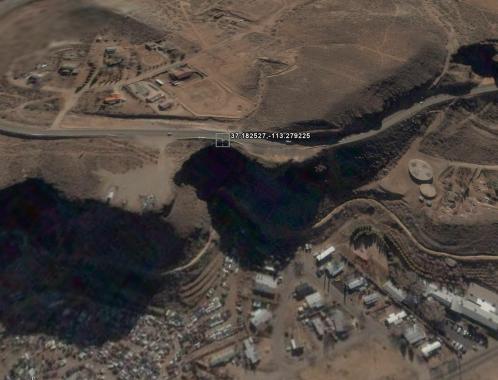
Snopes' research goes so far as to give us an arial photo of the same spot:

culvert_arial

So now the obvious question for your dinner table:

Luck, fate or karma?

As I often tell the seniors in a local assisted-living home where many are mobility-challenged: If you're here today, that means you have something to contribute to the world. Even something as "small" as a smile can change the world.

(Even if your answer to the question is "luck", doesn't this attitude make life more liveable?)

Think about it.

 
Shabbat Shalom

PS - the locals want you to know that they call their town “Her-ah-kun”. Don't want you to sound like a tourist, they say.

PPS - IMHO, the idea of karma relates to the Jewish idea of hashgacha.
 
PPPS - Follow me on Twitter, or tweet this week's email, or like it, or just forward it on...

Wednesday, September 04, 2013

If I Can Do It, So Can You

The purpose of this email is to stimulate the cerebral cortex of those at your Rosh Hashana table. Please print and share.
Please see below for an important announcement.


Full mailboxWhen is losing gaining, and gaining losing?

Today, erev Rosh Hashana, I have a story for you to share at your table.

A true story of grit, sweat and determination.

It is the dramatic and ultimately cathartic tale of my...

INBOX.

Yes, it's true. The last Table Talk of the year (and the first, if you share it tonight) is a blog about the inbox.

Most of the time we are in such denial about our inbox that we pretend that it's not worthy of conversation.

But if you think about it, the inbox is an excellent indicator of a person's inner health.

Show me your inbox and I'll know what kind of person you are.

Show me a person with an endless inbox, and I'll show you a person who never seems to get projects finished, is always running from one thing to another and feeling quite overwhelmed by life.

(Or perhaps it's just a person who is using gmail. For some reason.)

Show me a person with an empty inbox, and I'll show you someone who is in charge of their life.

But (aside from those who suffer from gmail-itis) is an empty inbox even possible? And if it is possible, is it a goal worth striving for?

My personal story begins two years ago when I saw my inbox surge - after deleting spam and all low-hanging fruit - to over 900 messages. To some of you that probably seems petty, like someone bemoaning gaining five pounds.

It was indeed similar to the feeling I had around the same time when I noticed my waistline exceed 36 inches.

I could see the direction this was going.

And I didn't like it.

I knew it was going to be an epic battle, a clash of wills between me and.... myself.

Who was going to win?

There are multiple roads to success on trimming down. But what's the value if you lose but regain?

So the first step is setting up some new habits. Like folders to file away any email that doesn't get a reply within 1 week. For any reason. If it didn't get a reply in a week, it must not have been that urgent.

Well, like my weight loss, I was able to trim significant fat in the first year. But when I got to around 100 messages, it seemed like I just couldn't cut more. That inbox bounced up and down from about 75-125 for this past year.

It was crazy. And a bit frustrating.

Maybe a sane person would just give up and learn to live with himself.

Maybe I'm insane, but last Rosh Hashana I decided to dream big.

I dreamed of what I wanted to become, my greatest vision for myself.

And that was someone with an empty INBOX.

Frankly, it has been a brutal year. Up and down, up and down, more down than up, but then you go out of town and look what happens, you end up bloated... What kept me hopeful through it all was that vision.

And of course I had a plan, a system.

Well, today I'm happy to say, on the very last day of the year I did it.

I surely had a lot of help from Above, but the first thing I had was a vision, a dream.

What's your dream? What kind of person would you like to become?

Organized? Patient? Punctual? Calm?

Happy?

Visualize that potential you on Rosh Hashana. Ask for it when you hear the shofar.

Then on Sunday morning, write down on low-tech paper three steps you need to take to get there.

Tonight and over the next 2 days is our annual chance to  push RESET.

How is this year going to be differerent for you? Is it going to be the same old patterns and bad habits, or something new.

Think about what it would be like to have an EMPTY inbox.

Down to ZERO messages.

It feels great.

I recommend you do it to.

Not only with your email. With any clutter in your life.

If you knew you could absolutely accomplish one personal goal in the coming year, what would it be? Think about that yearning dream when you listen to the shofar tomorrow.

That vision is what will justify another year of life.

Important Announcement: At this time of year, many people try to give extra tzedaka. If you're that type, please help eleviate hunger or support Jewish education. This blog is supported exclusively by tax-deductible contributions from readers like you. This is one of two times each year we invite you to become a paid subscriber. Nothing is free, so if you're not a supporter, someone else is paying for you to enjoy this. If it's worth a nickel to you or more, please do the math and click here. It only takes a minute or so and any amount helps.

May you be inscribed and sealed for life, joy, health, wealth and peace...and an empty inbox.

RAS


PS - I've created a downloadable sheet of "significant omens" that are traditionally said at the Rosh Hashana meal. I've added a few jocular modern ones. Try adding your own, and encourage anyone you're with to do the same. The public sample is here, you can download the full one here (requires free logon if you don't already have one).


Friday, October 12, 2012

Begin Again Now

The purpose of this blog is to help you turn your Shabbat table into an vibrant salon. Please share.
In honor of my dear Mother's birthday - Happy Birthday Mom!
(To dedicate a future TT, send an email.)


For a conversation-starter, try showing this photo around the table and ask everyone what they think it depicts:

Foxconn

(If you cannot view the photo in this email, click here.)

Hint: The snap shows a street at Foxconn, the Shenzhen (China) factory that makes our iphones, ipads, ipods and many other gadgets.

So what are those nets for?

They were installed in 2010 in response to the high rate of suicide at the factory that year.

That's the screaming headline.

In fact, even at the peak of its problem, Foxconn (which employs a mind-boggling 400,000 people in Shenzhen) had a lower suicide rate than the national China average.

But I'm re-hashing this topic because it makes an interesting conversation starter and an opener to the bigger question of the week:

What is wrong with suicide?

I'm sorry if that sounds morbid, but it's really a question about life and meaning, and purpose. So now that the High Holidays have passed and Jewish life is "back to normal", I'm challenging you to ask this at your table: Why shouldn't suicide be a moral and legal option?

I hope that the discussion will lead to an affirmation of the value of life, and perhaps greater scrutiny of what makes life itself precious.

Shabbat Shalom


PS -  If you haven't already, please download our (corrected) fall bulletin here.
PPS - This week's title is borrowed from a terrific book by Rabbi Pliskin well worth your time.

Friday, July 27, 2012

The Dynamic Duo

The purpose of this email is to provide something creative for dinner table conversation. Please print and share.

You may have noticed that I don't often use this space to comment on the news.

There are massacres committed daily in distant lands.

There are natural disasters that boggle the mind.

There is rampant thievery. And poverty. And disease.

I would like this message to be a mini refuge from the "news" which is invariably bad news. For some reason, our journalists feel that we are mainly interested in hearing the bad news. It used to be because "bad news sells." But is that still true today?

But there's something particularly disturbing to me about this Batman massacre.

Maybe it's the image of these innocent people settling down for some truly innocent pleasure.

Rather than only shake our heads, let's see if we can gain something positive from this evil.

This story hit close to home. Maybe, if nothing else, we can allow ourselves to be reminded that every moment is truly precious, how each day may indeed be one's last.

We should therefore live each day as if it were our last.

If you knew this were going to be your last day, what would you do?

Would you savor your food?

Would you hug your kids?

Would you say I love you to anyone?

Would you say I'm sorry to someone?

Would you do an act of kindness?

Would you try to control your anger/impatience/anxiety - just for the day? Go out on a high note?

Would you turn off the TV and learn a little wisdom?

Notice the dynamic here?

The self is a fusion of two forces: my centrifugal drive to connect to others and to the world, and my centripetal drive to suck the world into myself (ego). This is a true dynamic duo!

Enlightenment is a measure of how well a person remains aware of this dynamic duo, of what truly matters. What matters is both what you do but also how you do it.

That's my two-bits (as my grandfather would have said). What's yours?


Shabbat Shalom

PS -Here is a video I just made related to this topic. This is a rough draft. I'd like to re-do it with a fancier production, but would like to hear your feedback first:

PPS - This Shabbat is the 9th of Av - Tisha B'Av. The fast is put off until Saturday night. To learn more, click here.

The iPhone app: http://tinyurl.com/amazingcalendarlink
Android version: http://tinyurl.com/amazingandroidcalendar

Bar and Bat Mitzvah gift suggestions at bestjewishkidsbooks.com (a service of JSL).

Friday, December 30, 2011

Master of the Name

The purpose of this blog is to provide a conversation-starter for your Friday night dinner table. Please print and share.

Last week's Table Talk generated a huge amount of positive feedback. If you missed it, it is archived here.


This week's story is for anyone who is feeling down.

Or knows someone feeling down.

Or might feel down one day and find it helpful to have a story like this on file to pull out and re-read at the time.

The protagonist is of the most famous rabbis of all time.

I don't know if it's true or not.

But they don't tell stories like this about you and me.

He's known as the Baal Shem Tov.

If you want to remind yourself who he was and what he did, click here.


Here's the story.....

For those who "do" Shabbat, even a little bit, Saturday night can be a mystical time.

The more you do Shabbat, the more mystical Saturday night can become.

Saturday night is when a person can savor the Shabbat that one just experienced. Bask in the glow. The greater the experience, the greater the glow.

Something like enjoying a drink or cup of coffee or tea after an excellent meal.

The long Saturday nights in winter, all the more so.

One such Saturday night, while all were basking in that glow, the Baal Shem Tov told his driver to prepare the wagon and they set out with several of his students.

When they reached the open road outside of town, he told the driver, "Get the horses into a gallup and then let go of the reins."

This driver knew better than question or doubt anything that the great tzaddik said.

The horses were allowed to run freely, to follow their instinct.......
They ran and ran, on-road, off-road, on paths seldom traveled.

Finally, after an hour or so, they slowed and stopped.

They had come to a stop before a small cottage on the outskirts of a small town in the forest.

The residents must have heard the noise outside because almost instantly a man came rushing out, a Jewish man.

"My friends," he called to them, hurrying to the road. "My friends, my friends, welcome! Please, come inside for a warm drink, for a bit of food. We seldom see travelers here, please do me the honor of welcoming guests into our home!"

The Baal Shem Tov, his students and driver all followed the man inside.

When the man heard that they were from Medzibozh, his face lit up even more. "Do you know the Baal Shem Tov?"

Before anyone else could answer, the rabbi said, "If you please, we are indeed hungry and thirsty, may we speak later?"

The man served them a hot meal. They sang songs together.

When the hour got late, he invited them to stay the night and they accepted.

In fact, they stayed not one night, not two nights, but five nights with this Jewish family, until they had consumed all of their food.

When they departed on the sixth morning, the many thanked them profusely and asked, "If you see the Baal Shem Tov, would you please ask him for a bracha for me, that I should raise my children to be good Jews?"

Finally, the rabbi told him. "I am the rabbi you are asking about. God sent me to you for a reason, and soon you will know why."

They departed before their stunned host could gather his thoughts and reply.

As he re-entered his house, still in a daze from what had just happened, he encountered his wife.

She was not happy.

To say the least.

"You fed those strangers every moursel of food in our house! We have nothing left! And the children are hungry! They're crying! What are you going to do?!!"

In despair, the man closed his eyes, and uttered a simple prayer.

"Master of the universe, what did these children do to deserve to suffer? Please send us help!"

He continued for a few minutes, thinking about his wife and children, what they needed and asking for help.

While lost in this meditation, there was a knock on the door.

It was a non-Jewish neighbor named Ivan.

Ivan often came by for a visit and a shot of vodka.

This time, Ivan had other business.

"My friend, I've known you a long time, and you know that I live with my daughter and son-in-law, and that they make me miserable. I can't stand it anymore. Let me come stay with you."

Before the Jewish man could tell Ivan he had no food in the house, Ivan continued.

"I won't bother you. In fact, it will be very good for you. You see, long ago I made a fortune and I buried it in the forest in a secret location. I don't want my daughter and son-in-law to get it. I will give it to you. All of it. Just help me get out of the misery."

Seeing that the man was incredulous, he added, "Come, come with me, we'll get some of the treasure right now."

Into the forest they went, shovel in hand, and sure enough, Ivan dug up a sack full of gold coins.

So Ivan gave the man the treasure in exchange for his hospitality.

Not only did the man's family have enough to eat, they became great givers of tzedaka.

A few years later, the man traveled to
Medzibozh to visit the Baal Shem Tov.
When the Baal Shem Tov saw him, he spent an unusual amount of private time with him.

Seeing this, his students asked, "Why did Rebbe spend so much time with this particular man?"

"You don't remember him. He is the Jew we visited Saturday night a few years ago. The Holy One brought us to him. There was a decree in Heaven that he should be blessed with great weath. The problem was that this simple Jew was so satisfied with what he had, that he never asked for anything more. There was a chance that the blessing would never reach him. We were sent to him to consume all of his food so that he would ask for help."


Question for your table: What is the moral of this story? Can you think of two or three?

Shabbat Shalom

PS - Thank you to all those who responded to last week's PS.... As I wrote then, if you're read this far, chances are you enjoyed this message. Tomorrow night at 11:59 pm is your last chance to make tax-deductible contributions for 2011. How many appeals have you received this year? But you read this email, so you got something out of it. Maybe you have enjoyed this Table Talk throughout the year. Please support the organization that makes this and many ambitious educational programs possible. Here's the link: http://jsli.org/donate/ No contribution is too small or too large.


PPS - Robert Zimmerman:


PPS - Another selection from the Amazing Jewish Fact-a-Day Calendar

++++++ Sunday’s Amazing Jewish Fact ++++++

6 Tevet 5772
1 January 2012

At the age of 40, Akiva (ca. 60 CE) was an illiterate shepherd.

At his wife's insistence, he went to learn, but was embarrassed to be sitting in school with kindergarteners. Yet he couldn't go home, because his wife told him not to return until he was a scholar.

Feeling sorry for himself. Akiva sat down by a stream and stared at the water.

As he watched the dripping water slowly wearing away a rock, he had a flash of inspiration:

"If water, which is so soft, can wear away a hard rock, surely a little Torah can get into my hardened heart!"

So inspired, he returned to kindergarten.

By the age of 64 he had become Rabbi Akiva, the greatest scholar in Israel, with 24,000 students.

Talmud Nedarim 50a, Ketubot 62b-63a

Wikipedia on Rabbi Akiva

A book about Rabbi Akiva
An amazing class by R. Akiva Tatz on the meaning of life 

++++++++++++++++++++++++++++++++
From the Amazing Jewish Fact-a-Day Calendar:

http://tinyurl.com/amazingcalendarlink (iphone/ipad version)
http://tinyurl.com/amazingandroidcalendar (android version)