Showing posts with label life. Show all posts

Friday, October 12, 2018

But Are We Awake?

The purpose of this blog is to restore spirited conversation to the Shabbat table. Please print and share.
In honor of someone very special's birthday today.... Happy birthday, Mom!
And a big mazal tov to Shalev and Rocky on your wedding!

two-candles-in-handsA Jew I know just lost his non-Jewish mother.

Unlike the Jewish custom of quick burial, this Catholic family will not have the funeral for several weeks.

First 2 questions for your table - Have you ever been to a wake? Do you know why they call it that?

(No, it isn't because they hope the deceased will wake up.)

Once upon a time, I attended one. It wasn't Catholic, as far as I recall. They just called it that. It was in a funeral home. The deceased was a young man - 18 years old - who had drowned while swimming with friends in a rural swimming hole.

It was incredibly sad. But seeing him there, embalmed with makeup to make him look like he was merely sleeping, somehow made it more painful, to me.

Next 2 questions: Why don't Jews do embalming? Why do we hurry to bury our dead?

We obviously love life, we don't love death.

But we don't ignore it. We even have a beracha to say upon the death of a loved one.

Question 5 for your table - Why don't we like to talk about it? Why does it make us so uncomfortable?


Some say that the answer is because we live in a culture that really does glorify the physical aspect of existence (the human body and its pleasures) and we have all been trained from a very young age to  become deeply attached to that vitality.

Put it this way: the Olympics and Superbowl get a bit more attention than the World Chess Championship.

(Although it's always encouraging to see the media pay attention to the newest Nobel Prizes.)

Others point out that even spiritual people have trouble with death. They argue that we expect God to be good and loving and kind and taking a loved one away is painful and therefore unkind and that's a contradiction so we'd rather ignore it than grapple with the contradiction.

What say you?

According to the Talmud, there are 903 types of death.

(And if anyone cares, it even tells us which are the most and the least painful.)

Question 6 for your table - What would you say are the best and worst ways to die?

Question 7 - If the Talmud is going to talk about 903 ways to die, why doesn't it also tell us how many ways there are to live?


Shabbat Shalom

 
Enjoyed this Table Talk? Vote with your fingers!  , , forward it....


Friday, October 27, 2017

The Game of Go

The purpose of this blog is to add a nugget of inspiration to the Friday night dinner table
 
Dedicated by Lily Kanter and Marc Sarosi to the memory of Yermiyahu Matan (Jeremy Dossetter), alav hashalom.

JeremyJeremy is the young man I wrote about last week who disappeared into the warm waters of Molokai.

Hundreds attended Shiva at his family's San Francisco home this week, all feeling the same thing — how can there be comfort for losing a son and brother?

Even more so when you can't have a funeral.

If you had met Jeremy, I know that you would have loved him.

I know that because everyone loved him. There was absolutely nothing about him not to like.

No trace of anger, impatience, laziness, jealousy, gluttony, greed, pride or vanity.

He was calm but passionate about life and everything he did. He seized the day.

One of his emerging passions was the weekly pursuit of Jewish wisdom.

He intuitively understood "Torah" by its full name, "Torat Chayim" - instructions for living. In every topic, in every discussion, he calmly probed until he found a life lesson.

So this week I was thinking back to those past few years studying with him, trying to recall what "Torah" Jeremy found most meaningful or uplifting.

What came to mind was a chapter he particularly enjoyed.

It was last January, as he was preparing to move to Hawaii. We happened to be learning this week's portion (Lech L'cha).

It begins:

Go for yourself from your land, from birthplace, from your family....

The protagonist (Abraham) is obviously on a quest or spiritual journey of self-discovery. What Jeremy found so moving is the tightening circles of leaving: land, then birthplace, then family.

His interpretation:

- It isn't enough to travel physically from your land, if your head is still in your hometown.
- It isn't enough to unchain your mind from your hometown, if your heart is still preoccupied with your family.
- Self-discovery sometimes requires leaving the familiar and comfortable, and venturing out into the world.

Before leaving to Hawaii, Jeremy embraced the idea that physical, mental and emotional distance would help him discover himself. To discover his true passions and ambitions.

He also knew that going doesn't mean you can't come back....

But maybe you won't.....

Question for your table: Even if you do, will you still be you?


May his memory be for a blessing.


Shabbat Shalom


Enjoyed this Table Talk? Vote with your fingers! Like it, tweet it, forward it....


Friday, December 16, 2016

Wheel of Fortune.... How does it turn?

The goal of this blog is to not leave the Friday night table talk to chance.... Please share.
In memory of Moshe Simcha Moskowitz and wishing a speedy recovery to Tamar Adina bas Kayna Shulamis.


Dreidel RouletteA horrific accident this week.

A mother and her son drop older sister off at the airport, going to Israel to study. What a happy goodbye!

On the way back, in front of her is a disabled vehicle on the highway - she slows down, but the semi behind her does not slow down and rams her into the stalled vehicle.

How long it took first responders to arrive, who knows and who wants to know. Both mother and son were airlifted to separate hospitals in DC.

The mother is presently in ICU, fighting for her life.

The son - a 13-year-old in our son's school - did not make it.

The funeral was yesterday.

It looked like the entire Jewish community was there. Not only were all 600 seats filled in the huge sanctuary, so was every foot of the standing room, so was the overflow room, spilling out into the hallways and the foyer.

First question for your table: Was it because the parents are well known and loved?

But speaker after speaker told of how special this boy was. His name was Moshe Simcha - and he was always happy (simcha means happiness). He wasn't an extroverted, joking kid. He was mild-mannered, soft-spoken, but extremely friendly and even more than friendly, he was helpful.

His seventh-grade teacher said, "You know those days when you come in to school and you really need a coffee but you don't have time because you have to go copy your handout? Moshe would make sure you had a coffee on your desk and the copies made before you even had a chance to ask him for help."

His father said, "At home, he was always asking, 'What can I do to help?'"

It seems that he had perfected the
mitzvah of honoring your parents.
 
Other kids loved him, because he was super nice to everyone, of all ages.

Our son called him "really nice". (That is a very rare compliment.)

He was a fighter - he didn't let diabetes stop him from training for and completing a 120-mile bike-a-thon to raise money to help disabled kids go to camp.

He was a learner - he recently asked his father if they could spend five minutes a day learning together the laws of lashon hara. Why? "Because it's really important and I don't think I know it well enough."

His father, a beloved first-grade teacher, said, "Moshe taught us all something. He was a teacher - a rebbe - to all of us."

Even those of us who never met him.

(Even those of us who merely read about him in an email?)

His family ask:

• In his memory, that we aspire to emulate him;
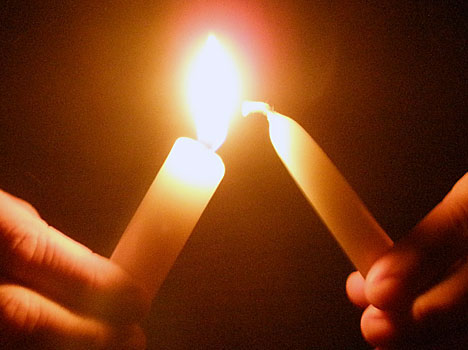
• As a collective "prayer" for his mother, that we light Shabbat candles five minutes early today.

Hence I share the story with you, and ask you to
forward it to everyone you love.

Second question for your table: What's a greater tragedy - a meaningful life cut short at 13, or a long, healthy life without meaning or mission?


Shabbat Shalom


PS - After 2,500 years, there is finally a new way to play dreidel. Click on the image above.

Like this post? How about putting your gelt where your gab is: Like it, tweet it, or just forward it.

Friday, July 22, 2016

PG-613? (Pokemon Go, is it a Mitzvah?)

The goal of this email is to augment reality at the Friday night dinner table....

twitter v. pokemonI heard that the new Pokemon-Go game works like a pedometer and knows when you are walking, giving extra points for being on your feet.

I also heard that it rewards sportsmanship and teamwork.

Is that icing on the cake, or a silver lining on a gray cloud?


The cake is that people are obviously having a lot of fun with it.

The gray cloud is that it's a hammer in our ADD-toolbox.

(And perhaps some other pushback.)

There is a solution, based on last week's Hellen Keller piece.

This is a tool that you can use right now to enact Keller's vision (pardon the pun).

It's called NATURE.

Ironically, it works best when your smart phone runs out of juice.

If you're one of the unfortunate few to have an ultra-long battery life, it may require shutting off your phone. Or leaving it in the car.

(Hard to do, right? I know.)

It's great to be out in nature.

It makes you mentally and physically healthier.


But what do you do when you have to return home, and get back to work/school/life?

How about this: bring nature home with you.

Here's how:

Two years ago we launched the Amazing Nature for Teachers curriculum.

The site is now called teachamazingnature.com.

Last year, we trifurcated it:

1. Amazing Nature - for secular teachers
2. Nifla'ot - for Judaics teachers
3. Ma Rabu - for teaching tefila (prayer)


There are three ways you can play:

1. Register your kid's teacher or school for next year.
2. Sign up your family.
3. Subscribe yourself.

Go ahead - give it a try! I guarantee it will give you 301x more long-term gratification than Pokemon-Go, or your money back.

Now let's get to this week's first question for your table - Why is Pokemon Go so popular, even though it is PG (pardon the second pun)?


Is it the instant gratification? Is it the challenge?

Is it that it's safe (well, most of the time anyway)?

Is it the energy and synergy?

When you watch people play, it seems like are striving for something that seems intangible, like the energy of a fire.

In Jewish wisdom, fire represents the evil inclination. And the only way to cool it down is through the Torah.

Yet the Torah, too, is compared to a fire. Fight fire with fire? The Torah is also a challenge that is also nearly instantly gratifying, and is 100% safe.

Some say it's the greatest "game" ever played.

We have an ancient tradition that just as Jerusalem was destroyed with fire, it will be rebuilt with (metaphorical) fire.

It so happens that "Pokemon Go" in Hebrew has the gematria (numerical value) of 301, which is the same as eish (fire).

Hmm....Will Jerusalem be rebuilt through Pokemon?

Or through millions of people waking up from their augmented-insanity, deleting that app and making room in their heads for a bit of Jewish wisdom?


Shabbat Shalom


Like this post? How about putting your gelt where your gab is: Like it, tweet it, or just forward it.

Friday, November 13, 2015

Even Higher

The goal of this blog is to bring some fresh air your Friday night dinner table a little higher. Please print and share.
Happy recent birthdays....to Amy in San Jose, Harmon and Steve in San Francisco.


atmospheric_layersQuick - can you name the four major layers of the atmosphere, from bottom to top?

OK, forget their actual names... How about what each one does for us?

If you look at a typical high school science textbook, you might see a diagram like the one to the left.

For 75 percent of the students, that is BORE-ing.

Why are we teaching to only 25 percent of our students?

Here's a way to teach it that will excite 95-100 percent of your audience.

There are exactly two things I want you to know about the atmosphere:

1. There are four layers of the atmosphere. (We know this because there are sharp changes in temperatures between them.)
2. Each layer does something for us we couldn't live without!

Layer 1 - where we live - the Troposphere. Holds 80% of the air (thanks, gravity!) and all of our weather. Without it, we would suffocate.
Layer 2 - where airplanes fly - the Stratosphere. Has the ozone layer which stops over 90 percent of the UV rays. Without it, we would fry!
Layer 3 - the middle area - the Mesosphere. Really hard to study, too high for planes and balloons, too low for sattelites. But what we do know is that it stops about 19,000 meteors from becoming meteorites - every day! That's about 100 tons of junk we are being protected from.
Layer 4 - where the ISS and other satellites fly - the Thermosphere. Gives us long-distance AM and shortwave radio and absorbs deadly x-rays from the sun. That's fortunate. And gives us the awesome Northern (and Southern) Lights, for which to my knowledge there is no practical benefit whatsoever!

If that doesn't give them a breath of fresh air, nothing will.

Thin atmosphereBut here's something else to add:

Ask at your table: If I made a basketball-size model of the Earth, how thick should I make the atmosphere? A centimeter? An inch?

Answer: the thickness of a sheet of paper.
Get that?
Just a thin blue line protecting you and me from the black chasm of space.

You are walking around all day, minding your own business and not even thinking about all of this. Admit it — you are living as if the 4 layers of the atmosphere don't exist and don't matter.

But they do exist, and without them, you wouldn't.

That's something amazing I learned this week. How about you?

Shabbat Shalom


PS - Have you checked how many days til Hannuka?


Like this email? How about voting with your finger: Like it, tweet it, or just forward it.

Friday, October 02, 2015

When Does Life Begin?

The goal of this blog is to pursue and promote wisdom at your Friday night dinner table.... please print and share.
In honor of Keith on his 50th birthday! The doctor is in? (see below)

KeithImagine there is a bank that credits your account each morning with $86,400.

It carries over no balance from day to day.

Every evening, it deletes whatever part of the balance you failed to use.

What would you do?

Draw out every cent.

Each one of us has such a bank.

It's called "time."

Every morning it credits you with 86,400 seconds.....

+++


The above is the intro to a three-minute video that is linked below.

I have watched it a dozen times.

I recommend you watch it.

And think.

But before you do, here is a rabbinic background.

The rabbis (of old) say that a person goes through 12 stages of development:


At five years old study the Written Wisdom
at ten years the Oral Wisdom,
at thirteen become responsible for your actions;
at fifteen dialectics,
at eighteen get married,
at twenty find an occupation;
at thirty for authority,
at forty for discernment,
at fifty for counsel,
at sixty to be an elder,
at seventy for gray hairs,
at eighty for special strength.


Maybe you're precocious, maybe you're a late bloomer.

The question for your table:

Are you en route to "special strength" or are you headed the other way ?

The three-minute time video is now playing on our home page: http://jsli.org


Happy Sukkot and Shabbat Shalom

Like this email? How about voting with your finger: Like it, tweet it, or just forward it.

Tuesday, September 23, 2014

Overwhelmed? Here's what to do.

The goal of this blog is to inspire a new year of engaging dinner table discussions with the whole family. 
Dedicated in honor of Kyle and Shelli's anniversary - mazal tov! You are true roll models for how to create an amazing family.

I would especially like to wish
you and yours a healthy, happy and sweet new year. As many have noted, 5774 was a challenging year for the Jewish People and the world. May 5775 be a year of true peace.


bigstock-The-word-Everything-on-a-To-Do-45656401Last Friday, I asked, For you, what's a good life?
 

By now, I assume you've had deep meaningful discussions around that question. Therefore the goal today is to create some action points for Rosh Hashana, to turn theory into practice.
  
Let's make it global in perspective, local in action.
Globally, there's some highly disturbing news. So much so that it can be overwhelming.


First, there's global warming. It's happening too fast and is alarming. 

Second, the incredible rise in violence by the anti-idolatry group in Syria and Iraq (who named themselves after an ancient Egyptian goddess by the way).

Third, let's add the ebola tragedy. Some of the world's experts in infectious diseases are quite worried about this one. It is becoming an historic pandemic of biblical proportions.


To call the suffering heart-wrenching seems like an insultingly huge understatement. Is this what it takes to get Americans to wake up?


Fourth, let's not forget about the new reality of Big Brother. He appears here to stay.
( : -  ( >

 
What does all this have to do with Rosh Hashana?


More important what does it have to do with you and me?

Most important, what does it have to do with me?

The connection is through a little tidbit of rabbinic wisdom.

The rabbis tell us that in order to live a meaningful life, don't just absorb the news passively. Don't just react as if it's happening somewhere "over there".


Instead, react as if you are living in a Matrix-like virtual reality where everything that happens is custom-designed for you.

For example, take the ISIS stuff. A historian will react with detached historical question, a sociologist with a detached sociological question.

A Jew entering Rosh Hashana will ask a very attached question: What is the message here for me personally?

It is interesting that the ancient Pirkei Avot - the Jewish book of ethics, deals with these very two issues - an increase of knife violence and an increase of infectuous disease. The rabbis who wrote Pirkei Avot transmitted two very specific, very attached interpretations of these two news events.
The sword comes to the world for the procrastination of justice, the corruption of justice, and because of those who misinterpret the Torah.

Plagues increase....in the fourth year [of the seven-year cycle], because of [the neglect of] the tithe to the poor that must be given on the third year; in the seventh, because of the tithe to the poor that must be given on the sixth; on the year after the seventh, because of the produce of the sabbatical year; and following each festival, because of the robbing of the poor of the gifts due to them.
In other words, to use the current news as a call to action should mean increasing the learning and teaching of Torah, and increasing tithing (giving 1/10 of your income to charity).

What's the connection to Rosh Hashana?

Rosh Hashana is our annual chance to recalibrate. Where are you going? What kind of person do you want to be? Patient or impatient? Giving or selfish? Warm or cold? Energetic or lazy?

And why?

Rosh Hashana is an amazing day for revisiting yourself. My handy one-page sheet may be a useful guide (see below).

That said, Rambam (Maimonides) says that one of the best ways to change your personality is to start by changing a habit.

For example, a person who wants to become more friendly but doesn't feel like it could start by trying to smile more. That smiling will lead to a greater inner sense of friendliness.

I have a worksheet to help you think about these big questions on Rosh Hashana. I'd like to send it to you.

But the news is telling us - screaming at us - to do more: to increase Torah and increase tzedakah (charity).

Hey, great timing! There happens to be an ancient Jewish tradition of increasing Torah and tzedakah at this time of year. Giving tzedakah is the action Rambam was talking about - its a selfless action. Most of my shortcomings are rooted in selfishness! What a smart tradition!

In fact, there is a present need. As long-term subscribers know, I rarely ask for anything. Although there are expenses involved in creating this weekly email, it comes to you every week like public radio, free of charge. Once or twice a year I ask for your support. For the above reasons, this is the best time of year for you to become a partner, or to renew your partnership.

To thank you for your one-time or monthly donation to support JSL's teaching of Torah wisdom, we'll send you these new 2014 materials:

1. 25 Questions to Think About From Rosh Hashana to Yom Kippur (2014 edition)
2. Traditional Simanim-Omens for Rosh Hashana Dinner.
Here's a sample.

3. My Rosh Hashana prep class (audio) from last week

Here's the organization website: jsli.org.
Here's the donation link: jsli.org/donate.


Finally, I'd like to end with an update on our friend Harmon, in San Francisco.

Harmon loves to sail. So much so that when given the opportunity to put his life on hold and jump on a world-class sailboat in Alaska as a voluntary crew member, Harmon signed up. It was to be a month or more at sea.

Think of all the preparations you'd have to make to leave your family and business for a month. Not to mention the sailing-specific prep.

Think of the disappointment when the trip has to be cancelled due to weather etc. Docking for the winter. Yada yada yada.

The reason that Harmon's story is an inspirational Rosh Hashana story is because he dared to dream big. BIG. It didn't work out this time, but the dream is still there. The prep work, that's all the hard work, but it has to start with a dream, a vision.

That's Rosh Hashana - a day to clarify your dreams. What kind of person do you want to be? What kind of life do you want to live? Get my 25 Questions sheet and start to work it out, and use Rosh Hashana to set sail to a great year.


  Positive thinking can only get you shofar 
L'Shana Tova!

May you and your family be inscribed and sealed for life, health, happiness and peace in 5775. 

Have a sweet year.


PS - If you search youtube you may find my experimental RH/YK videos from a few years ago.

PPS – To find High Holiday books and activities for kids, or gifts for teachers (and other thoughtful adults), please use bestjewishkidsbooks.com.

Like this email? How about putting your mouse where your mouth is: Like it, tweet it, or just forward it to someone who might enjoy it.


Friday, June 27, 2014

Floating Through Life?

The goal of this email is to help your Friday night dinner float above the first six days of the week. Please print and share.
In memory of my grandmother Yehudis bat Alexander, whose yahrzeit is remembered tonight.


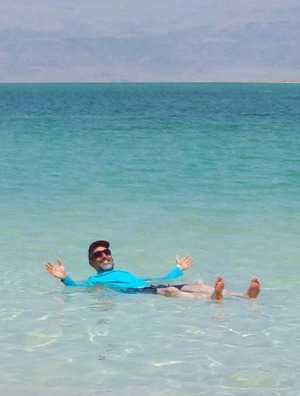
Dead Sea Float

Greetings from Terra Santa!

Here's my take on the Dead Sea, the lowest spot on Planet Earth.

You've heard about how you can't sink?

You wondered if it's true?

OK, so it's true. See the picture? I'm truly not sinking.

But here's the thing.

There's nothing refreshing to me about the Dead Sea. It's called "dead" for a reason.

One wouldn't enjoy swimming there. One ends up quite slimy.

They say it restores health. I'm not convinced.

I'm pretty sure the only reason to go is to get a picture of yourself floating in it.

"Look Ma, no hands!"

"Now where are those showers?"

(I should add here that I'm exaggererating to make a point. For those who are into sunbathing or being slimy, it's a fabulous spot.)

So here's this week's question for your table: How often do you do something just to be able to say you did it, but with no actual cultivation? Is this a problem? If so, what's the solution?

(Hint: it has something to do with this word.)


Shabbat Shalom


PS - Speaking of not floating thru life, check this out

Friday, May 31, 2013

What's the Opposite of Pain?

Happy Birthday to Rick! Wishing you health and blessings "ad me'ah v'esrim" - until 120!

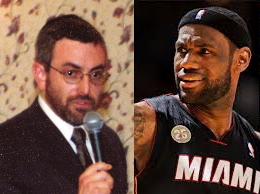
lebronDid you ever see LeBron James play?

Who would LeBron James rather play one-on-one —

Kobe Bryant or…

Alexander Seinfeld?

Why would he obviously want to play Kobe? Won’t he beat me so much more easily?

It’s obvious, isn’t it? Pleasure in life is not the absence of pain! We find pleasure only through challenges, or “pain” as it were.

No pain, no gain.

There is this guy I know.

He's trying to conquer an internet addiction.

He's trying to conquer an addiction to unhealthy food.

He's trying to conquer an addiction to comfort.

We have such a pull towards comfort - everyone knows that comfort sells.

Judaism says that comfort does not = pleasure.

Comfort comes when you get rid of pain.

Pleasure comes when you use pain to gain.

Think about exercise and sport. Think about learning music. Think about learning anything. Think about trying to be a better wife or husband or parent or child or friend.

Difficulties in life, these are the pain that we need in order to experience the real pleasures of life.

Think about it.

For your table - What are the biggest pains in your life? What are the biggest pleasure?


Shabbat Shalom

PS - This Table Talk was adapted from The Art of Amazement - nearly a decade in print.

PPS - Want to make your Table Talk rabbi happy? Like it, tweet it, or just forward it to someone who might enjoy it.

Wednesday, September 26, 2007

Significance

If you are a regular reader of this blog, please note that starting tonight through next week I will be sitting in my Sukka and have very little access to the web, and there will be no post next week.

For this week, I submit to you one question and two gripping videos for your enjoyment.


Question for your table: What is more amazing, the universe or the mind that contemplates it?


(not my favorite choice of background music, but it works)


Chag Sameach – gut yontiv – happy holiday.

And if you are in our neck of the woods, please stop by and sip a cold drink with me and my family.

Alexander Seinfeld

Speaking schedule
October 15-16 – San Francisco area
October 17-18 – Los Angeles

(For details, send an email)