Showing posts with label Israel. Show all posts

Friday, June 19, 2020

Who's Going Up?


The purpose of this blog is to bring a little "aliya" to the Shabbat table... Please print and share...

New OlimA troubling realization dawned on me yesterday.

We are in an historic moment in so many ways. But there is present detail that I hadn't noticed. I wonder how many people have noticed?

A bit of background, and then the reveal, and then the question.

Ever since I turned 18, I've always made sure my passport was up-to-date. Even when I had absolutely no plans to travel, I've always liked the idea that I could, in a moments notice, get on a plane and go almost anywhere.

Today this is still true. (I don't mind wearing a mask on the plane.)

With one exception.

For the first time in my life, I am not able to get on a plane in a moment's notice and go to the Land of Israel.

Anyone without a current visa (student/work/etc) is being denied entry.

This came up because I have two daughters who are both hoping to move to Israel in late summer (one to live, the other to study). It is currently unknown when they will be allowed in. Makes it tricky to plan!

The short-term outlook remains 0% certain due to the recent rise in cases. The current trend is not good.

This is also true of you - just about anyone reading this. Unless you have a current Israeli passport or visa, you are barred from the Holy Land - for the first time since 1948.

Here's your question for the table: How do you feel about that?


Shabbat Shalom.
 
PS - Click on the image above for a related summer book that I'm betting you've never read.

PPS - Shopping on Amazon? 
Please use 
https://smile.amazon.com and Amazon will donate a % of the sale to the non-profit of your choice (such as Jewish Spiritual Literacy), at no extra cost to you. Why not?
 
Enjoyed this Table Talk? Vote with your fingers! Like ittweet it, forward it....
  

Friday, November 03, 2017

Uncaged

IcelandIf you read this email last week or the week before then you know about Jeremy.

This week, hundreds of family & friends gathered on Sunday for his Memorial Service. Among the uplifting eulogies, the quote that sticks with me is his mother's comment about his flying helicopters:

"If we had tried to stop him from flying, it would have been like caging a bird. He had to fly."

I mentioned that he had been interested in touring Israel as an adult. His last trip there had been when he was 13. Similarly, there was a man at the Memorial who told me that he hadn't been to Israel for 40 years, but now cannot go because it's too expensive.

Too bad I didn't know on Sunday what I know now — I'll make this a trivia riddle for your table:
  
What's the hottest cold way to get to Israel right now?

Hint: Name the country in the above photo.

Hint: Airport code KEF.

Still not sure?

Here's another image, maybe this will help:

AuroraIf you're protesting, "But I've never been to Iceland!" - neither have I. But where else in the world could look like that?

Second question: Did you ever think about going?

Too cold, right? Low on your list right?

There's a reason why the median home value in Los Angeles is $500,000. Someone I know was visiting LA this week. He said, the weather is so beautiful, he feels sorry for Angelenos who have to move to the East Coast.

But don't feel too bad for the Icelanders. They are (along with their Nordic cousins) at the top of the world happiness index. California doesn't do too shabby, but not as well as Minnesota. What's going on here?

Well, I suppose it means that happiness doesn't have as much to do with the weather as previously reported. In fact, psychologists have studied this alleged correlation and found it either weak or even negative.

So why isn't the world beating a new path to Reykjavik?

Maybe we are: on Wow Airlines, it is now possible to get to Iceland from most corners of the US for a hundred bucks.

More important, they also fly nonstop
Reykjavik-Tel Aviv and it turns out that traveling to Tel Aviv via Reykjavik is cheaper than flying to Mexico.

Bottom-line: go. Don't wait for an occasion. Book it now.

Question for your table: When you go to a new place, is it better to get a general overview at the expense of depth, or an in-depth encounter, at the expense of breadth?


Shabbat Shalom

The purpose of this email is to set loose the conversation at the Shabbat table. Please like it, tweet it, forward ....
Dedicated by friends in San Francsico to the memory of Yermiyahu Matan (Jeremy Dossetter), alav hashalom.
To dedicate a future Table Talk, send me an email.

Friday, August 11, 2017

What's Your Milk and Honey?

The purpose of this blog is a nourishing & pleasing Shabbat table. Please print and share, or forward or...

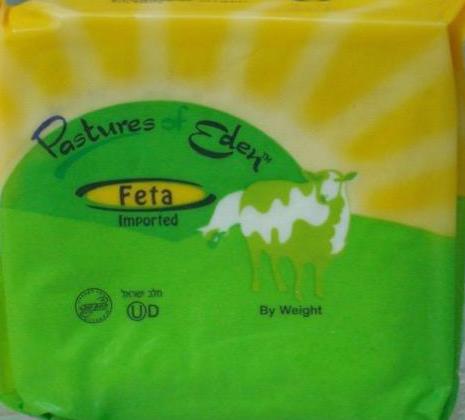
Mmm FetaDespite my previous post about the quest for falafel, Israel is not called "the land of falafel."

It's well-known that the Torah calls it, "the land of milk and honey."

What is that supposed to mean, really? Abstract bounty?

As you know, I'm always looking for the deeper meaning, so last week I went on a quest to find the holy source of one of my favorite milk-products:

Pastures of Eden Feta.

To the uninitiated, this Trader Joe's staple is one of the best fetas ever.

And I'm not the only one who says so.

And it happens to be kosher.

From Israel.

(And you can even buy it online if your local TJ's is sold out, which they often are.)

All that you will glean from the packaging is that it's made from sheep's milk on a farm .... somewhere in the Land of Israel.

But where?

It was really hard to find information about it. The online info is out of date. After several unanswered emails and phone calls, I was about to give up, when I hit the jackpot. I reached someone named Avi who was indeed the exporter of Pastures of Eden.

Now, he couldn't set up a tour for us on such short notice, but he did reveal to me the region where it is made.

Guess what? It was right where we were staying in Tzippori.

(BTW, this was our guest house - another story for another time), but here's a picture of how we felt when we arrived after a hot day of driving:

Happy campers

See the pool? It's a work of art. Fed by a natural spring, decorated with beds of fragrant mint.)

Mitch, the owner, has a few acres of olive trees which he makes into oil, vines from which he makes his own wine, and so many pomegranate trees he doesn't know what to do with them.

I Mitch if he knows any sheep dairy farmers nearby.

Sure, two doors away.

Picture this - an American family moved to Israel 30 years ago and started their own sheep and goat dairy farm. Selling their wares at farmer's markets. Pretty simple.

No, it wasn't the TJ source. But we tried their feta and it was just as good. (Better, actually - because it was fresh.)

In a word: amazing.

So that's the milk. What about the honey?

We criss-crossed the northern part of the country, throughout the Galil (Galilee) and Golan.

Everyone talks about how small the country is, "about the size of New Jersey."

But when you drive around you get this feeling, "Wow, it feels so spacious."

You see forests and mountains, many small and large towns, countless fertile farms; but even more barren hills awaiting creative Americans to come and build their own towns or sheep farms....

And then there are the endless orchards.

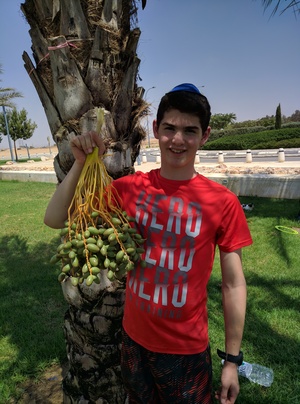
And date palms nearly everywhere you look, such as this one (those are unripe dates he's holding):

Unripe dates
To me, that's the meaning of honey.

It's the sweetness that you don't need to live, but makes life so, well, sweet.


Question for your table:

What's your milk and honey?


Shabbat Shalom


Enjoyed this Table Talk? Vote with your fingers! Like it, tweet it, forward it or .... 

Friday, May 26, 2017

Does Jerusalem Exist?

The purpose of this blog is to build a city of peace at the Friday night dinner table.... Please forward / like / tweet....
Happy birthday shoutouts to Joan (turning 80!) and Kyle. And wishing EF a speedy recovery.
(To dedicate a future Table Talk, send an email.)


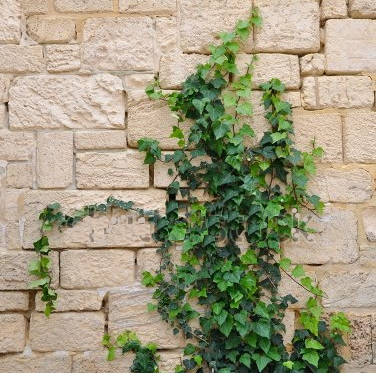
Ivy - Western WallThis may be a first.

Imagine you found out that you had poison ivy.

How would you react?

Not too thrilled?

This morning, a friend told me just that - that he has poison ivy.

And this news made him happy.


So this week's first question for your table is a riddle:

When would a person be happy to learn he has poison ivy?

The answer (of course) is: when he had thought that he had had something even worse.

You see, for several days, he had thought that the itchy pain keeping him up half the night was shingles.

Shingles is a painful rash caused by the varicella-zoster (chicken pox) virus.

Everyone knows that if you had chicken pox, you're now immune for life, because your blood now has anti-varicella-zosters.

But some of those varicella-zosters stick around 
in nerve tissue near your spinal cord and brain. If your immune system should ever weaken, the virus can wake up....

So that's one secret to being happy even while in pain: knowing that it could be a lot worse.

But Question #2 for your table: Can this wisdom apply to any situation? Could it ever be so bad that a normal person could not be happy?

And here's a real douzy - Could an increase in pain ever make someone happier? (hint)

Our confusion about pain reminds me of our confusion about "peace".

Peace is not the end of war. That's a truce, but that's not shalom.

Shalom is harmony.

So it's ironic that the world's most-contested real estate is called Jerusalem - if you know what the word means.

Hint: in Hebrew, it's Yeru-shalayim.

Now that you know what it means, you can ask this question at your table: Does it exist?


Shabbat Shalom
and Happy Shavuot


Enjoyed this Table Talk? Vote with your fingers! Like it, tweet it, or just forward it.

Friday, October 16, 2015

Inflammatory

The goal of this blog is to turn extrospection into introspection at your Shabbat table.... please print and share.

Joseph's Tomb in FlamesThe image to the left is Joseph's Tomb, set ablaze by a mob last night.

Here is a little background.

In 1867, Mark Twain wrote:

"
About a mile and a half from Shechem we halted at the base of Mount Ebal before a little square area, inclosed by a high stone wall, neatly whitewashed. Across one end of this inclosure is a tomb…. It is the tomb of Joseph. No truth is better authenticated than this....Few tombs on earth command the veneration of so many races and men of diverse creeds as that of Joseph. Samaritan and Jew, and Christian alike, revere it, and honour it with their visits. The tomb of Joseph, the dutiful son, the affectionate, forgiving brother, the virtuous man, the wise Prince and ruler. Egypt felt his influence--the world knows his history."

For Allasake, there is an entire sura in the Koran devoted to him (#12: "Joseph - Peace Be Upon Him").

So how has it come to this?

There are so many answers!

1. The Moslem preacher's answer:

http://www.memritv.org/clip/en/5098.htm

2. The US government's answer:
Mr. Obama's true feelings.
Mr. Obama's "clarified" feelings.

3. The Stanford professor's answer:

http://www.huffingtonpost.com/david-palumboliu/whats-behind-the-explosio_b_8298362.html

4. The American Anthropology Association's answer (make sure you read the comments):
http://www.anthropology-news.org/index.php/2015/09/22/two-views-on-anthropologists-and-boycotts/

5. Hadassah Hospital's answer:
http://www.timesofisrael.com/terrorist-teen-executed-by-israel-confesses-to-attack/

6. The New York Times' answer (and a YU professor's critique of it):
http://www.jta.org/2015/10/13/news-opinion/opinion/op-ed-the-new-york-times-big-lie-about-the-temple-mount

7. The European press's answer:
http://www.jta.org/2015/10/13/news-opinion/world/in-european-coverage-of-israel-confusion-over-who-is-attacking-whom

Two weeks ago the question was, "When does life begin?" Last week the answer was: Now and the question was, How?

This week the question for your table is
8. What's the Jewish answer?

Shabbat Shalom


PS - Hint #1 - www.aish.com/jw/id/The-Solution-to-Israels-Wave-of-Terror.html
PPS - Hint #2 - www.youcaring.com/children-of-rabbi-eitam-and-naama-henkin-h-yd-450838
PPPS - Hint #3 - www.randomactsofkindness.org/kindness-ideas
PPPPS - Hint #4 - www.amazon.com/gp/product/1578194547?ie=UTF8&tag=j099-20

PPPPPS - Hint #5 - www.learntorah.com or www.webyeshiva.org or jsli.org/recommended-readings 

Like this blog? How about voting with your finger: Like it, tweet it, or just forward it.

Friday, February 13, 2015

A Real Treet

The purpose of this blog is to add something tasty to your Shabbat table. Please print and share.

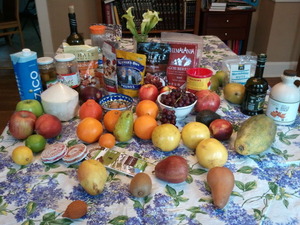
PomegranatesThe emails are still coming in in reply to my wish for a "good news" news service.
As a reader pointed out, there already is the goodnewsnetwork.org. Someone else has nominated upworthy.com.

But then there were the readers who directed me to websites dedicated to good news from Israel, such as this facebook group and Israel's Good News Newsletter and Take A Pen and Israel21c.


On that note, last week marked the greatest Jewish holiday that nobody seems to celebrate. According to the Talmud, it's one of four Rosh Hashanas.

Here's a clue from the Seinfeld celebration:


TubishVat 5775

It's called "Tu Bishvat" - the New Year of the Trees.

Some have spun it as a paen to the Land of Israel. I'm not opposing them, but I see it differently.

Trees are worth celebrating in their own right.

They are a frequent subject of poets.

Remember this one?
I think that I shall never see   
A poem lovely as a tree.   
   
A tree whose hungry mouth is prest   
Against the sweet earth’s flowing breast;   
   
A tree that looks at God all day,
And lifts her leafy arms to pray;   
   
A tree that may in summer wear   
A nest of robins in her hair;   
   
Upon whose bosom snow has lain;   
Who intimately lives with rain. 
   
Poems are made by fools like me,   
But only God can make a tree.

- Joyce Kilmer 
 
So in honor of the trees, please allow me to introduce the muricata, from this week's Amazing Nature series.

muricata fruit

Ever seen one of these in the grocery store? Probably not. But it's a pity.

The muricata is a juicy edible fruit cultivated in Central and South America. It has a delicious, tangy taste. Some say it tastes like candy.

One muricata fruit will give you about the same amount of energy as a candy bar, but it’s a different kind of energy — it gives you a sustained energy that doesn’t make your body’s insulin go crazy like processed sugars.

Plus, unlike candy bars, when you eat one of these you also get a lot of protein, fiber and vitamin C, plus vitamin B6, magnesium and potassium and even some copper — all essential vitamins and minerals for good health.

Some people claim that muricata has medicinal value as well. An extract from the leaves has been reportedly successful in lowering elevated blood pressure (by decreasing peripheral vascular resistance).

In laboratory studies, muricata extracts can kill some types of liver and breast cancer cells that are resistant to particular chemotherapy drugs. (But we need more studies to know if it can work as a cancer treatment.)
 
Ma rabu ma’asecha A-donoy kulam bechachmah asita malah haaretz kinyanecha
How great are Your works, God, all of them you made with wisdom, filling your Earth!
Tehillim/Psalms 104:24

Is the muricata what King David meant when he wrote that?
 

Photo: © Muhammad Mahdi Karim, www.micro2macro.net


Shabbat Shalom

PS - The muricata is a sample of our Amazing Nature program.
PPS - We are still adding new Purim and Pesach ideas to bestjewishkidsbooks.com


Friday, December 26, 2014

Merry HUXmas?

The goal of this blog is to shake things up a bit at your Friday night dinner table. Please print and share.

This week my friend Raffi phoned from Jerusalem.

Raffi is a husband and father, and a graduate student in physics at the Hebrew University of Jerusalem (HUJI).


He told me that he was unhappy about an announcement from the University this week:

All classes would be canceled on December 25.

Yes, you heard it here first:


For the first time in its ninety year history, the Hebrew University of Jerusalem - home to the world's largest Judaica book collection - had Christmas vacation.

They called it "Yom ha-Molad" - literally, "Day of the Birth".

Raffi was not merry.

He was merely perplexed, given that HUJI's student body are ninety percent Jewish and nine percent Muslim.

One of his fellow students complained, "What's next, Christmas trees?"

It seems to me that such chagrin is misplaced.
 
Their real complaint should be that they only got one lousy day - in the middle of the week!

Why not two weeks like every other country? Or at least a 3-day weekend?


For your table: What do you think? Did HUJI go too far on this one, or not far enough?


Shabbat Shalom


Oy! Channuka come and gone and you forgot a gift for someone? No problem: gift them a subscription to Amazing Nature for Teachers - AmazingNature4Teachers.com. Great for a teacher, great for a parent, great for anyone who enjoys a daily dose of inspiration.

Or, you could make a donation in their honor. One week left to make a tax-deductible 2014 contribution to your favorite tzedakas. To help keep these emails coming takes about a minute here: http://jsli.org/donate.


Like this email? How about putting your gelt where your gab is: Like it, tweet it, or just forward it.

Friday, December 05, 2014

Let's See, How Can We Blame This on the Jews?

The goal of this email is to add some controversy to your Shabbat table. Please print and share.

Important Channuka announcement #1: We have added a handy Hannuka-countdown timer to the JSL homepage.
Important Hanuka-announcement #2: We have added a slew of new Chanukka books etc. to bestjewishkidsbooks.com.


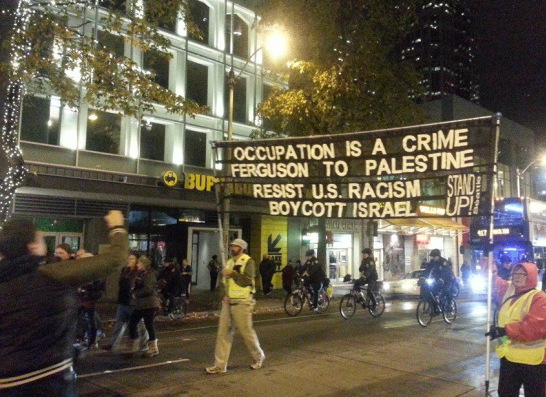
ferguson-palestine-cropJust when you thought you'd seen it all....

Under the joyous holiday lights
march the righteous Seattleites.


They evidently consider the Treaty of Point Elliott (1855) to be fair and just and the Battle of Seattle (1856) decisive. Or perhaps they're doing penance for Seattle's founders, who (in the 1860s) banned Elliott Bay's native Duwamish people from their new town.

First question for your table: Why can't we all just get along?

The answer is that some people really don't want to get along with us.

They really don't.

That's what a certain wandering Jew said to me yesterday.

I reached him via Skype at his current abode on an island in the Pacific. The main attraction there is scuba diving. He sent me some images — Wow!

Here's the thing: this guy is literally on the other side of the planet from his native New York. He's living a pretty easy life, running his US business long-distance.

And what's on his mind (besides the situation in Israel)?

"Why does the Torah have animal sacrifices?"

(Note, he assures me that this question is not connected to the fact that he's an ethical vegetarian. His point is that it seems inexplicable that a transcendent, infinite God would want or need animal sacrifices.)
 

The second question for your table is a question about his question:
 
Given all the things one could be thinking about, why do you think this bothers him so?


"Your religion was written upon tablets of stone by the iron finger of your God so that you could not forget. The Red Man could never comprehend or remember it." - Chief Seattle


Shabbat Shalom

PS - Looking for an unusual Hannuka gift for a teacher in your life? Send them a subscription to the Amazing Nature for Teachers program - AmazingNature4Teachers.com.

PPS:
 

Like this blog? How about putting your mouse where your mouth is: Like it, tweet it, or just forward it to someone who might enjoy it.

Friday, August 29, 2014

An Open Letter to NPR's David Greene

The goal of this email is to add some passion to your Friday night dinner. Please print and share.

schabasTo: David Greene, NPR's Morning Edition
Re: William Schabas interview

Dear Mr. Greene,

I listened with great dismay to your August 25, 2014 interview with Prof. William Schabas.

You began strong, with the real potential to tell this story well, but ended painfully.

You had the opportunity to hold him accountable.

But you let him get off so easy it almost sounded like pandering.

Now, to your credit, you played a passionate critical quote from the Israeli UN Ambassador:

Choosing William Schabas to lead this council makes about as much sense as choosing Count Dracula to run the blood bank!
Then you allowed him to respond. Here was his response:
The ambassador of Israel, he doesn't want this commission. He won't be happy with anybody. I'm obviously a lightening rod and a few of my previous statements have contributed to that, but he wouldn't be happy with anybody…. Because he's opposed to the Commission, he's opposed to the Human Rights Council, he's opposed to all the human rights mechanisms within the United Nations. That's his target. Perhaps I underestimated the venom that would be associated with my own appointment. But this is all to be expected, there is nothing surprising there. If there are other important governments around the world and more credible that come and say I'm not the right person, I'm going to be a little more attentive than I am to the Israeli permanent representative.
In other words, True, I've said some anti-Israel things in the past but the Israeli government is unconcerned with human rights and with truth so we can dismiss their concerns.

Israel is unconcerned with human rights? That's so patently false it leaves one speechless. Yet I suppose if you repeat a lie often enough it becomes true?

Notice how he down-grades the Ambassador's title to "Permanent Representative", an extraordinary Freudian slip!!

Mr. Greene, if that's not bias, what is?

How come you didn't ask him why such bias doesn't disqualify him from this commission?

How come you didn't ask him to explain his widely publicized question,

Why are we going after the president of Sudan (at the ICC) for Darfur and not the president of Israel for Gaza?
(Note: dovish Shimon Peres was Israel's President at the time!!)

How come you didn't ask him why he hasn't at the very least made comparable statements about the leaders of Hamas (a terrorist organization according to its neighbors Egypt and Israel, plus Australia, the European Union, Japan, the UK and the US, and banned in Jordan) who declare their pride that they target civilians with rockets, kidnap and murder, and bus bombs?


Or how about Iran, who are publicly proud of their role supplying Hamas with these rockets?

Because you are an excellent interviewer, it was particularly painful to hear you fall short of your usual high standard. This  and reinforced the long-term perception among many Americans that NPR has a subtle but persistent anti-Israel bias.

Sincerely,

Alexander Seinfeld

PS - Schabas Shalom.

PPS - Want to sign the petition to dismiss Prof. Schabas from the Commission? Click here (but don't bother if you're not from an "important and credible country"... ;-).

PPPS – You might find this commentary useful. Also, see this. Also this.


Friday, July 25, 2014

Yes, But Are They Evil?

In memory of my father, Dovid ben Eliezer (Dennis Seinfeld), whose 9th yahrzeit was observed this week.
We are wishing
Nosson Tzvi ben Sarah Rivka Kashtia
, a toddler in a coma, a speedy and complete recovery.
The goal of this blog is to meld some minds around your Friday night dinner conversation. Please print and share.

Shalom Wall Hanging

They use human shields to protect their weapons.

They invest millions of donated funds in sophisticated attack tunnels instead of schools, hospitals and roads.

They regard every Jewish community in the Land of Israel, without exception, as "occupied territory".

They aim to kill as many civilians as possible.

They celebrate death.

All these facts are well known.

But we still have the question: Are they evil?

Try asking this at your dinner table and you will likely be surprised at the range of opinions.

My father, who died 9 years ago yesterday, enjoyed ethics discussions.

He was eulogized by the local paper as "one of the good guys".

His epitaph reads, "Champion of Justice" but it could just as well have read, "Champion of Peace".

He fought tirelessly for justice, but he also had the wisdom to see that sometimes peace requires foregoing a bit of what you "deserve". In Jewish talk, this quality is called being mevateir.

He was able to see both sides of an argument. Doesn't mean he always agreed, but he could disagree without being disagreeable.

Someone asked me to write about what Jews and others around the world could do to help bring shalom to the Land of Israel. Here's my top four:

First and foremost, cultivate peace in your own relationships. Greet people with a smile, your family members, your neighbors (even the ones you don't like), strangers. Try to be mevateir.

Second, put your money where your mouth is:

Feed a Soldier
Adopt a Soldier
Thank a Soldier

Support Terrorized Civilians
Share this Video Liberally
Help Israeli Farmers
Visit Israel
Buy Cool Israeli Stuff (have you seen the Zaksenberg juicer?)

Third, if nothing else, be better informed And here. And here. Oh yeah, and here.

Fourth, ask this question at your Shabbat table:

True or False - "There are no evil people. Only very confused people."


Shabbat Shalom

PS - Have you told your kids'/grandkids' schools about the Amazing Nature for Teachers program?


Friday, July 11, 2014

Could it Be Any Other Way?

The goal of this blog is to bring peaceful conversation to your Friday night dinner. Please print and share.
In honor of our great friend in Jerusalem, whose birthday was this week - Happy Birthday, Pinchas.


669928.503perseverance_orig

A young woman phoned me the other day - someone I've never met - with a burning Jewish question, that is so good I offer to you as this week's Table Talk question:

Did God have to create a world with pain and suffering?


It seems to me the answer must be yes....

....or no


Let's start with the no.

The question assumes that we're talking about creating a world with a specific purpose. Let's say that purpuse is for us to achieve a certain thing. So the question is, did God have to create this purposeful world with pain and suffering - was it impossible to create a world with the same potential but without the pain and suffering?

If the answer is "no" - that God could have created creatures with the same potential yet without the pain and suffering, then it seems to point to God the sadist. Why would God make us suffer unnecessarily?

OK, so perhaps God is a sadist.

But if that's so, then God isn't a very successful god. After all, millions of people are happy. Millions of people - despite their pains and sufferings - are enjoying many blessings. If God were a sadist, he's not batting 1000.

So we have to reject the "no" answer and turn to the "yes" answer - that God had to create this purposeful world with pain and suffering, or at least with the potential for pain and suffering (perhaps triggered by our own actions).

That is, we need pain and suffering in order to achieve our purpose.

What is that purpose?

Simply put: knowledge of God.

In other words: the pain and suffering are custom-designed for each person to achieve divine knowledge.

The reason people are confused by this is because our materialistic culture teaches us that our purpose is material (money, leisure).

Judaism is a spiritual culture, teaching us that our purpose is spiritual.

In a materialistic culture, pain and suffering are inherently bad, because they are the opposite of comfort.

In a spiritual culture, comfort is not the goal. The goal is enlightenment, and usually this only comes through discomfort.

The girl's question was, Couldn't God have made a world with the same enlightenment but without the discomfort (pain)?

The answer is no, because learning to deal with discomfort is part of the enlightenment. Without discomfort, we would be missing certain facets of the jewel of enlightenment:

Without someone testing my patience, how will I learn patience?
Without someone testing my calmness, how will I learn calmness?
Without having my honesty tested, how will I learn honesty?
Without feelings of laziness, how will I learn zeal?


And so on.

And here's the real zinger for your table:

What's the greatest discomfort (pain) in the world?

I'm interested in your answers. Here's mine:

The greatest pain in the world is the bruised ego.

That's why the Torah starts with the legend of Adam and Eve in the Garden. Their great mistake wasn't eating the fruit - it was their refusal or inability to admit they'd done something wrong.

Thus the singlemost important thing you and I can do right now in order to become enlightened is to look in the mirror and practice over and over saying the two hardest phrases in the English language:

- "You are right - I'm wrong"
- "I'm sorry."


Only by embracing the pain of saying those two phrases can a person become truly great.

Good luck....

....and Shabbat Shalom


PS - There is another, less painful, route to enlightenment, and you can find it here.


Friday, June 27, 2014

Floating Through Life?

The goal of this email is to help your Friday night dinner float above the first six days of the week. Please print and share.
In memory of my grandmother Yehudis bat Alexander, whose yahrzeit is remembered tonight.


Dead Sea Float

Greetings from Terra Santa!

Here's my take on the Dead Sea, the lowest spot on Planet Earth.

You've heard about how you can't sink?

You wondered if it's true?

OK, so it's true. See the picture? I'm truly not sinking.

But here's the thing.

There's nothing refreshing to me about the Dead Sea. It's called "dead" for a reason.

One wouldn't enjoy swimming there. One ends up quite slimy.

They say it restores health. I'm not convinced.

I'm pretty sure the only reason to go is to get a picture of yourself floating in it.

"Look Ma, no hands!"

"Now where are those showers?"

(I should add here that I'm exaggererating to make a point. For those who are into sunbathing or being slimy, it's a fabulous spot.)

So here's this week's question for your table: How often do you do something just to be able to say you did it, but with no actual cultivation? Is this a problem? If so, what's the solution?

(Hint: it has something to do with this word.)


Shabbat Shalom


PS - Speaking of not floating thru life, check this out

Friday, December 20, 2013

Face 2 Face

The purpose of this email is to help create some great face time at your Shabbat table. Please print and share.
Face 2 Face

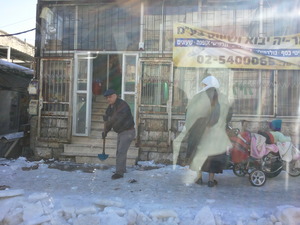
Jerusalem snow scene 2OK, so I'm back from Yerushalayim.

The first thing I did in the airport in New York was to get a professional New York shoe shine for my poor Oxfords, blanched by the Jerusalem blizzard.

How was your trip?

I didn't visit any "sites".

I didn't eat any falafel.

I did drink a lot of coffee.

(Peet's best flavor, that I brought with me. Guess I'm a little spoiled.)

The highlight of the trip?

Surely watching children gleefully, exuberantly reveling in the snow was, hands-down, the greatest joy.

Some kids used baking pans as sleds.

One 13-year-old, who has never left the Land of Israel, told me wide-eyed, "It's like being in Switzerland!"

What is it about connecting with people?

What is it about connecting with people face-to-face?

In eight days I connected meaningfully with eight people/families, any one of whom would have been worth the effort.

Six were old relationships, two were new.

They all have phones. Most have email.

I have asked this question before, but this trip gave me a new way of asking it.

With all this great video technology, why does a face-to-face meeting still matter so much?

You probably know that I'm a big fan of long-distance relationships:

- A live class in San Francisco every Friday morning, while sitting at my desk in Baltimore.
- Studying with individuals and couples via video and phone most days of the week
- Tweeting
- Posting
- (anything new I'm missing?)

Yet... there's something missing, right?

A Forbes survey agrees.

I was pondering this yesterday when I struck up a conversation with a United Airlines pilot. He said, "It's a great truth that is the only thing that keeps airlines in business!"

In other words, in the business world, it's no secret.

This Hilton Hotels report explores some of the psychological reasons.

But I'm not sure they get to the very heart of the question.

So I'll leave it to you and your table tonight:

Why does face-to-face matter so much? Is it merely because our technology isn't good enough to make the other person seem like they're in the room? Can you imagine a day when the video is so realistic that face-to-face won't matter anymore?


Shabbat Shalom

PS - If you want to know the real reason I went to Jerusalem, watch  this ... or this.

PPS - Want to make your Table Talk rabbi happy? Like it, tweet it, or just forward it to someone who might enjoy it.  

Even better, come visit us in Baltimore for some face-to-face time over some great coffee.

Thursday, March 08, 2012

If You Eat Hamantashen, are You a Cannibal?

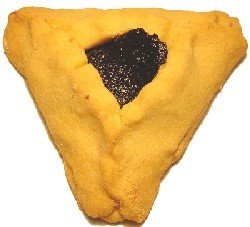
Did you ever eat a hamantashen?

To remind you, here’s a mouthwatering photo:


Why are they shaped like that, and what does hamantashen mean, anyhow?

When I was a kid, we used to call them “Haman’s hat”. But that’s because we didn’t spreken Yiddish. Then I went to Israel where they call them “Oznay Haman” - Haman’s ears.

So I thought that tashen meant ears.

(Do Israelis imagine themselves as cannibals when they munch on their hamantashen?)

In fact, if you look in your Yiddish dictionary or talk to your Bubbe, you will learn that a tasch is a purse or bag.

There you have it. Hamantashen = Haman-bags.

Maybe they’re called “bags” because they are folded over with fruit inside, and “Haman” because they do look like Haman’s hat.

Or maybe he carried a triangular handbag.

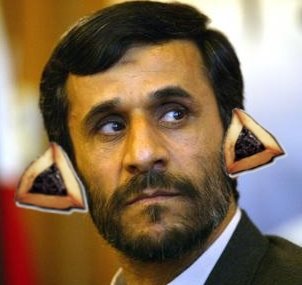
Or maybe he did have triangular ears.

At this stage of my investigation I stumbled upon hard evidence that the ear theory is correct:


So what are supposed to do – defeat our enemies by mocking them? Sounds like a Monty Python line:

“We spit on you, you silly Persian. Your mother was a hamster and your father smelled of elderberries. Now go away or we will taunt you a second time!” (say with French accent)

Sometimes they make it so easy, by making themselves into clowns:

Gaddafi

Sometimes we should also laugh at ourselves.... Here's an oldy-but-goody:

A rabbi approaches a guest in the Shul and says, "I want to give you an Aliyah. What is your Hebrew name?"
 The man says "Sara bat Moshe."
 The rabbi says "No I need your name."
 The man repeats "It is Sara bat Moshe."
 The rabbi asks "How can that be your name?"
 The man answers "I've been having serious financial problems so everything is in my wife's name.”

Badum-dum.

Question for your table: How many rabbis does it take to change a lightbulb?

Remember, every Haman has his hour, and his downfall.

Happy Purim, and Shabbat Shalom

PS - Here's a recipe for low-call, no-gluten, no-cane-sugar hamantaschen.

PPS - If you don't have my iphone/android app, you're missing out on today's amazing Jewish fact! But you can read it online here.

PPPS - Here's a link to my newest Purim class: Click here.

In that class, I play a video. Here's the great video....


(Hebrew version)

Here's one more cute Purim-friendly video.

Friday, July 01, 2011

Being Childish

This week's post is dedicated to my wonderful wife, a true woman of valor, who has stuck with me for 15 years (this week).

As always, the goal of this blog is to give you something interesting and meaningful to discuss at your Friday night dinner table. Please print and share.


Shalom from Jerusalem.

Here visiting my sister and family.

One of my favorite things about visiting Israel is getting to spend time with them all.

Her six-year-old, Yehoshua, looks like one of those religious kids in the movies. Extremely short hair, long side curls, fringes dangling from his waist.

And like kids anywhere, he can say the darndest things.

To understand the first vignette, you have to know that that in the Torah there is a concept called "tuma" which is a ritual impurity. One can contract it and become tamay, among other ways, from contact with someone or something that has died. Sort of like the cooties.

We're exploring an ancient site called Maresha, which was a cave-town carved out of limestone. It's just a stone's throw away from where David fought Goliath. Today you can easily explore these labyrinthine caves, a child's dreamscape.

The last cave we visit had been used for burials. Yehoshua starts to climb into one of the crypts.

His eight-year-old sister stops him. "You can't do that! You'll become tamay!"

But Yehoshua is no dummy. "We're all tamay anyway!"

"Yeah, but then you'll get more tamay!"

First question for your table — Is there any benefit to giving people a rule to follow that defies reason?

So then later when I'm walking them home Yehoshua suddenly says to me (or to himself?):

Kol ha-goyim magiah may-ha-kotel ad kahn
Hashem ohev lishmoah otam.


That translates roughly as:

The voice of the Gentiles reaches from the Western Wall until here
Them God loves to hear.


Which Gentiles? What voice? Why does God love to hear them?

As we walk, he explains: the Moslems in the mosques, you hear their prayers (on loudspeakers). God loves to hear them because they are monotheists and not worshipping idols.

It took some prying, but I finally get it out of him that he got this idea from the rabbi who is his primary school teacher.

"And their voice reaches all the way to here?" I ask.

"No, back there!" he corrects me.

Question #2 for your table: We adults spend a lot of time talking about what and how to teach children, but what should we be learning from children?

(Rav Nachman, the famous Chasid, used to say: We should learn three things from children: They're always busy, they're always happy, and when they want something, they say "please, please, please Daddy" until they get it.)


Shabbat Shalom


(Did I mention printing out this message and reading at your dinner table? Try it, they'll love it.)

Friday, June 17, 2011

Where's Your Utopia?

This week, dedicated in memory of my paternal grandparents - Sylvia and Les Seinfeld - whose yahrzeits both fell this week, Sima bas Mordechai Yaakov and Eliezer ben Zelig.


I was lucky to grow up with grandparents around.

My grandfather ("Pop") used to tell us stories about his childhood. Sometimes he would talk on and on until it felt like your mind was going numb, but he was always so caring and always smiling. Nevermind that we'd heard the same stories over and over, we had a sense that it would be wrong to say so, or to appear disinterested.

Here's the kicker: Every story had a point, some kind of moral.

As I reached adulthood, Pop's monologues became more brief, until he was able to distill the moral wisdom in a single sound-byte.

One of these was his attitude towards intermarriage.

He never said that it mattered to him whether or not I married someone Jewish. But he did have a firm opinion:

"Every family should have a religion" with a strong emphasis on the "a".

He told me this at least 6 to a half-dozen times.

Pop explained that having a single religious/spiritual/however-you-want-to-frame-it tradition in the family is important for "shalom bayit" (harmony).

Both he and my grandmother excelled at shalom bayit, that was one of their highest values. They were amazing at modeling how to care for each other. Family meant everything to them. So you can imagine how they felt about my failure to settle down nearby.

But if you had asked me back then to list the top places where I might settle down, my list probably would have looked something like this:

1. Paris
2. San Francisco area
3. French Riviera
4. Rome
5. New York

(not necessarily in that order)

Note that Israel is not on the list.

It wouldn't have even made it into the top 10.

Farthest thing from my mind, absolutely nothing pulling me there.

Imagine my surprise, then, in the mid-90s, when I find myself not only living in Israel, but enjoying it!

...except for one thing: the bureaucracy.

Every country has bureaucracy, but I'd never experience anything like this. My new wife and I would show up at the city office to deal with my property tax (charged to renters) and after an hour in line find out that I needed some document that we'd left at home. So I'd return the next day with that document only to be told by a different clerk that I needed yet another one that we'd left at home.

It would the same routine at every government office.

We finally figured out that we needed an "everything folder" in which we kept triplicate copies of absolutely everything - American documents, Israeli documents, photos, bank statements, water bills, phone bills, insurance documents, rental agreements, letters of reference, etc. etc. etc.

This maddening experience was the one thing that really made life in Israel unpleasant.

In late 2000, we moved to America. Guess what we discovered?

American bureaucracies can be just as maddening. (Especially with the growth of computerized phone systems - invented in Israel by the way - where you never can get a real person on the phone.)

So it took coming to America to feel shalaym (complete) about living in Israel.

Question for your table: Chances are, Israel isn't very high on your list of places to live either. What would it take, hypothetically, to get it into the top 5 or 10?

Shabbat Shalom

Friday, June 10, 2011

What Drives You?


Tornadoes, fires, scary stuff.

We had a tornado watch here a couple weeks ago and had to explain to the kids what that meant.

Last night a severe thunderstorm with awesome lightning passed over, giving the thirsty garden a great sprinkling.

While everyone else delights in the lightening, 5-year-old Devorah is sobbing.

"What's the matter, are you scared?" asks Mommy?

She nods her head in tears.

"What are you scared of?"

"I'm scay-wed there might be a potato!!!"

=====

These videos tell their own story. Each one is only a few minutes. They make great discussion topics for the dinner table, followed by 2 questions....


Question for your table: What drives these people (pardon the pun)?

Question #2: What drives YOU?


Shabbat Shalom

PS -


The goal of Table Talk is to give you a conversation-starter for the Friday night dinner table. Please print and share.

Friday, March 18, 2011

We're All Settlers

In memory of the Fogels.

In case you were distracted by civil war in Libya, the disasters in Japan and your own life in general, there was a great tragedy last Shabbat in Israel. An entire family, parents and small children, were murdered in their sleep.

The community of Itamar is of course a "settlement".

But what does that mean?

From the perspective of Hamas, every Israeli community, including Tel Aviv, is a "settlement".

From the perspective of every anti-Semite, every Jew worldwide is a "settler".

Question #1 + 2 for your table: Do you ever feel like a settler in your life? Is this good or bad?

I just came from a funeral home. Even though I don't have a shul - or perhaps because I don't have a shul - they sometimes ask me to run a funeral for someone who didn't have a connection to any of Baltimore's many synagogues.

In this case, I happen to have known the deceased. She was a shining person whom one remembers first and foremost for her smile. One of her grandsons told me today that this trait was not newly acquired - that even as a child, people called her "the girl with the million-dollar smile."

Questions #3 + 4:

How would you like to be remembered like that?

What are you going to do about it?


Shabbat Shalom and Happy Purim

PS - in honor and memory of the slain Fogel family, 20,000 people signed up on Facebook to light Shabbat candles tonight. Click here to join.

PPS - here is a video in memory of the Fogels...


PPPS - here is a moving Jerusalem Post memorial.

PPPPS here is a poem written by a friend of ours who happens to be a neighbor of the Fogels:

Just down the road
a family was murdered
just down the road
a knife was jammed into a baby's heart
just down the road
3 beautiful children became orphans and bereaved brothers and sisters
just down the road
lots of people who hate me and my nation sleep quietly at night

I know, it's not new news
my Bubie saw her parents murdered in front of her, and became in seconds a
seven year old mother for her two younger brothers
I know, nothings new
almost all of my husband's family turned into ashes in the holocaust
and now I know - Amalek is still sticking around

But-
just up the road, wonderful families are setting down roots in the land of
Israel
just up the road, live humble, honest and faithful men and women
just up the road, there are people who believe in the eternity and strength
of Am Israel

the road is lengthy and winding, but its direction is clear and certain
on this road i cry and fear, pray and believe, wish and hope,
and deeply thank G-d, for giving me the privilege to take this road on, a
few steps forward.

written in pain
erev Purim 5771

Friday, December 24, 2010

Jew-Jitsu

Happy Birthdays this week and next to Lily and Suzanne - neither of you have hit your prime yet, but keep up the great work - you're getting there! (;-)>
Two amazing things for you this week:

When the Arab Street rises up, the Jewish Street looks for somewhere to hide.

We shall cower no more.

Background: People frequently ask me about the compatibility of Judaism with Eastern traditions, including Buddhism, Yoga and the martial arts.

As you may know, the first two I deal with in The Art of Amazement and in several classes such as this.

Today, for the first time, here's something about the martial arts.

Some believe (based on passages in Tanach) that King David's soldiers practiced a form of martial arts.

There is a small but growing movement to restore or recreate an authentic Torah martial arts (Torah-do?).

And we're not talking IDF here. Check this out:


See more here: http://www.abirwarriorarts.com/en

This leads to 2 questions for your table....

1. After looking at that link and those videos, do you buy it?
2. Do we need a "Jewish martial arts"?


Shabbat Shalom

Friday, December 03, 2010

Channuka Fire

As you read this, the worst forest fire in modern times is raging in the Carmel Mountains in the Land of Israel. 40 people have been killed and thousands evacuated from their homes in Haifa. Today's Table Talk is dedicated to the firefighters from Israel and neighboring countries who are grappling with this epic blaze, and to everyone living there who haven't had a drop of rain since the spring.

+++++++

I walk into the house on the first night of Channuka and declare joyfully, "Happy Hannuka". Yosephi (1st grade) looks up from his coloring project and says, "Hannuka, what's Hannuka? I've never heard of Hannuka. It's Channuka!"

Sounds like the makings for a dispute....

Question for your table: How many famous disputants can you name from history?

Let's see, there's

* Socrates and Protagoras
* Lincoln and Douglas
* Bert and Ernie
* Siskel and Ebert

Hmmm.... is this a decline or is it just me?

In the Talmud, the most famous pair are Hillel and Shammai, and their academies, "Beit Hillel" and "Beit Shammai".

Among all of their disagreements, the most colorful Hillel-Shammai dispute is about Channuka. Beit Hillel (who wins the argument most of the time) state that the Channuka menorah should be lit with one additional candle each night, until on the last night there are 8 candles. Sound familiar?

Can you guess what Beit Shammai say?

Start with 8 candles on the first night, then 7 and so on until you have only one on the last night.

Question #2 -
What are the advantages to going like Beit Shammai? What are the advantages to following Beith Hillel?

This video from Charlie Harary in my opinion is a Beit-Shammai video:


While this video from yours, truly is a Beit Hillel video:


Happy Hannuka and Shabbat Shalom


PS - worldjewishdaily.com has featured my iphone app on the home page - check it out here (you can also read all about the fire there).


PPS - Need a last-minute holiday gift? My iPhone/iPad app can now be gifted - click here: The Amazing Jewish Fact-a-Day Calendar.