Showing posts with label Seinfeld. Show all posts

Friday, March 15, 2013

That Kid-Cat-Dog-Stick Shtick

The purpose of this blog is to give you an excuse to change the subject at your Shabbat dinner table. Please print and share.  

This week's topic is a Passover enigma.

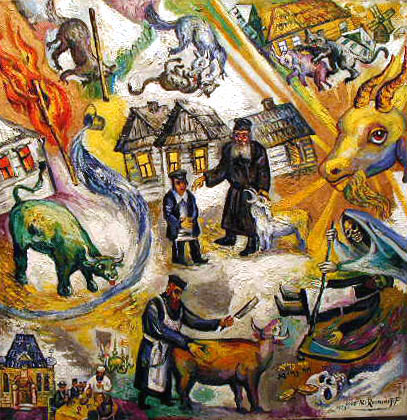
You may recall that the Passover Haggada ends with the fun but peculiar song, “Chad Gadya” – An Only Kid.

This colorful song features a kid (i.e., a baby goat) purchased by “my father” for the price of two zuz, evidently an ancient coin.

No sooner does he buy the kid, it is eaten by “the cat”, which is in turn bitten by “the dog”, which itself suffers being beaten by “the stick”. The stick doesn’t get off lightly for its beating; it is burnt by “the fire”, which is naturally doused by “the water”.

What happens to the water seems quite natural: it gets lapped up by “the ox”, which leads to the fatal slaughtering of the ox by “the butcher”. The butcher faces none other than the Angel of Death, and in case you thought that this dastardly fellow was invincible, he is ultimately vanquished at the conclusion of the song by the Holy One, Blessed be He.

So what's it all about?

Try asking that at the table, listen patiently, then read on.

The symbolic meaning of this sequence of people, animals and objects remained obscure until the Vilna Gaon (Rabbi Elijah of Vilna, late 1700s) presented the following interpretation.

Each verse alludes to one person or event in Jewish history:

The kid is the birthright mentioned in Genesis 25. This is the right to take the baton that had been passed from Abraham to Isaac, to continue Abraham’s mission to build a world full of lovingkindness and monotheism and devoid of idolatry, child sacrifice and other evils.

My father is Jacob who bought the birthright from his twin brother Esau, who had been born first and thus had the natural right to the birthright.

The two zuzim are the bread and stew Jacob paid Esau for the birthright.

The cat represents the envy of Jacob’s sons toward their brother Joseph’s, leading them to sell him into slavery in Egypt.

The dog  is Egypt, where Joseph landed, and where eventually the entire clan of Jacob and the subsequent Israelite nation lived, were enslaved and were redeemed.

The stick is the famous staff of Moses, used to call forth various plagues and part the waters of the Sea for the Israelites to cross.

The fire represents the thirst for idolatry among Israelites that proved to be a persistent bane for over 800 years, from the year they left Egypt until the destruction of the First Temple in the Fifth Century BCE.

The water represents the Fourth Century BCE sages who eradicated idolatry.

The ox is Rome (Esau’s descendent) who destroyed the 2nd Temple in 70 CE.

The butcher is the “Messiah Son of Joseph” (Mashiach Ben-Yoseph) who will restore full Jewish sovereignty in the Land of Israel.

The Angel of Death needs no introduction; in this song he represents the death of Messiah Ben-Yoseph.

The Holy One of course also needs no introduction; here He arrives with Messiah Ben-David.

The repetition in each stanza underscores the ebb and flow of Jewish history – sometimes we’re down, but then we rise up. While most of the song looks backwards, it ends with an optimistic view toward the future, a fitting conclusion to the Seder.

Adapted from the new Art of Amazement Haggada  

Leader's Edition (i.e., for someone leading a Seder)
Standard binding: www.createspace.com/4198678
Spiral binding: click here

Freedom Edition (i.e., for everyone else)
Standard binding: www.createspace.com/4208226
Spiral binding - coming soon! 

Shabbat Shalom

PS - Passover begins Monday March 25.

PPS - Want to make your Table Talk rabbi happy? Like it, tweet it, or just forward it to someone who might enjoy it.

Oh, yeah, one other thing - please remember, don't forget, when looking for 10-Plagues toys, other Passover books, even matzah, start your search here: http://bestjewishkidsbooks.com

Your rabbi will be proud of you.

Friday, December 26, 2008

Hannuka for the Rest of Us

Guess what? I just made my 4th foray into the youtube world. Please check it out here (and leave a rating!).

In case you are not able to view the vid, here’s a rough transcript:


Take a look at this picture:
Is this what Hannuka has become?

How do you have a Hannuka that is more in tune with the ancient, pre-Xmas wisdom of the holiday?

The secret is on the last night, the eighth night.

This year, on Sunday night, get yourself a menorah and those eight candles lit.

While they are burning in the darkness of the night, take a few minutes to meditate on the candles.

What the 8 candles represent is that totally spiritual person that is inside of you trying to get out.

On Sunday night, meditate on those candles and find that person inside of you who wants to have a totally meaningful life. That person inside of you who wants to change the world.

Then you can enter 2009 inspired with the simplicity and joy of a child, and the wisdom of the ancients.

Have a Happy Hannuka!

and Shabbat Shalom.


PS – here is an inspiring article on Hannuka in a concentration camp.
- here are some jazzy new Hannuka songs.
- feeling the winter blues? Here’s Tom Lehrer to bring you some Hannuka sunshine:


Tis the season.... If you enjoy this weekly message, please support it. For as little 25¢ a week, you can become a partner in our educational mission. Make your tax-deductible contribution to the address below or go online to the website below and click on the “donate” button.

Friday, September 19, 2008

Top 10

If you know someone (yourself included) who is on their own for Rosh Hashana and would enjoy an invite – anywhere in the country – please let me know.
If you know someone (yourself included) who would like an “alternative” Rosh Hashana program – anywhere in the country – please let me know.


OK, if you missed my debut youtube video last week, you can still catch it here:


Here's the link if you want to see it on youtube or send to anyone else:
http://www.youtube.com/watch?v=B7NZSZCowS8

Last week I said, “Don’t go to shul on Rosh Hashana.”

Question for this week: What do you I think I meant by that?

This week’s video, 10 ways NOT to prepare for Rosh Hashana, is now available:


Please send your feedback.... And if you want to send the link to anyone, use this:
http://www.youtube.com/watch?v=oY20-m3VYbs

Wishing you a great New Year,

and for now,

Shabbat Shalom


Speaking schedule:
Rosh Hashana and Yom Kippur – Baltimore program - “High Holidays for the Rest of Us”


For details, send an email.

Friday, August 31, 2007

It Ain't Bliss

In honor of Harmon and Jorun Shragge, who have rounded the last turn on a seven year effort to learn all of Tanach. It’s the home stretch!

This six-minute video says about all that I want to say this week (Warning: It may make you feel ignorant!):

(By the way, I disagree with what it says about Yom Kippur - I’ll explain in a couple weeks.)


After you see the film, try this Question for your table:

What’s wrong with this statement: “I envy those who believe in something.”


Do you ever hear this?

This summer, I created a class that compares and contrasts what Jews, Christians and Moslems believe about themselves and about each other. I gave it to a group of Jewish teachers. The hardest thing for some of them to grasp is that unlike them, Judaism does not and never has asked us to take a leap of faith. A leap of faith is required by other traditions. Not by Judaism. It’s all about study and philosophy. The problem with our approach, however, is it takes more effort to study to get a Yiddishe kopf than to take a leap of faith.

If you don’t want to make the effort, don’t complain that you’re not connecting Jewishly.

If that film doesn’t inspire you to get off your duff and learn something about the world’s oldest wisdom tradition, that happens to be yours, then nothing will.

If, on the other hand, you want to start a small but meaningful study program at home or in your area, send me an email.


Shabbat Shalom


Einstein quote of the week:
"Try not to become a man of success, but rather try to become a man of value."
-Albert Einstein


Israel fact of the week:
Israel has the highest per-capita book sales in teh world.

Announcements:
New Amazement website about to launch – sneak preview: http://jewishspirituality.net – please send your feedback!


Speaking schedule:
September 12-14 - Rosh Hashana - Baltimore (“The Un-Shul” for people who want to connect but don’t connect to shul)
September 21-22 – Yom Kippur - Los Angeles (“The Happiest Yom Kippur of Your Life”)

(For details, send an email)


Yiddish of the week:
Yiddishe kopf — Jewish perspective (lit., Jewish head)

Yiddish review - how many do you know?
anee — poor person
koptsen — panhandler
ballaboss — homeowner; layman
nu — various meanings (see archives)
mishpocha — family
mameh — mother
tateh — father
mazal – (MAH-z’l) luck or fortune, as in, “It was good mazal that....”
beshert – (b’shairt) - meant to be, as in “It was beshert that...”
mine eltern – my parents
mine lair-er – my teacher
hamantashen – Haman-pockets
zeigezunt – all the best (said upon parting)
kesher - connection
Ikh volt veln a kave, zayt azoy gut. - I'd like a coffee, please.
...kave mit shmant. – ...a coffee with cream.
...kave mit milkh. – ...a coffee with milk.
...kave mit tsuker. - ...a coffee with sugar.
Di Fir Kashes - The Four Questions
Oy vey! - Good grief!
mensch — a decent person
rachmanos — mercy
neshoma (neh-SHOH-ma) — soul
minig — custom, as in, "Why do you do that?" "It's my minig!"
Gavaltig — wonderful
Oy gavalt — how wonderful (sarcastic)
Azoy gait es! — That’s how it goes!
Shabbos — Cessation; stopping; day of stopping; weekly sabbatical experience
"Gut Shabbos" — "Enjoy your weekly sabbatical experience"
Neshoma — Soul
meshugass — insanity
meshuganeh — insane
kyna hara — no evil eye
shvitz — sweat
shanda — shame
Lechayim! — Cheers!
Pinteleh Yid — the Jewish feeling in the heart of every Jew
Zreezus — zeal
Mkohm — place (pl. mkohmas)
mamalashen — mother tongue
bentch — make a bracha
bashert – meant to be, pre-destined, as in, “He’s my bashert” or “It was bashert that...”
kvetch — complain
kvell — burst with pride
hishtadlus — effort, due diligence; as in, “Do your hishtadlus and let Hashem worry about it.”

Friday, July 20, 2007

Bunk History

In memory of Hayem Elazer Roullah ben Shalom (Babazadeh) whose yarzeit was this week.
To dedicate a future Table Talk, send an email.

2,500 years ago, the awesome army of Baghdad (then called Babylon) pacified central Israel and hammered Jerusalem until the walls came down, the city was in ruins and the Temple burned to the ground. The cruelty and carnage was unbelievable. Most of the Jews who survived the war were taken in a death march down to Iraq (what it’s called today).

Those who survived the trek were welcomed by a decade-old Jewish community. This influx of immigrants created a Jewish presence along the Euphrates that not only survived but flourished for about 1,000 years, producing many of the greatest scholars in Jewish history and one of our most precious intellectual heirlooms, the Babylonian Talmud.

Even after the Islamification of Iraq, Jewish life continued there for centuries, and like everywhere Jews have lived, they contributed mightily to the prosperity of the society.

Eventually, like nearly everywhere Jews have lived, we became non-grata.

It would be interesting to tell a history of the Jewish people based on places we’ve gone and how those places have affected all of Jewry. For example:

Babylon – Talmud (among other great works)
France – Rashi and the Tosofists
Poland – Hasidism
USA - ???

Should we also mention material contributions?

The USA and Persia (Iran) are two countries where Jews have never been officially kicked out. Uncomfortable at times, but prosperous. I am presently in Los Angeles, where I have met many Persian Jews. They tell me that they are much more comfortable here! But one consequence of their comfort is that the long-term continuity of their community is no longer taken for granted.

Now, remember my friend Shlomo Shulman who is the only Jewish chaplain serving in Iraq? He was recently promoted to Captain. Here is a website with some moving photos of Jewish life in Iraq today – I encourage you to scan through some of these photos.
BAGHDAD MINYAN


25 centuries after Nebuchadnezzar, here are Jews who have returned to Babylon to try to help make the country free and peaceful again.

As my grandmother would have said, How do you like that?

Question for your table: What are three mkomas you’ve been that had the biggest impact on your life?

Shabbat Shalom.


PS – here is a meditational reading for Monday night.


Speaking schedule:

July 24 – Tacoma, Wash.
August 7-8 – St. Louis (CAJE):
"You Can Teach the Talmud!"
"Combating Missionaries: The 'Why be Jewish?' Defense"
"Two Plus Five: How to Teach Spirituality"

(For details, send an email)


Yiddish of the week:
Mkohm — place (pl. mkohmas)

Yiddish review - how many do you know?
anee — poor person
koptsen — panhandler
ballaboss — homeowner; layman
nu — various meanings (see archives)
mishpocha — family
mameh — mother
tateh — father
mazal – (MAH-z’l) luck or fortune, as in, “It was good mazal that....”
beshert – (b’shairt) - meant to be, as in “It was beshert that...”
mine eltern – my parents
mine lair-er – my teacher
hamantashen – Haman-pockets
zeigezunt – all the best (said upon parting)
kesher - connection
Ikh volt veln a kave, zayt azoy gut. - I'd like a coffee, please.
...kave mit shmant. – ...a coffee with cream.
...kave mit milkh. – ...a coffee with milk.
...kave mit tsuker. - ...a coffee with sugar.
Di Fir Kashes - The Four Questions
Oy vey! - Good grief!
mensch — a decent person
rachmanos — mercy
neshoma (neh-SHOH-ma) — soul
minig — custom, as in, "Why do you do that?" "It's my minig!"
Gavaltig — wonderful
Oy gavalt — how wonderful (sarcastic)
Azoy gait es! — That’s how it goes!
Shabbos — Cessation; stopping; day of stopping; weekly sabbatical experience
"Gut Shabbos" — "Enjoy your weekly sabbatical experience"
Neshoma — Soul
meshugass — insanity
meshuganeh — insane
kyna hara — no evil eye
shvitz — sweat
shanda — shame
Lechayim! — Cheers!
Pinteleh Yid — the Jewish feeling in the heart of every Jew
Zreezus — zeal

Friday, July 13, 2007

Runs in the Family

In memory of Dovid ben Eliezer.
To dedicate a future Table Talk, send an email.


Does anybody remember Jim Fixx? He found himself at age 35 an overweight chain smoker and decided to do something about it. By age 45 he had run the Boston marathon and written one of the best-selling fitness books of all time.

Could this be you?

Why not?

What is it about exercise?

It was eerie when Fixx died of a heart attack. Running is supposed to make your heart stronger. (And maybe it did, as his own father’s heart attack came when he was seventeen years younger.)

When my father passed away at age 65, part of the shock for many people was his fitness. He was a little bit zealous about health, challenging others to follow in his footsteps.

One morning when I was visiting from Israel he woke me up at six to run downtown. I didn’t even have time to put on tefillin, as I had started to do. “Honor your father” is in the Top Ten, right? It was a grueling trot through back alleys, down railroad tracks, over and under bridges, taking every chance to stay off the beaten path.

My dad also knew that the way to get someone to overcome their laziness and act with zreezus is to give them a challenge. His favorite was, "How can you run across seven bridges downtown without repeating? His running-mates at the Y created an annual “Denny’s Seven Bridges Run” fundraiser, in his memory (this year it will be on August 3 in the downtown Y).

But the reverberations from the death of a righteous person come from his impact. Jim Fixx and my father had that in common too.


Hamming on camera for the grandkids


I don’t know why I always associate them with each other. Maybe because of Fixx’s famous legs on the cover of his book look a lot like my dad’s did. Maybe because they were born and died exactly 6 days apart on the Hebrew calendar (albeit in different years).

So if you’re like me and not getting enough CV exercise, what’s your excuse?

Try this at your table: What are the most common reasons for people not doing what they know and agree that they should be doing?

I’m of the opinion that health is only half the benefit of exercise – the other benefit is simply the exercise it gives to your free will. After all, it is so hard to get off that couch! But it gets a little easier every time...

The other pillar of longevity, of course, is oatmeal. Needless to say?

So let’s take it out with yet another excellent youtube film, that I know my dad and Jim Fixx would have loved:


Shabbat Shalom.

PS – no, Fixx was not Jewish, to my knowledge, but the lead singer of the Fixx is.

Upcoming speaking schedule:

July 18 – Los Angeles (Helkeinu, 310-785-0440)
August 7-8 – St. Louis (CAJE):
"You Can Teach the Talmud!"
"Combating Missionaries: The 'Why be Jewish?' Defense"
"Two Plus Five: How to Teach Spirituality"

(For details, send an email)


Yiddish of the week:
Zreezus — zeal

Yiddish review - how many do you know?
anee — poor person
koptsen — panhandler
ballaboss — homeowner; layman
nu — various meanings (see archives)
mishpocha — family
mameh — mother
tateh — father
mazal – (MAH-z’l) luck or fortune, as in, “It was good mazal that....”
beshert – (b’shairt) - meant to be, as in “It was beshert that...”
mine eltern – my parents
mine lair-er – my teacher
hamantashen – Haman-pockets
zeigezunt – all the best (said upon parting)
kesher - connection
Ikh volt veln a kave, zayt azoy gut. - I'd like a coffee, please.
...kave mit shmant. – ...a coffee with cream.
...kave mit milkh. – ...a coffee with milk.
...kave mit tsuker. - ...a coffee with sugar.
Di Fir Kashes - The Four Questions
Oy vey! - Good grief!
mensch — a decent person
rachmanos — mercy
neshoma (neh-SHOH-ma) — soul
minig — custom, as in, "Why do you do that?" "It's my minig!"
Gavaltig — wonderful
Oy gavalt — how wonderful (sarcastic)
Azoy gait es! — That’s how it goes!
Shabbos — Cessation; stopping; day of stopping; weekly sabbatical experience
"Gut Shabbos" — "Enjoy your weekly sabbatical experience"
Neshoma — Soul
meshugass — insanity
meshuganeh — insane
kyna hara — no evil eye
shvitz — sweat
shanda — shame
Lechayim! — Cheers!
Pinteleh Yid — the Jewish feeling in the heart of every Jew