 Here's a conversation-starter for your Shabbat table based on Chapter 5 of the new book:
What's the difference between a rabbi, a rebbe, a rav, and a reb?
Part of the confusion is that the meanings of these words have changed over time.
In general, a rabbi nowadays means a certified ("ordained") expert on one or more Torah topics.
For instance (typically), people often earn ordination in kashrut, enabling them to work in the kashrut supervision industry or to be a community rabbi and answer people's kashrut questions.
A rebbe means a mentor—either in learning Torah, or in life.
A rav means a teacher of Torah. Someone can be a rav without being a rabbi, or a rabbi without being a rav.
Reb just means "mister."
Some people use the word "rav" in the sense of "rebbe"—like a personal mentor. This usage dates back to the Mishnah, which states:
Aseh l'chah rav—Make a rav for yourself. (Avot 1:6)
It's an interesting choice of words and suggests an additional question for your table: How do you make a rav for yourself?
Shabbat Shalom
Friday, July 31, 2026
Rabbi, Rebbe, Rav...?


Friday, July 24, 2026
Restoring the Talmud
 Try asking these at your table:
What do you know about the Talmud?
Have you ever learned any amount of Talmud?
How many people do you know who have learned a minimum of 1 page of Talmud?
Can you guess how many pages are in the Talmud? [2,711 double-sided pages]
Do you know when the Talmud was written? [completed ca. 500 CE]
Can you guess what proportion of the Talmud is legalistic? [about ⅔; the other ⅓ is philosophical/moral stories]
A sugiya is a Talmudic topic. Can you guess how many sugiyot are in the Talmud? [about 10,000]
What does the Talmud say about airplanes?
Why do some Jews consider the Talmud authoritative, while others don't?
Why do Jew-haters like to attack it?
To answer these questions and more, I'm pleased to announce the newest book in our Restoring Judaism series (please click the pic).
Since its completion around 500 CE, the Talmud has traveled with Jews wherever we have wandered in the Diaspora. It is like a suitcase of Jewish wisdom—a didactic mixture of law and lore. Yet modernity has brought divergent views on how to frame this uniquely Jewish text.
Restoring the Talmud will give you a clear understanding of what the Talmud is, what it does, and why it matters.
TABLE OF CONTENTS
Please use the link in the image above for hardcover/paperback/Kindle.
There is also an iBooks version.
"The Talmud is one of the most remarkable literary productions of antiquity... It embodies the mental labors of ancient Jewish teachers during a period of about eight hundred years... The pages of this great work are replete with wise observations, ethical maxims, beautiful legends and parables, and exegetical explanations." – Hermann L. Strack (1848–1922), German Protestant Professor of Theology at the University of Berlin
"Wherever Jews have won influence they have taught men to make finer distinctions, more rigorous inferences, and to write in a more luminous and cleanly fashion; their task was ever to bring a people 'to listen to reason'... Europe owes the Jews no small thanks for making people think more logically, and for establishing cleanlier intellectual habits" – Friedrich Nietzsche
"The Talmud is a colossal collection of human wisdom and human ingenuity... a vast sea of discussions where the mind is sharpened to a needle’s point by endless debate over duty and righteousness." – G. K. Chesterton (1874–1936)
"Priestley knew no more of the Talmud or Cabala than I do, and that is just nothing at all.... The Talmud is a collection of Jewish traditions, explanations, and commentary on the Hebrew Scriptures. It contains a vast mass of matter, much of it curious, much of it absurd, much of it profound, and much of it nonsense. It is the work of many ages and many hands. To understand it thoroughly would require the labor of a long life, dedicated to that single object." – John Adams (in a letter to Thomas Jefferson, November 14, 1813)
Final question for your table: If not now, when?
Shabbat Shalom
Appreciated this Table Talk? Like it, tweet it, email it...
Thursday, July 16, 2026
Tooth Big, Tooth Fail
 Got a call yesterday from a woman who had a stroke of bad luck.
So she went to her scheduled dental surgery a few days ago for the extraction of a bum tooth. It was a large dental office with a lot of hustle and bustle.
Remember Murphy's Law? Anything that can go wrong will go wrong.
(I always loved Murphy's Law. Click on the image for my favorite Murphy's Law book.)
You can probably guess where this is going... would you believe that the surgeon walked in and carelessly and cavalierly removed the wrong tooth?!!!
Without going into the web of medical, legal, and ethical issues here, let's just process one single point: she did nothing wrong, she was a 100 percent victim.
Sometimes we can sort of blame the victim. We can say that they shouldn't have been on that road at that hour. Even if we would never say so out loud, but we all know that people put themselves in dangerous situations all the time.
This was not such a case. It was a routine dental procedure. It was complete negligence and victimhood.
Now for privacy reasons I am not going to say much about the case including what city it occurred in. But I would like to suggest taking a contrarian approach to the story as a trigger for some interesting Shabbat table conversation.
While she is a victim and the dentist was negligent, I highly doubt that the dentist is a bad person. In fact, she told me that he was extremely remorseful and already offering to try to make her "whole" with an expensive dental implant (free of charge).
Haven't we all been there? Haven't we all inadvertently hurt someone, maybe through carelessness?
My question for your table is this: Is making her "whole" by replacing the wrongly-extracted tooth with the best implant that money can buy enough? Is there anything more that he can do, or should do? What would you do?
Shabbat Shalom
Friday, July 10, 2026
Love Your Neighbor's Journey?
In memory of my father Dovid ben Eliezer whose yahrzeit is tonight.
Love Your Neighbor's Journey?
 For some people, reunions are dangerous.
They haven't seen someone for years, and then they reconnect. They start hearing about their successes and failures in life and can't help but compare their life with their friend's life, for better or for worse.
The question for your table is: Isn't that just inevitable? Doesn't everyone do that?
I know at least one person who did not do that. He is not with us anymore, tonight is his 21st yahrzeit (see above and pic to the left).
My father genuinely rejoiced in other people's successes and shared with them their struggles, without any of his own ego mixed in. What was his secret?
I suspect he was able to fully achieve "love your neighbor" because he naturally fulfilled the latter part of the verse: "as yourself." When you know your own intrinsic value (which is infinitely precious, by the way), then you're able to see the full intrinsic value in other people, no comparison needed.
So that leads to the obvious question: How can a person cultivate one's own intrinsic value?
Shabbat Shalom
Appreciated this Table Talk? Like it, tweet it, email it...
Friday, July 03, 2026
Was the 4th Good For the Jews?
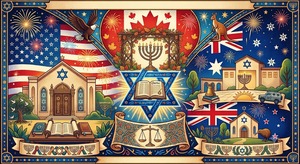 The The 4th of July, 1776, as an act of rebellion, triggered a war. The Star Spangled Banner is a song about war (have you ever seen the full version?)
Was it inevitable? Was it necessary?
Was it as revolutionary as we like to think?
A thoughtful discussion on this week's New Yorker Radio Hour podcast asked the question, "What did the American Revolution look like from Britain?"
More provocatively, host David Remnick asked, "In the long-run, are we better off than we would have been had we remained part of the Commonwealth like Canada, Australia, and New Zealand?"
I would like to suggest a Jewish angle to this question for your Shabbat table:
Which country has been better for Jews and Jewish life: the USA, Canada, Australia, or New Zealand?
Some points to consider:
- Social freedom: Despite the past discrimination (eg, Jewish immigrants having to forsake Shabbat in order to keep a job, being barred from universities and jobs, and so on), Jewish life in America was almost always better than elsewhere and the First Amendment has been the special sauce, expanding our freedom.
- Religious freedom: Under the Canadian Charter system, if a traditional Jew in Montreal or Toronto runs into a condo association rule banning structures on balconies, the law shields them powerfully. In the landmark case Syndicat Northcrest v. Amselem (2004), the Supreme Court of Canada ruled that if a person sincerely believes a practice is a religious necessity, the law will aggressively protect their right to do it, overriding private property contracts or aesthetic bylaws. For the daily practitioner, this means a massive level of reassurance. In the U.S., despite the First Amendment, private homeowners' associations (HOAs) and local city zoning laws routinely tie Orthodox Jews in knots over sukkahs, eruvin (Sabbath boundaries), and home-based synagogues. While the First Amendment stops the federal government from interfering, local municipalities use neutral zoning codes to restrict religious structures, forcing communities into expensive, exhausting federal lawsuits under specialized statutes like RLUIPA (Religious Land Use and Institutionalized Persons Act) just to run a local shul or build an eruv.
- Shechita (kosher slaughtering): In the U.S., the First Amendment acts as an absolute brick wall against any animal-rights or secular legislation trying to ban shechita. The Supreme Court views religious ritual as practically untouchable by the state. In Australia, Canada, and New Zealand, there is no absolute constitutional shield for ritual slaughter. Instead, shechita exists because the community’s leadership has successfully negotiated explicit exemptions within secular animal welfare acts. If public sentiment shifts heavily, those exemptions can theoretically be amended or stripped away by a simple majority vote in Parliament—as has happened in several European countries.
- Education: Because the Commonwealth doesn’t share America's rigid interpretation of the "Separation of Church and State," their governments routinely pours millions of tax dollars directly into private religious day schools—tradition is financially viable for the middle class. In America, the First Amendment's Establishment Clause means that the U.S. government cannot directly fund religious education. Consequently, an American Jewish family must pay 100 percent of the cost of their children's intensive religious education entirely out of pocket, leading to a crushing, structural "tuition crisis" that dictates where families (especially larger ones) can afford to live and how they structure their entire economic lives.
- Education: While Jewish day schools in the US were historically limited to the Orthodox and Conservative, Australia pioneered a model where 80 percent of all Jewish children—regardless of their parents' personal level of observance—attend Jewish day schools, creating a community with a universally high baseline of Jewish literacy.
- Community: Remnants of the great European yeshivas and Hasidic dynasties relocated to the U.S., building robust traditional communities. Yet Melbourne received the highest per-capita concentration of Holocaust survivors outside of Israel, many of whom were deeply traditional Eastern European Jews.
- Social cohesion: America's Jews are polarized between the various streams; in Melbourne, secular and traditional Jews share the same communal roof.
- Comfort: The U.S. pioneered the modern industrialization of kosher food. Because of American corporate scale, kosher certification became a default global standard, making traditional observance easier across the continent.
- Self-defense: In Commonwealth countries, the state maintains a strict monopoly on lethal force and the safety of the community relies on the local police and the insulation provided by strict national gun laws, which significantly limit the availability of high-capacity firearms to potential attackers in the first place. In America, the 2nd Amendment has given Jews the first country in our long Diaspora that allows communities to protect themselves when seconds count. And if you're going to say, the 2nd Amendment allowed Tree of Life to happen, one could retort that a 2nd Amendment could have prevented Bondi Beach from happening.
Which country has been better...what do you think?
Shabbat Shalom
This message may also be read online at Blogspot and Times of Israel.
Appreciated this Table Talk? Like it, tweet it, email it...