Showing posts with label bar mitzvah. Show all posts

Friday, April 13, 2018

Step Into (Not Onto) My Shoes

The purpose of this blog is to generate some sympathy for teenagers - and their parents. (Please like it, tweet it, forward).
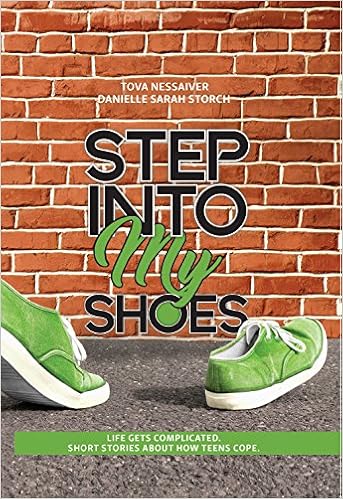
 
Step Into My Shoes bookTalked to a teenager lately?

Ever been aggravated by one?

This post may be for you.

First, the book on the left.

Just published by two mothers, it is a refreshing, inspired, inspiring, pragmatic (and well-written) read for anyone looking for a Jewish approach to parenting a teen.

(Please click on the image to see it on Amazon.)

Second, on that theme, here's a true story you could try sharing at your dinner table tonight, with 3 questions.

This morning someone mentioned that they are taking their son to their temple's mandatory Bnai Mitzvah Shabbat retreat.

Sounded fun until he mentioned that the son has less than zero interest in attending.

So why are they going?

Well, "mandatory" means that if you don't attend, they cancel your bar mitzvah.

First question for your table - Is this a case of laudable hardball rabbi-ing, or is it an "oy va-voy"?

I asked, "Does he want to have the bar mitzvah?"

"Oh yes, he does."

"What does that mean to him?"

"Well, I'm not sure he's going to be ready to read from the Torah, so I don't know. I guess it's mainly the party."

Second question for your table: Should we force our teens to do things they don't want to do? Or should they be able to pick and choose? Is this one of those times?

So I said, "What about creating a super meaningful backyard bar mitzvah at the time of your choosing (and not when it fits the Temple calendar)?"
 
Many people don't know that an at-home bar mitzvah can be perfectly kosher (sometime even more kosher). And probably saves money too.

Question 3: If someone could have a more enjoyable, perfectly kosher, 100% meaningful bar mitzvah at home, is there a downside?

(I've personally run a few of these, they were wonderful and as far as I know, there were no regrets.)

Today's Table Talk is the first in a series on the subject of our wonderful teens and parenting them.

Next week, the smart phone edition.

In the meantime,


Shabbat Shalom

 
Enjoyed this Table Talk? Vote with your fingers! Like it, tweet it, forward it....


Friday, May 05, 2017

May the Mitzvah Be With You

The purpose of this blog is to raise the bar at the Shabbat table.... Please forward / like / tweet....
Mazal tov to Yoseph Seinfeld on the celebration of his becoming Bar Mitzvah.


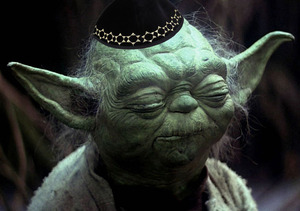
Yoda-PrayingYes, not everyone loves archaeology and some don't care for neophilism....

So today's theme is something we all want.

Well, we all say we want it.

We probably do want it.

But how many of us achieve it?

I'm talking of course about living in the present moment.

How many of us actually do it?

Every moment?

Once a day?

Once a year?

Why is it so hard?

Here is the answer you've been looking for your entire life.

Notice above at the top of this message in the fine print, I wrote, "becoming bar mitzvah".

How come I didn't write, "on his bar mitvah"?

Do you get the difference?

"Having a bar mitzvah" or "having a bat mitzvah" means that the event is external to you. It is a celebration of something, but the occasion - the event - is external - it's something you're having. Like having breakfast. You consume it, and maybe some of it affects you, maybe some of it even stays inside of you, but it begins (and ends) as something external that you "had". Once it's over, you "had" it and it is in the past.

But "becoming bar mitzvah" means it is all about you, about what's going on inside of you, about your relationship to the concept of "mitzvah".

What is the concept of "mitzvah"?

A mitzvah is - yes - a good deed. Better: it's an opportunity to do a certain kind of good deed, namely one that is defined as "good" by the Torah.

So a bar mitzvah is someone who has the awesome ability to do a TGD - a Torah Good Deed.

Question 1 for your table: What if a person becomes of age and is unaware of their ability to do a TGD?

Question 2: What if a person is aware they are bar or bat mitzvah, but doesn't know much about the Torah?

After everyone offers their answers, you might share mine with your table:

Imagine someone has telekenesis but is unaware of it. Then one day they accidentally will a chair to move in order to prevent a child from injury - the power was there all along, they just didn't know it. It is merely a matter of concentration.

That's what a mitzvah is like to a bar mitzvah. You have the power to turn every - yes every - action into a TGD.

Once again: You can turn every action into a TGD.

How?

Step 1: Want to.

Step 2: Do the hardest thing in the world to do:

You must use your mind.

Think about it obsessively.

When you wake up and when you lie down.

And pause before every action to think, "How can this action be a TGD?"

May the mitzvah be with you.

Shabbat Shalom


Good one this week? Vote with your fingers! Like it, tweet it, or just forward it.
(Haven't tried the new "forward" button yet? Give it a tap!)

Friday, October 30, 2015

Big Ben

The goal of this blog is to chase down some "true" wisdom at your Shabbat table.... please print and share.
Happy Anniversary to Lawrence and Amy and Happy Birthday to Steve, all in California! Live long and prosper. (To dedicate a future Table talk - send an email.)
BenThis week I had the honor of attending a unique event.

It was the bar mitzvah celebration of a young man in California.

His name is Ben.

It was unique in the very true sense that Ben is unique. It had his unmistakable imprint.

Some of the guests were nonplussed at the venue - a golf club instead of a synagogue? Is that allowed??

In my opinion, the essence of a bar mitzvah is not the ritual, it is the bar mitzvah boy's (or girl's) speech. He's teaching us a bit of Torah wisdom that he has learned.

That is his true coming-of-age - taking ownership of the tradition.

As I told him, "It's your Torah as much as it is mine."

What Ben said was inspired and inspiring.

He spoke of his favorite pastime - the game of golf - and how Torah lessons can be applied to the game. He then expanded the theme to point out that the same is true for life itself.

After all, Ben concluded:

The Torah’s full name is Torat Chayin – which means wisdom for living, wisdom for life. So you could say that the entire book is wisdom not just one section. One of the great rabbis, Ben Zoma, said: the person who is wise is someone who learns from all others. I think this is a great way to sum up the entire Torah.

The obvious question for your table is, What in the world does Ben Zoma mean? How can he define wisdom as "learning from all others"? Does he really mean all others?

Mazal tov Ben!

and Shabbat Shalom

PS - Here's your countdown timer to remember how many days til Hannuka.
Like this post? How about voting with your finger: Like it, tweet it, or just forward it.


Friday, February 17, 2012

Dear Abby


Here is a genuine question from the Dear Abby advice column last week:

Dear Abby: I’m planning my son’s bar mitzvah, and my ex-husband hasn’t lifted a finger to help me. I received two small checks for his portion of the guests who will attend the reception.
My question is, should I put his name on the invitation? Or do I just put my name on it since I’m the one hosting and putting the party together? I want to do the right thing, but I also want it made clear that I did the planning myself.
         
            — Mitzvah Mama in New York

First question for your table - before reading Abby's answer - how would you reply to Mitzvah Mama?

Here's Abby's reply:
A. Dear Mitzvah Mama: Be benevolent. For the sake of your child, include your ex-husband’s name on the invitation. It isn’t necessary to omit it so that you can get the credit. All you need to do is confide in one “yenta” that your son’s father is a “schnorrer” and word will get around. Trust me.


Question #2 for your table: What do you think of Abby's answer?

Want to tell Abby what you think? Here's the link.

(If you want to hear what I think, use the comments section below and let me know.  I'll give you my 2-bits, as my grandfather would have said.)

Friday, January 21, 2011

Son of a Gun! Daughter of a Mitzvah!

Mazal tov to Goldy Seinfeld who became bas/bat Mitzvah this week. (Notice how I said "became" and not "had"...why is that?) (PS - we don't want to embarrass her, but we are very proud of her!)

Two stories for you this week, and two questions.

Story #1

At a rabbinical conference in New York on Sunday. The best part of this annual conference is mealtime. I hardly eat, but it's the best shmuze-time.

So here I am sitting at dinner hoping someone interesting will sit next to me. The voice arrives before the face:

"Excuse me, is this seat taken?"

The voice was vaguely familiar, but the face was a textbook caricature of a rabbi - black hat, long beard, serious gaze.

I did a bona fide double-take.

Peering out from under that hat and beard was my childhood Sunday School classmate Joe Kanofsky.

Sorry, that's Yossel Kanofsky.

Sorry, that's Rabbi Yossel Kanofsky.

In fact, to you, that's Rabbi Dr. Yossel Kanofsky, a menshe if there ever was a menshe.

Surely the most warm-hearted and intelligent person ever to come out of Tacoma Wash (the serious expression was a put-on).

And here he was, in living color. Son of a gun!

First Question for your table... Is it comforting or discomforting to see someone who knows things about you ( and you know things about him) that no one else in the world knows?

Story #2

The next day I found myself back in sunny San Francisco, former home of my great-grandmother Granny Goldy.

My itinerary included a bunch of private meetings and two semi-public classes (see below for audio links).

In one class I made a bold statement that some participants found challenging to accept.

I declared that the classical definition of "mitzvah" is not simply a good dead. It's more than that.

It's a good deed performed mindfully.

One person told me it bothered her that I declared this value as normative, as in "Judaism says that a mitzvah requires kavana (mindfulness)."

Question #2 - What was bothering her about that statement?


A final note - yesterday you may have missed it, it was Tubishvat - the mini Jewish celebration of the trees. Missed it? Don't miss out - do what we're doing, serving a platter for desert tonight with as many edible tree-products as we can find (and yes that includes chocolate!)

Shabbat Shalom

PS - Here's the link to my SF class, "Why Money Matters". (If you get the download and need the handouts, send me an email.)

PPS - Don't know where we keep finding these inspiring videos, but if you like dogs, or happy stories, you'll enjoy this week's amazing video.

Friday, July 02, 2010

Devorah Torah

Did you ever find yourself struggling to stay awake during a sermon?

Who hasn’t?

Did you ever find yourself giving a sermon and wonder why so many people were sleep-deprived lately?

Yesterday someone asked me if I could help his daughter with her “Dvar Torah” for her Bat Mitzvah. He wanted me to send him some thoughts about her Torah portion.

More specifically, he wanted me to send her ideas about the portion of her portion that was her portion, or at least a portion of the portion of her portion that was her portion.

I asked him if she felt that she had to speak specifically about a portion of her portion of the portion. Or should she necessarily speak about any portion of the portion?

For example, another young lady in San Francisco chose to speak about the hugely-important mitzvah of not speaking gossip (lashon hara). She even made a public commitment not to speak OR LISTEN TO lashon hara.

Thanks to her, there has been an estimated 7.7 percent decline of lashon hara levels in San Francisco over the past 30 days.

That’s the nature of a good Dvar Torah – it inspires the audience to think about their own lives in a new way.

So now I’d like to share a most unusual Dvar Torah at our own Friday night dinner table.

First we sing “Shalom Aleichem”. (To learn one of the classic tunes for this great song, click here.)

Then the children line up for their parental blessing. We go oldest to youngest, but we've heard there are families who go youngest to oldest. (The traditional blessing is here.)

(but I always add my own words).

Then we sit down, say “Shabbat Shalom” or “Gut Shabbos” or “Good Shabbat” to each other and do Kiddush and Hamotzee.

Then I start to ask the kids what they learned this week. In their schools and camps, they USUALLY learn something about the Portion. But if they didn’t, I try to have a story ready for them. (looking for great books of dinner-table-friendly stories? see below.)

(At some point, of course, I tell over the week’s Table Talk, of course...)

Lately, at some point in the meal, our 4-year-old Devorah gets out of her seat, strides over to the bookcase I keep by the table, takes a large book and announces, “I have a Devorah Torah!”

She insists that everyone listen.

We listen.

She opens the book and, pretending to read, starts to improvise a story that can go on for quite a long time.

It’s entertaining… for a few minutes.

What keeps it going is her radiant joy, and our reluctance to stop her.

There are two morals to this story.

The first is what makes a great Dvar Torah?

1. Be happy
2. Be personal - tell a story
3. Be brief

Question for your Table: What’s the second moral to this story?


Shabbat Shalom

“Without tradition, art is a flock of sheep without a shepherd. Without innovation, it is a corpse.” – Churchill

Some recommended books of meaningful stories:

1. http://tinyurl.com/touchedbyastory (or use this for paperback)
2. http://tinyurl.com/maggidspeaks (or use this for paperback)

If you use one of these links, a portion of your purchase is donated to support JSL’s programs.

Need more ideas? Send me an email.

PS...


Friday, April 16, 2010

13


13 years ago this week, a child was born.

I remember it like it was yesterday.

Well, maybe like it was last year.

It was early Wednesday morning, before sunrise, in an unfamiliar Jerusalem neighborhood.

He had reddish hair from day 1, then later became blond.


He had his bris on day 8.

And every Passover for 13 years, we’ve watched him become more and more like the “wise child” at the Seder.

The Dvar Torah that he wrote for tomorrow has nothing to do with this week’s Torah portion.

It is an analysis of one detail in the Talmudic ethics of returning a lost-and-found object.

You and I – most people reading this blog – we were there once upon a time, when we were 12 or 13.

We were full of great potential.

By the way, we’re still full of great potential.

Old people sometimes need young people to remember that you’re never too old to change yourself or the world.

The kids and I sometimes make Friday night Kiddush at a nearby assisted-living home.

Most of the residents have extremely limited mobility.

The oldest resident is 107, the youngest 85.

They don’t always feel like they can change the world. They don't always look like they can change the world.

So I frequently point out to them that when they choose to smile at someone even thought they don’t feel like it, or refrain from speaking lashon hara, you changed the world.

Think about it.


Shabbat Shalom

To improve is to change; to be perfect is to change often. - Churchill

PS - You'll appreciate this: Soldier, survivor have emotional reunion | detnews.com | The Detroit News