Showing posts with label bat mitzvah. Show all posts

Friday, April 13, 2018

Step Into (Not Onto) My Shoes

The purpose of this blog is to generate some sympathy for teenagers - and their parents. (Please like it, tweet it, forward).
 
Step Into My Shoes bookTalked to a teenager lately?

Ever been aggravated by one?

This post may be for you.

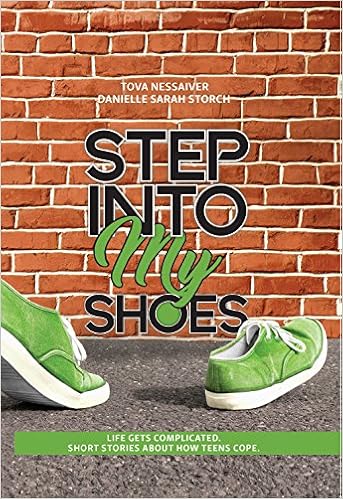
First, the book on the left.

Just published by two mothers, it is a refreshing, inspired, inspiring, pragmatic (and well-written) read for anyone looking for a Jewish approach to parenting a teen.

(Please click on the image to see it on Amazon.)

Second, on that theme, here's a true story you could try sharing at your dinner table tonight, with 3 questions.

This morning someone mentioned that they are taking their son to their temple's mandatory Bnai Mitzvah Shabbat retreat.

Sounded fun until he mentioned that the son has less than zero interest in attending.

So why are they going?

Well, "mandatory" means that if you don't attend, they cancel your bar mitzvah.

First question for your table - Is this a case of laudable hardball rabbi-ing, or is it an "oy va-voy"?

I asked, "Does he want to have the bar mitzvah?"

"Oh yes, he does."

"What does that mean to him?"

"Well, I'm not sure he's going to be ready to read from the Torah, so I don't know. I guess it's mainly the party."

Second question for your table: Should we force our teens to do things they don't want to do? Or should they be able to pick and choose? Is this one of those times?

So I said, "What about creating a super meaningful backyard bar mitzvah at the time of your choosing (and not when it fits the Temple calendar)?"
 
Many people don't know that an at-home bar mitzvah can be perfectly kosher (sometime even more kosher). And probably saves money too.

Question 3: If someone could have a more enjoyable, perfectly kosher, 100% meaningful bar mitzvah at home, is there a downside?

(I've personally run a few of these, they were wonderful and as far as I know, there were no regrets.)

Today's Table Talk is the first in a series on the subject of our wonderful teens and parenting them.

Next week, the smart phone edition.

In the meantime,


Shabbat Shalom

 
Enjoyed this Table Talk? Vote with your fingers! Like it, tweet it, forward it....


Friday, January 28, 2011

Being Mivater

בס’ד
My Bas Mitzva D’var Torah

Let’s say you walk into the dining room Friday night, to eat your meal. As you approach your normal seat, you notice someone sitting there. Who’s that someone?

Your most annoying, pesty little brother.

What do you do? Well, you have three choices.

Either you:

a. You shout “Get out of my seat! You have your own seat!” You run towards him, shove him off your chair causing him to cry, plop down in your seat, satisfied at what you just did.

b. You say “Please give me my seat.”

c. Quietly, without a word, you walk to a different chair, causing no problems.

What’s the difference between these three responses?

#A is getting really mad and totally going out of control and lousing your temper.

B, however, is different. There's nothing wrong with it. You have every right to ask for your seat back.

#C is what we call being mivater. You care more about other people’s feelings than about what you deserve.

It’s very hard to do #C, be mivater. You are thinking “What chutzpa does he have to sit in my seat!! You have to fight your Yetzeir Harah, hold back your anger, and quietly be mivater.

Why is it so important to be mivater?

We all know that after 7 years of working, Yaakov (Jacob) was able to marry Rochel Imeinu (Rachel). They were ready to get married. But did Yaakov marry Rochel? Oh, no! Tricky Uncle Lavan came along and gave Yaakov Rochel’s sister, Leah, to marry. He hid her face with a veil so Yaakov would not be able to see who it was. Yaakov and Rochel knew Lavan would do this, so they made secret signs so they would know if the kallah (bride) was really Rochel. But when it came time for the wedding, Rochel knew her sister would be so embarrassed if she didn’t know the signs, so she told them to Leah.

The midrash tells us that years later, when the Jewish People went into Gulus (exile), each of the Avos and Imohos (Forebears) pleaded to God to set their children free. But Hashem said “no” to each one.

First, Avraham came forward and said, “Please, in the merit of bringing my son up for a sacrifice, You should free my grandchildren,” but Hashem didn’t listen.

Then Yitchok (Isaac) came and said, “How about in the merit of my allowing myself to be a korban (sacrifice)? I asked my father to tie me up so that I would a kosher sacrifice for you!” but Hashem didn’t listen.

And so on, every Forefather and Foremother came forward to plead for the Bnei Yisroel (Jewish People) but Hashem didn’t listen.

Then Rochel Imeinu came to plead to Hashem. She told Him that even though she really wanted to marry Yaakov, she gave up her whole life to her sister just so that her sister wouldn’t be embarrassed. Then Hashem said: “Because of what you did, in your zechus (merit), I will bring the Bnei Yisroel back to me.”

We therefore learn from Rochel the importance of being mivater.

But the story needs an explanation.

Why is being mivater any better than Avraham Avinu and Sara Imeinu’s Hachanasas Orchim (hosting guests in their home)? Or Avraham giving up his only precious son to Hashem? Or Yitzchak Avinu giving up his life to be a sacrifice to Hashem? Or Yaakov learning so many years of Torah? After all, we learn that Talmud Torah Kineged Koolam - learning Torah is compared to everything! Surely Hashem should have agreed to take Bnai Yisroel out of exile in Yaakov’s zechus (merit).

I think that there are 2 ways to be mivater.

Lets say 5 year old Shprintzter Shloigenboigen wants his mother to give him a dollar for a soda, and Shprintzy who is a year older also wants one. Their mother only has one dollar in cash on her and so finally, after much arguing, Shprintzy is mivater and lets her younger brother have the dollar for soda. Shprintzy wanted the dollar. She didn’t deserve it. And she gave in. That’s the easy way to be mivater.

The second way to be mivater is like this.

Let’s imagine Rochel Imeinu’s chasunah (wedding). She had been engaged for 7 years. It wasn’t only that Leah was taking her chosson, she was taking her chasuna too! It was her invitations, her guests, her music, her banquet. She’s been planning this for 7 years already and she didn’t even get to get married - instead, she let Leah get married. And she did all this just so that her sister would not be embarrassed in front of everyone.

That’s the hard way to be mivater - when you totally deserve something, yet you let someone else have it anyway. This gives us a clue why Hashem only listened to Rochel’s pleas. All the other Avos and Imohos did what was right, but Rochel did beyond right.

If we really want Hashem to listen to our tefillos (prayers), we should concentrate less on what we deserve, and more on what other people need.

- Goldy Seinfeld


Shabbat Shalom

Friday, January 21, 2011

Son of a Gun! Daughter of a Mitzvah!

Mazal tov to Goldy Seinfeld who became bas/bat Mitzvah this week. (Notice how I said "became" and not "had"...why is that?) (PS - we don't want to embarrass her, but we are very proud of her!)

Two stories for you this week, and two questions.

Story #1

At a rabbinical conference in New York on Sunday. The best part of this annual conference is mealtime. I hardly eat, but it's the best shmuze-time.

So here I am sitting at dinner hoping someone interesting will sit next to me. The voice arrives before the face:

"Excuse me, is this seat taken?"

The voice was vaguely familiar, but the face was a textbook caricature of a rabbi - black hat, long beard, serious gaze.

I did a bona fide double-take.

Peering out from under that hat and beard was my childhood Sunday School classmate Joe Kanofsky.

Sorry, that's Yossel Kanofsky.

Sorry, that's Rabbi Yossel Kanofsky.

In fact, to you, that's Rabbi Dr. Yossel Kanofsky, a menshe if there ever was a menshe.

Surely the most warm-hearted and intelligent person ever to come out of Tacoma Wash (the serious expression was a put-on).

And here he was, in living color. Son of a gun!

First Question for your table... Is it comforting or discomforting to see someone who knows things about you ( and you know things about him) that no one else in the world knows?

Story #2

The next day I found myself back in sunny San Francisco, former home of my great-grandmother Granny Goldy.

My itinerary included a bunch of private meetings and two semi-public classes (see below for audio links).

In one class I made a bold statement that some participants found challenging to accept.

I declared that the classical definition of "mitzvah" is not simply a good dead. It's more than that.

It's a good deed performed mindfully.

One person told me it bothered her that I declared this value as normative, as in "Judaism says that a mitzvah requires kavana (mindfulness)."

Question #2 - What was bothering her about that statement?


A final note - yesterday you may have missed it, it was Tubishvat - the mini Jewish celebration of the trees. Missed it? Don't miss out - do what we're doing, serving a platter for desert tonight with as many edible tree-products as we can find (and yes that includes chocolate!)

Shabbat Shalom

PS - Here's the link to my SF class, "Why Money Matters". (If you get the download and need the handouts, send me an email.)

PPS - Don't know where we keep finding these inspiring videos, but if you like dogs, or happy stories, you'll enjoy this week's amazing video.

Friday, July 02, 2010

Devorah Torah

Did you ever find yourself struggling to stay awake during a sermon?

Who hasn’t?

Did you ever find yourself giving a sermon and wonder why so many people were sleep-deprived lately?

Yesterday someone asked me if I could help his daughter with her “Dvar Torah” for her Bat Mitzvah. He wanted me to send him some thoughts about her Torah portion.

More specifically, he wanted me to send her ideas about the portion of her portion that was her portion, or at least a portion of the portion of her portion that was her portion.

I asked him if she felt that she had to speak specifically about a portion of her portion of the portion. Or should she necessarily speak about any portion of the portion?

For example, another young lady in San Francisco chose to speak about the hugely-important mitzvah of not speaking gossip (lashon hara). She even made a public commitment not to speak OR LISTEN TO lashon hara.

Thanks to her, there has been an estimated 7.7 percent decline of lashon hara levels in San Francisco over the past 30 days.

That’s the nature of a good Dvar Torah – it inspires the audience to think about their own lives in a new way.

So now I’d like to share a most unusual Dvar Torah at our own Friday night dinner table.

First we sing “Shalom Aleichem”. (To learn one of the classic tunes for this great song, click here.)

Then the children line up for their parental blessing. We go oldest to youngest, but we've heard there are families who go youngest to oldest. (The traditional blessing is here.)

(but I always add my own words).

Then we sit down, say “Shabbat Shalom” or “Gut Shabbos” or “Good Shabbat” to each other and do Kiddush and Hamotzee.

Then I start to ask the kids what they learned this week. In their schools and camps, they USUALLY learn something about the Portion. But if they didn’t, I try to have a story ready for them. (looking for great books of dinner-table-friendly stories? see below.)

(At some point, of course, I tell over the week’s Table Talk, of course...)

Lately, at some point in the meal, our 4-year-old Devorah gets out of her seat, strides over to the bookcase I keep by the table, takes a large book and announces, “I have a Devorah Torah!”

She insists that everyone listen.

We listen.

She opens the book and, pretending to read, starts to improvise a story that can go on for quite a long time.

It’s entertaining… for a few minutes.

What keeps it going is her radiant joy, and our reluctance to stop her.

There are two morals to this story.

The first is what makes a great Dvar Torah?

1. Be happy
2. Be personal - tell a story
3. Be brief

Question for your Table: What’s the second moral to this story?


Shabbat Shalom

“Without tradition, art is a flock of sheep without a shepherd. Without innovation, it is a corpse.” – Churchill

Some recommended books of meaningful stories:

1. http://tinyurl.com/touchedbyastory (or use this for paperback)
2. http://tinyurl.com/maggidspeaks (or use this for paperback)

If you use one of these links, a portion of your purchase is donated to support JSL’s programs.

Need more ideas? Send me an email.

PS...