Showing posts with label holiness. Show all posts

Friday, December 01, 2017

Our Biggest Problem?

The purpose of this blog is to turn the Friday night dinner table inward. Please print and share (+ like it, tweet it, forward).
 
PogoHow did you do on last week's "5 Thanksgiving Questions"?

Current events have brought up a long-forgotten memory.

In college I spent a semester in Rome, the so-called "Eternal City".

Every day we had a field trip to some part of the city or around Umbria, to look at something Classical or Baroque.

On our big trip to southern Italy, this incident occurred on a bridge in Naples.

We were waiting for the bus to fetch us when a couple of Italian guys came up to me and wanted to negotiate a price for being intimate with one or two of the women in our group.

At first I assumed they were joking and so I played along with it.

But then one of the women became suspicious and asked me what they were saying.

Only then did it dawn on me that they were actually serious.

And that it didn't really matter.

What mattered was that, the entire premise of the conversation, joking or not, was highly offensive. But it was so absurd that I played along with it...."guy talk".....

Q1 for your table: That kind of "guy talk" is bad, but how bad?

And let's flush this out with a few random comparisons.

(Q2 for your dinner-table conversation.)

We all have limited time and attention spans, so we should focus on the most urgent problems, right?

Therefore, what's worse?

Guys talking guy talk, or guys like Matt Lauer having a secret button?

Guys like Matt Lauer, or plastic choking our ecosystems?

The steady destruction of marine ecosystems, or the loss of young people to opioid overdose ?

The opioid epidemic, or the technology-depression-suicide epidemic?


It is interesting that Judaism addressed some of these issues thousands of years ago.

For instance, there is a millenial-old prohibition against a man and woman who are not family to be secluded together. Even to touch each other beyond a formal handshake.

This is not the path of "orthodox" Judaism. It is Jewish wisdom. Just like you don't have to be "religious" in order to decide not to speak lashon hara and to practice shmirat halashon, you also don't need to be religious to practice shmirat hanegiah and save your hugs and kisses for your family.

But don't we live in a culture that expects hugs and kisses at every social gathering?

We also live in a culture that honors lashon hara.

Think about it.

They said the following story of the late Dayan Erintroy - he was once visiting a factory in Germany for a kosher food inspection. The manager was a woman who extended her hand. He said, "I'm sorry, the only woman I touch is my wife."

She smiled and said, "If my husband had had that attitude, we'd still be married!"


Q3: Maybe some habits simply too engrained to make it worth the fight?


Shabbat Shalom

PS - Counting down the days to Channuka? Have you seen our recommended books and toys for kids of all ages?


Enjoyed this Table Talk? Vote with your fingers! Like it, tweet it, forward it....


Friday, February 15, 2013

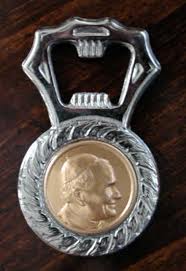
On Popeners and Closures

The purpose of this blog is to add some zest to your Shabbat meals. Please print and share.

popenr


Years ago, pre-internet, ownership of a genuine popener was a sign of true worldliness.

It was one of those souvenirs that when your friends saw it in your kitchen, declared, "I - yes I - have been to Rome!"

And it only would have cost you a couple thousand liras.

Nowadays, you can score one for a score from the comfort of your living room.

(They're rumored to be infalliable. Until they get too old and need to

(But you would presumably prefer one of these or these.)

Get 'em while they're hot....

All this Rome talk reminds me of what my grandfather used to ask me when the subject of keeping kosher came up.

"Haven't you ever heard of the expression, 'when in Rome'???"

(In case it isn't clear, what he meant was, when you're around people who don't keep kosher, why do you insist on eating kosher?)

He probably asked me that, with a glimmer in his eye, a dozen times.

And each time he said it, he heard the same retort:

"Yeah, but look what happened to them!"

(i.e., they're gone and we're still around)

Of course, they're not really gone, they're helping the faithful open beer bottles 'round the world.

Which reminds me....last week's Superbowl blog drew a reader's critique:

It is NOT G-dly "sheleimut" to offer pity and condescension to ANYONE (e.g., lobbing the ball softly up into the air for Shaya and pretending that Shaya actually hit a home-run) -- it's exactly the opposite -- it's INSENSITIVE and DEMEANING and SELF-CENTERED

Glurges such as Shaya’s, although well-intentioned, can potentially damage the self-esteem of persons with disabilities and other challenges who do NOT want any pity or handoutsv — they just want a fair chance to do the best they can to the limits of their innate, G-given talents and abilities; they are PERFECT (exactly as they are) for THEIR G-d-ordained Mission and Purpose in this One Life.


Rather than telling you my response, let me pose the question to you, Dear Reader, and your table:

Is the Shaya story (whether true or not) admirable or objectionable? Right or wrong? Holy or profane?


Shabbat Shalom 


PS - My grandfather always chuckled.


If you enjoyed this blog, please like it, tweet it, or just forward it to everyone you know.

Friday, February 11, 2011

Talmudic Airplane?

Happy Birthday Lily - may you continue to fly higher and higher!


Astonishingly, the Talmud, completed ca. 500 CE, asks questions about flying towers and flying boxes.

The Talmud (Sanhedrin 106b) asks: “What is the meaning of the verse, ‘…He who counted the towers’ (Isaiah 33:18)?”

Answer: The verse refers to the many questions concerning "a tower flying in the air."

For example: Does passing over a cemetery in a flying tower cause a person to contract ritual impurity like walking though it would?

Another: Is a Cohen/priest (whose holy status means he may not enter a cemetery) permitted to fly over a cemetery in a flying box?

(Excerpted from the Amazing Jewish Fact-a-Day Calendar, http://tinyurl.com/amazingcalendarlink)

First question for your table - What do you think? Did these ancient rabbis foresee the future development of airplanes, or did they just have wild imaginations?

Second question - What's your answer? Should a Cohen be allowed to fly over a cemetery?


Shabbat Shalom

Friday, February 19, 2010

On Ice and Snow

Attention all ye snow birds out there, and that includes you Easterners who are really really ready to see springtime arrive...

What comes first, righteousness or holiness?

Let's say someone is acting all holy, keeping kosher, praying, that kind of thing, but speaks a lot of gossip. Or cheats on their taxes. How do you react?

Pretty disappointing, right?

OK, let's say someone is super-duper ethical in action and speech, but has no spiritual practice, in fact disdains "spirituality" as "mythology" and is exceedingly proud of his or her great accomplishments. How do you react?

I used to be a big fan of the Winter Olympics.

I particularly loved the Giant Slalom (perhaps because as a skier, I could somewhat relate to the sport).

What changed me was a realization that the thesis of "human perfection" has a spiritual antithesis, of humility.

The Olympics do not seem to encourage nor honor humility.

Just look at the face of the Russian figure skater, standing on the podium with his silver medal.

Silver! He ought to be thrilled. But he has the scowl of a sore loser.

Righteousness is like striving for the gold.

Holiness is like being happy with whatever the outcome may be, whether Gold, Silver, or even being disqualified or falling during your routine.

How do you fall on this topic? Here's the big question you can ask your table to flush out where everyone stands:

With whom would you rather spend an hour and why:

A) Your favorite Olympian (or pro athlete)
B) His Holiness the Dalai Lama (or other comparable person)

If you answered "B" - how does your time cultivating holiness compare to your time watching sports?

These days, I've become a "small" fan of the Olympics.

Shabbat Shalom


He has all of the virtues I dislike and none of the vices I admire. - Churchill

Thursday, May 29, 2008

Who Needs It?

Dedicated to Arye ben Chana.
(To dedicate a future Table Talk, send an email.)


I’ll never forget my first encounter with the Talmud.

I had been wandering around the Old City of Jerusalem with my backpack and someone who looked like a rabbi asked me if I needed help finding wherever I was going. I was looking for a place that some Jews I had met in Paris told me about. They called the Such-and-Such Yeshiva. There, they promised me, you can learn the Talmud in English.

“The Yeshiva? You’re here!”

Where I was standing didn’t look anything like a yeshiva, in fact I was in the middle of the street. “All these buildings around you are the yeshiva. By the way, it’s Friday afternoon, do you have plans for Shabbos?”

I didn’t.

The next thing I knew, I was in the back seat of an old white Citroën headed out to the Judean Hills as the sun descended towards the Mediterranean.

My host, I’ll call him Shlomo, it turns out was something of a renaissance man. A wiry, slender man with a long, thin graying beard, he was a combination Talmudic scholar, fix-it-man and guru on organic foods and herbs.

The community was not wealthy. They lived very simply, even by Israeli standards. But they seemed very happy on their bluff with a view of the Dead Sea. It turns out that I happened to arrive for a very special Shabbat, when “the rebbe” was visiting. This was not the famous Lubavitcher rebbe, he was the community rabbi, who was the most angelic person I’d ever met, with the sweetest, softest smile framed by a lush black beard. Friday night during the song “lecha dodi” song, he got everyone dancing outside. It was a divine, timeless moment.

Sunday morning, still radiating the afterglow of that Shabbat, I met Shlomo back at the yeshiva for my introduction to the Talmud.

He unlocked the door to an old building that had arched ceilings and almost no artificial light. Most of the light streamed in through high windows. The small room was lined with unsteady-looking bookshelves, jammed full of ancient Hebrew books of all sizes.

Shlomo pulled a massive volume from a bottom shelf, larger and heavier than any book I’d ever held, and put it in my hands. “Why don’t you put this over there,” he gestured to a reading table. He disappeared and reappeared with two dictionaries, one Hebrew-English and the other Aramaic-English.

For the next three hours Shlomo had me read (without vowels) and look up every word in the first half of the first page, going over it again and again until I could read it on my own. It was like weeding a dandelion field - every step was slow and deliberate. I felt like a baby trying to become a toddler. But Shlomo seemed to have infinite patience for my baby steps and I was determined to figure out this puzzle, which had to do with two people fighting over a object that they both claimed to have found first.

Finally, after this grueling effort at mastering that first section, Shlomo put his hand on the page and looked me in the eye. “Do you know why we learn Torah?”

“That’s a really good question,” I was thinking, “Um, shouldn’t we have discussed this before?” But my actual reply was, “Isn’t it supposed to teach us how to live?”

“Not necessarily. We could learn how to live in other ways. Many people around the world learn how to live without the Torah. We could learn how to live from the animals – from dogs how to be loyal, from beavers how to be industrious...” That image reminded me of King Arthur, who according to legend did exactly that.

The point was, he had a point, and I didn’t have a clue.

“So what’s the reason?”

“The Torah,” he intoned slowly, “Is to teach us how to be holy.”

“Oh....” My voice and thoughts trailed off.

I looked down at the gigantic page of ancient text in front of me. The paper was faded. The corners were worn as if they had been touched by a thousand hands. The air was cool, and in the shaft of sunlight streaming down from behind the bookcase, a fly buzzed.

I wasn’t sure what “holy” meant, or what it had to do with the property dispute that I had been sweating for three hours to decipher. But something told me it might have something to do with that Shabbat “experience”.

Shabbat Shalom


Travel/speaking schedule:
June 17 – Chicago - “A New Twist on the Old Game of Love” (downtown business lunch)
June 18 - Los Angeles – “How Frustrations are the Key to Successful Dating” (for singles)
June 24 – Los Angeles - “Jewish Secrets to a Spicy Marriage” (for married men)
June 25 – Los Angeles - “How to help our children get married without interfering (too much)” (for parents)

For details, send an email!