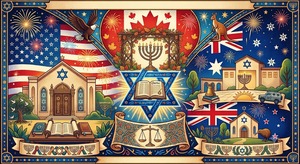
 The The 4th of July, 1776, as an act of rebellion, triggered a war. The Star Spangled Banner is a song about war (have you ever seen the full version?)
Was it inevitable? Was it necessary?
Was it as revolutionary as we like to think?
A thoughtful discussion on this week's New Yorker Radio Hour podcast asked the question, "What did the American Revolution look like from Britain?"
More provocatively, host David Remnick asked, "In the long-run, are we better off than we would have been had we remained part of the Commonwealth like Canada, Australia, and New Zealand?"
I would like to suggest a Jewish angle to this question for your Shabbat table:
Which country has been better for Jews and Jewish life: the USA, Canada, Australia, or New Zealand?
Some points to consider:
- Social freedom: Despite the past discrimination (eg, Jewish immigrants having to forsake Shabbat in order to keep a job, being barred from universities and jobs, and so on), Jewish life in America was almost always better than elsewhere and the First Amendment has been the special sauce, expanding our freedom.
- Religious freedom: Under the Canadian Charter system, if a traditional Jew in Montreal or Toronto runs into a condo association rule banning structures on balconies, the law shields them powerfully. In the landmark case Syndicat Northcrest v. Amselem (2004), the Supreme Court of Canada ruled that if a person sincerely believes a practice is a religious necessity, the law will aggressively protect their right to do it, overriding private property contracts or aesthetic bylaws. For the daily practitioner, this means a massive level of reassurance. In the U.S., despite the First Amendment, private homeowners' associations (HOAs) and local city zoning laws routinely tie Orthodox Jews in knots over sukkahs, eruvin (Sabbath boundaries), and home-based synagogues. While the First Amendment stops the federal government from interfering, local municipalities use neutral zoning codes to restrict religious structures, forcing communities into expensive, exhausting federal lawsuits under specialized statutes like RLUIPA (Religious Land Use and Institutionalized Persons Act) just to run a local shul or build an eruv.
- Shechita (kosher slaughtering): In the U.S., the First Amendment acts as an absolute brick wall against any animal-rights or secular legislation trying to ban shechita. The Supreme Court views religious ritual as practically untouchable by the state. In Australia, Canada, and New Zealand, there is no absolute constitutional shield for ritual slaughter. Instead, shechita exists because the community’s leadership has successfully negotiated explicit exemptions within secular animal welfare acts. If public sentiment shifts heavily, those exemptions can theoretically be amended or stripped away by a simple majority vote in Parliament—as has happened in several European countries.
- Education: Because the Commonwealth doesn’t share America's rigid interpretation of the "Separation of Church and State," their governments routinely pours millions of tax dollars directly into private religious day schools—tradition is financially viable for the middle class. In America, the First Amendment's Establishment Clause means that the U.S. government cannot directly fund religious education. Consequently, an American Jewish family must pay 100 percent of the cost of their children's intensive religious education entirely out of pocket, leading to a crushing, structural "tuition crisis" that dictates where families (especially larger ones) can afford to live and how they structure their entire economic lives.
- Education: While Jewish day schools in the US were historically limited to the Orthodox and Conservative, Australia pioneered a model where 80 percent of all Jewish children—regardless of their parents' personal level of observance—attend Jewish day schools, creating a community with a universally high baseline of Jewish literacy.
- Community: Remnants of the great European yeshivas and Hasidic dynasties relocated to the U.S., building robust traditional communities. Yet Melbourne received the highest per-capita concentration of Holocaust survivors outside of Israel, many of whom were deeply traditional Eastern European Jews.
- Social cohesion: America's Jews are polarized between the various streams; in Melbourne, secular and traditional Jews share the same communal roof.
- Comfort: The U.S. pioneered the modern industrialization of kosher food. Because of American corporate scale, kosher certification became a default global standard, making traditional observance easier across the continent.
- Self-defense: In Commonwealth countries, the state maintains a strict monopoly on lethal force and the safety of the community relies on the local police and the insulation provided by strict national gun laws, which significantly limit the availability of high-capacity firearms to potential attackers in the first place. In America, the 2nd Amendment has given Jews the first country in our long Diaspora that allows communities to protect themselves when seconds count. And if you're going to say, the 2nd Amendment allowed Tree of Life to happen, one could retort that a 2nd Amendment could have prevented Bondi Beach from happening.
Which country has been better...what do you think?
Shabbat Shalom
This message may also be read online at Blogspot and Times of Israel.
Appreciated this Table Talk? Like it, tweet it, email it...


No comments:
Post a Comment