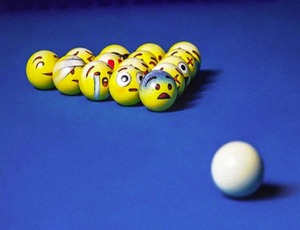
Can you complete the following sentence in a way that anyone could say it truthfully:
"Someone I know is trying to __________, but it's a struggle."
Everyone is struggling with something, right? So I guess in that broad sense, we can be sympathetic and supportive.
But are everyone's personal struggles so particular to them that there is no comparison? Or are there any struggles that are more universal than others?
It seems to me that one could put it this way:
"Someone I know is trying to change a long-standing habit, but it's a struggle."
One of the core teachings of Jewish wisdom is the universality of the struggle.... Knowing that you and I broadly share the same struggle is a great motivator. In that sense, it's a level playing field.
Whether the habit is food-related, or vaping, or time management, or patterns of speech (like a perpetual complainer), there is a universal human challenge of reclaiming autonomy from a habit.
Try shifting your thinking from, "I'm doing something wrong" to ""I'm caught in a universal trap, and here is the roadmap to get out."
Everyone is indeed struggling with something—usually, it’s the gap between who they are and who they know they could be.
Shabbat Shalom
This message may also be read online at Blogspot and Times of Israel.
Appreciated this Table Talk? Like it, tweet it, email it...
Thursday, April 23, 2026
Oh, We Got Trouble... With a Capital "T"...


Friday, May 06, 2022
Giving Tree?
The purpose of this blog is for Shabbat conversation to sprout and blossom....please share, forward, and of course print....

This wonder of nature is not a photoshop trick!
It's a tree in Montenegro that just happens to have a hollow core and just happens be growing over an underground spring that gushes every spring.
Too bad you can't plant a tree like that.
Or maybe it's not too bad? Maybe you don't want a pond in the back yard?
First questions for your table....Did you ever plant a tree? What about a fruit tree?
When we bought this house 13 years ago, it had about 4 trees. We now have over 30 trees on all sides of our home (mostly in the back yard).
Most started out as $14.99 saplings that I planted with my own hands and feet.
In fierce competition for tallest tree in the yard are a weeping willow and a fire maple. Of course, the willow wins branches-down for overall size.
When we bought the house, the backyard was a hot, unfriendly patch in the summer and a pond after a rainstorm. Today it's a shady, friendly urban oasis that never floods.
Trees are great.
Two of our trees masquerade as grape vines.
Planting vines (or any fruit tree) triggers one of the only agricultural mitzvos that applies worldwide (most of them only pertain to the Land of Israel). Can you guess which one?
Answer: not eating the fruit of a tree until its fourth or fifth year.
This mitzvah is called orlah and teaches one of the greatest lessons in the Torah.
Question for your table - What's the lesson?
Shall I give you a hint? Modern technologies have made this lesson more pertinent than ever before.
Shabbat Shalom
PS....
I think that I shall never see / A poem lovely as a tree.
A tree whose hungry mouth is prest / Against the earth’s sweet flowing breast;
A tree that looks at God all day, / And lifts her leafy arms to pray;
A tree that may in Summer wear / A nest of robins in her hair;
Upon whose bosom snow has lain; / Who intimately lives with rain.
Poems are made by fools like me, / But only God can make a tree.
— Joyce Kilmer
Appreciated this Table Talk? Like it, tweet it, forward it....
 |  |  |
Friday, May 13, 2016
Happiness is . . .
 Sometimes you have to wonder:
How could anyone live in a world with phenomena like this and not be happy?
I'm not talking about someone suffering. It seems to me they have a right to be unhappy.
I mean the average person who has food to eat and a place to sleep at night.
Now, in the new World Happiness Report, Israel ranks #11, ahead of the United States and most of Europe, prompting this Wall Street Journal writer to wonder why?
How can this be so? Israelis live in a hostile and volatile neighborhood, engaged in an endless conflict with the Palestinians and under the threat of nuclear annihilation by Iran. If you crunch the different components of these indexes, Israel falls much further down the lists. It ranks only 24th in GDP per capita, and comes in at No. 30 of the 36 OECD countries on security and personal safety. Israel has only the 17th-highest per capita income in the world.
But Israelis do not rank as stupid on any index. Israel was the fifth-most innovative country in the 2015 Bloomberg Innovation Index, and a 2014 OECD study ranked it fourth in the percentage of adults with a higher education.
So what explains the Israeli paradox? Do Israelis only become stupid when thinking about their own happiness?
So he evidently agrees with the premise that happiness is a function of (a) security and (b) income.
There's this week's question for your table: Is he right?
Shabbat Shalom
Like this email? How about putting your gelt where your gab is: Like it, tweet it, or just forward it.
Friday, May 04, 2012
Chase of Dreams
The goal of Table talk is to add some depth to your Friday night dinner table. Please print and share.
See our continuously-expanding Bar and Bat Mitzvah gift suggestions at bestjewishkidsbooks.com.
Our neighbors had an attempted break-in the other day and it reminded me of a story I told in this space five years ago. It's the kind of story that one ought to retell every few years.
The story starts with a question:
While I hope you will never experience this, imagine you were walking down the street and someone snatched something from your hands, running off. How do you think you would react?
Would you shout? Call for help? Run after him?
After everyone at your table gets a chance to answer, tell them this true story:
The famous Chafetz Chaim (who died in 1933) was once walking down the street in Radin.
Someone stopped him to ask for a handout. When he pulled out his wallet to give the beggar a coin, the beggar grabbed the wallet and ran off.
Again, put yourself in the rabbi's shoes: how do you react?
The Chafetz Chaim ran after him and shouted, “I forgive you! You can keep it! I give it to you! It’s yours!”
When an onlooker asked the rabbi why he responded that way, he explained:
“The fellow is obviously in need, desperate even. Eventually, he’ll think about what he did and may regret it. So why should he then benefit from stolen goods? Let him enjoy what’s his!”
I suspect most people reading this, and most people who hear this story at your table, would not have reacted that way. Correct me if I'm wrong.
And that gives us the second question for the table: What sort of attitude to you need to cultivate towards other human beings in order to react in that way?
Shabbat Shalom.